Facebook Launches Dedicated Seller App As Marketplace Steps Up eBay Competition

Meta is giving Facebook Marketplace sellers their own dedicated app, adding bulk listing, inventory and performance tools as the company builds a stronger competitor to eBay and other resale platforms.
The new app, called Seller, connects to Facebook Marketplace, carrying over existing listings, messages and sales history while publishing new items back to Marketplace.
Sellers can still manage items through the regular Facebook app, but Seller provides a separate workspace for those handling more than the occasional local sale.
 heathera
The app includes a dashboard showing orders to ship, unanswered messages and listings that may need attention. Sellers can create multiple listings, manage inventory, relist items and track views, clicks, conversations and sales.

Meta is also bringing its AI listing tools into the app, allowing sellers to upload photos and receive suggested titles, descriptions, categories and prices.
 Liz Morton
A unified inbox organizes buyer conversations by listing, addressing one of the biggest challenges for higher-volume sellers previously managing transactions across Messenger and the main Facebook app.
Meta says Seller is currently available through Apple’s App Store for US users 18 and older, with a web experience available to sellers who download the iOS app and Android testing underway.
Marketplace has historically operated more like online classifieds than a full-service ecommerce platform, particularly in the US. Buyers and sellers often arrange payment, pickup and shipping themselves, with communication handled through Messenger.
That low-friction model helped Facebook build enormous inventory, with roughly 430 million items listed globally each month, without requiring sellers to learn the more complicated systems used by eBay, Etsy or Amazon.
But it also made Marketplace difficult to use at scale, a gap that Seller appears designed to close by adding tools that are standard on established ecommerce platforms.
Meta has not announced any additional fees tied to the Seller app. Local Marketplace transactions remain free when buyers and sellers arrange payment themselves, while orders completed through Facebook’s shipping and checkout system carry a 10% selling fee, with a $0.80 minimum, calculated on the total item price, buyer-paid shipping and sales tax.
That still gives Facebook a clear cost advantage for local sales, though the comparison with eBay and other marketplaces may be closer for shipped orders, depending on item category.
As Meta makes it easier to sell directly through the app, it is also bringing more third-party inventory into its ecosystem.
For example, the company launched its Facebook Marketplace partnership with eBay in early 2025, allowing select eBay listings to appear in Marketplace in the US, Germany and France while sending buyers to eBay to complete the purchase.
 Liz Morton
Poshmark later joined the program, while Facebook Affiliate Partnerships have expanded Meta’s ecommerce relationships with companies including eBay, Amazon, Temu, Shopee and Mercado Libre.
Importantly, Facebook doesn't need to recreate every part of eBay’s marketplace to take business away from it.
Helping sellers manage larger inventories and complete more transactions would be enough to capture activity that might otherwise move to eBay, especially in key categories like trading cards, collectibles, and fashion.
The launch also comes after former eBay Vice President of Design Aaron Carámbula returned to Meta last year.
 Liz Morton
Carámbula joined eBay in 2022 after nearly a decade working on Facebook commerce products, including Marketplace, Live Shopping, messaging commerce, checkout, deals and thrifting.
At eBay, he helped lead the Evo design overhaul as the company worked to modernize the marketplace and attract younger buyers. He returned to Meta in June 2025, saying he would help support “the next evolution of Facebook.”
While it's not clear whether Carámbula directly led development of Seller, the app closely fits the commerce and recommerce work that has shaped his career. His return also gave Meta a senior design leader with recent experience inside eBay as both companies pursued simpler listing tools, artificial intelligence and younger users.
It's also worth noting that former eBay VP Buyer Experience Mohan Patt, who once co-led core Product and Technology efforts alongside current CTO Mazen Rawasdeh, left eBay in 2022 for Meta where he is still VP, Engineering, Monetization overseeing Shops and ads business.
Facebook Marketplace still has significant weaknesses. Sellers continue to deal with scams, lowball offers, abandoned conversations and inconsistent support.
The Seller app doesn't solve those problems, but it does show that Meta increasingly sees Marketplace sellers as businesses worth building dedicated products around.
For years, eBay has treated Facebook primarily as a marketing and distribution partner, while seemingly ignoring the budding competitor that is now coming into bloom.
 Liz Morton
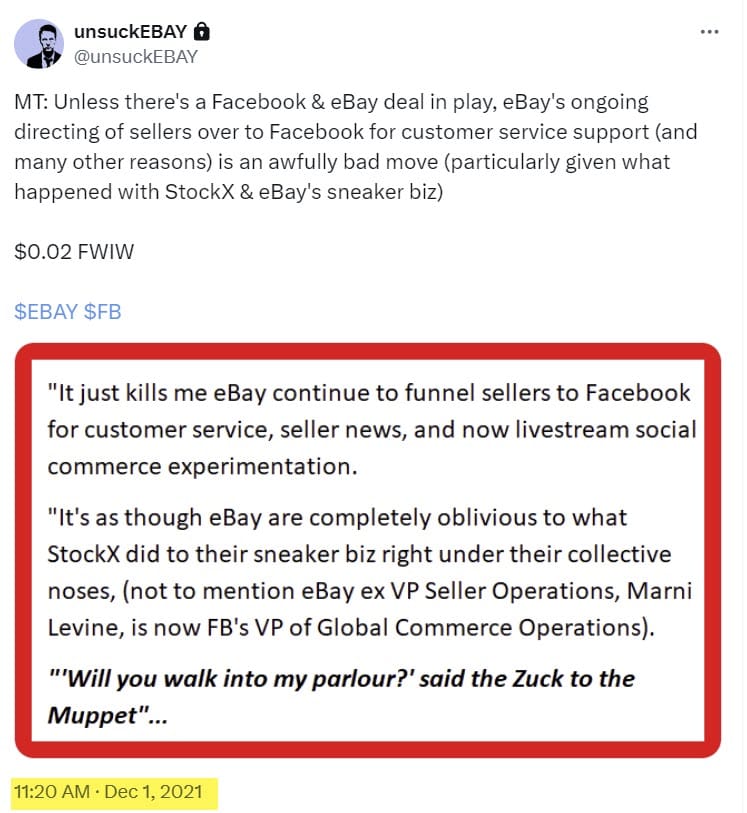
As @unsuckEBAY explained in 2021, continuing to funnel users to Facebook for support, engagement and live shopping seemed like a bad move, especially in light of how StockX took a big bite out of eBay's sneaker business in 2019.
For a brief moment in 2023, it seemed eBay may have finally understood its position vis-à-vis Facebook Marketplace as it sought to quash subpoena demands for confidential business information in an FTC lawsuit against Meta, acknowledging eBay "doesn't compete with Meta on social networking but does face off over the Facebook Marketplace ecommerce service."
 Liz Morton
But that lightbulb moment appears to have been short-lived as eBay has continued to double down on integrating social sharing tools into Meta-owned properties and the Facebook Marketplace partnership.
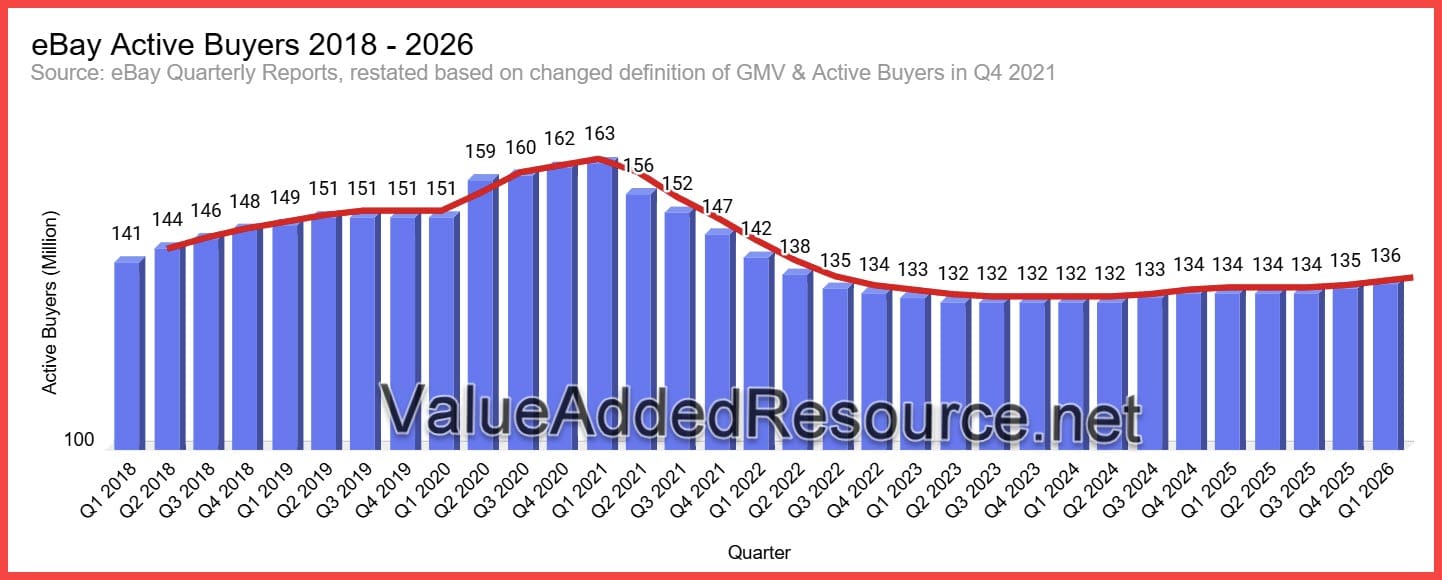
You would think the CEO of an ecommerce company that has reported fewer active buyers than in 2018 for 16 consecutive quarters, while also struggling to retain sellers, would understand the risk of encouraging either group to spend more time on a competitor’s site.
Meta’s latest move adds another data point for investors and shareholders questioning whether eBay’s leadership has adequately protected the marketplace from emerging competitors, an issue that has become even more pressing in light of GameStop CEO Ryan Cohen's roughly $56 billion bid to buy the company.
The eBay board formally rejected the offer in May, but Cohen says he's willing to take the matter directly to shareholders if needed. With GameStop now directly owning approximately 9.8% of eBay's outstanding shares, the company will likely have to contend with his critiques one way or another.
eBay shares fell approximately 3.7% Friday morning following Meta’s announcement, with the new app raising fresh investor concerns about competition for higher-volume sellers.