eBay Live Touts 8x Growth, But Scale Remains Hard To Measure

eBay says Live selling is growing quickly, pointing to sevenfold to eightfold year-over-year growth as it expands into new countries, opens more categories and spends heavily to bring buyers and sellers into livestream shopping.
How much that growth says about Live’s actual scale remains difficult to determine.
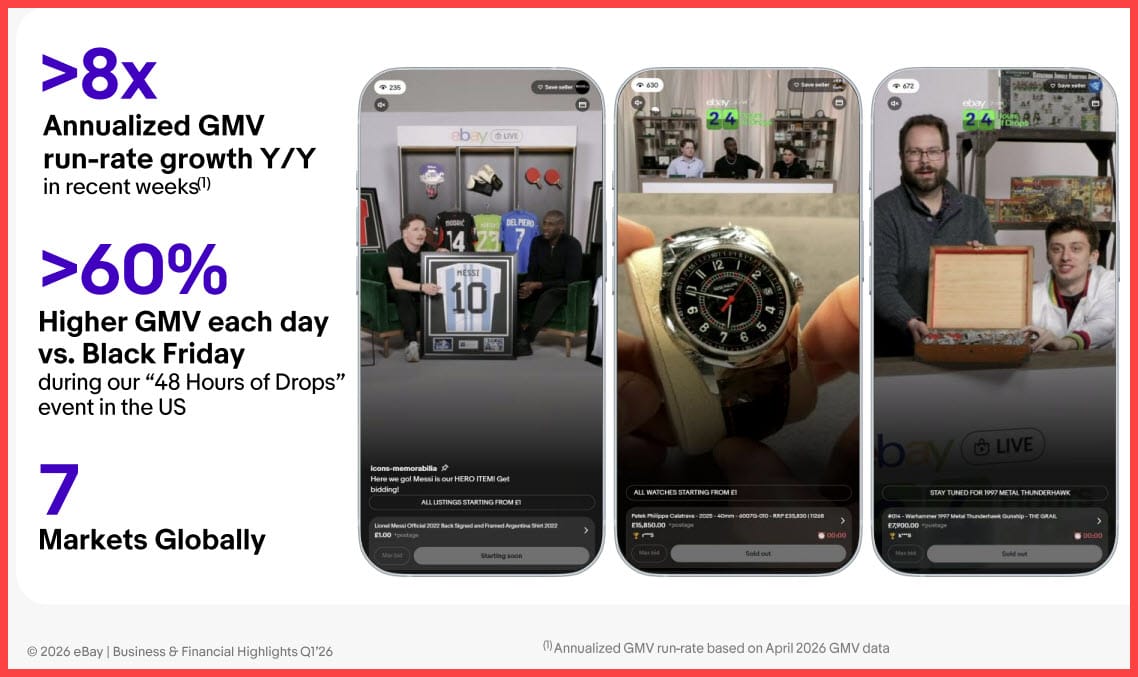
The company said in its first-quarter earnings presentation that Live’s annualized gross merchandise volume run rate had grown more than eightfold year over year “in recent weeks,” based on April 2026 data.
CEO Jamie Iannone also said daily GMV during the 48 Hours of Drops event was more than 60% higher than the previous eBay Live Black Friday record, while noting that Live was operating in seven markets globally.
More recently, eBay Live Vice President and General Manager Ashish Chhabra told Mantel during the National Sports Collectors Convention that the platform was experiencing sevenfold to eightfold year-over-year growth as it expanded beyond sports collectibles into fashion, luxury goods, electronics, beauty and sporting goods.
The figures sound impressive, and there are clear signs Live is gaining traction. But eBay has provided few of the underlying numbers needed to assess the scale or sustainability of that growth. The geographic expansion also makes the year-over-year comparison particularly difficult to interpret.
eBay Live launched in the US in June 2022, followed by a UK beta in 2024 that expanded more broadly in 2025. Germany officially launched in November 2025 and Australia followed in December. France and Italy came online in February 2026, with Canada joining later that month.
 Liz Morton
That means five of the seven markets included in eBay’s April 2026 presentation had been active for less than a year. France, Italy and Canada had only been operating for about two months.
If eBay is comparing total global Live GMV in April 2026 with April 2025, those newer countries would contribute sales to the current period with little or no corresponding activity in the prior-year base.
That can produce extraordinary percentage growth without showing how any specific market is actually performing.
eBay has not said whether the comparison adjusts for those launches or separates growth in established markets from GMV added through geographic expansion, new categories, additional sellers and company-funded incentives.
The company also has not disclosed actual Live GMV, active buyer or seller counts, transaction volume, average order value or repeat purchase rates.
Without those figures, more than eightfold growth could represent an increase from $10 million to more than $80 million, $100 million to more than $800 million or something else entirely. Each would tell investors a very different story about Live’s importance to a marketplace that generated $22.2 billion in total GMV during the first quarter.
Growing From A Restricted Base
The year-over-year comparison is also shaped by how slowly eBay initially rolled out Live.
The service debuted in the US nearly four years ago, but access remained limited to approved sellers in a narrow group of categories. Even as eBay promoted Live through seller events and celebrity appearances, most sellers could not participate.
 Liz Morton
More recently, eBay has begun opening the service to additional sellers and categories, including health and beauty, hard goods, art and antiques, apparel, electronics and sporting goods.
Expanding a feature that was previously kept small should produce rapid growth, while offering limited insight into where demand will settle once that expansion period passes.
Some sales may also be moving from traditional listings rather than creating new marketplace activity. A seller approved for Live in April 2026 contributes new Live GMV even if the seller’s total eBay sales remain unchanged. The shift could still benefit eBay by increasing purchase frequency or helping sellers move inventory, but the company has not shown how much Live growth is incremental.
eBay Is Paying To Build Activity
The growth is being supported by lower fees, buyer promotions and a significant advertising push.
eBay recently published standardized US Live rates of 6.9% plus $0.30 per order for coins, bullion and eligible sneakers, with most other categories charged 8.9% plus $0.30. Those rates are well below what many sellers would pay through the regular marketplace.
The company is also offering select US buyers up to $50 in coupons after a qualifying Live purchase, using one transaction to encourage two subsidized follow-up purchases.
 Liz Morton
Earlier promotions have included temporary fee cuts, $1-start auctions, celebrity events and prominent homepage placement. eBay has also launched its “Meanwhile on eBay Live” campaign across television, digital, social media and out-of-home advertising.
Those investments give buyers a reason to try Live, but also make it harder to judge how much activity will remain once discounts and promotional support are reduced.
CEO Jamie Iannone has previously criticized the broad marketplace coupons used under former CEO Devin Wenig, arguing they attracted low-value or one-time buyers. The current promotions are more targeted, but eBay still has to show that the subsidized activity produces lasting engagement.
A Faster-Moving Competitive Market
eBay has good reason to invest as dedicated platforms, social networks and established marketplaces compete for livestream sellers and viewers.
Whatnot has become eBay’s most direct dedicated live shopping competitor in the US and Europe, expanding from trading cards into fashion, coins, comics, toys, sneakers, electronics, food and other categories.
TikTok Shop presents a different threat, combining livestreams with short-form video, influencers and a massive built-in entertainment audience.
Poshmark has been building Posh Shows since 2022, using a format that fits naturally with its social and community-driven marketplace.
StockX presents a more direct challenge to eBay’s enthusiast strategy. Its US iOS launch focuses on sneakers, apparel, trading cards and collectibles, supported by $1 buyer shipping through August and no seller fees through September. The overlap with eBay Live is significant, and StockX already has an audience built around authenticated, higher-value products.
 Liz Morton
eBay’s advantage is its established marketplace infrastructure and base of 136 million active buyers, along with seller histories, integrated payments, feedback, buyer protection and decades of transaction data.
Chhabra described Live as “eBay gone live,” pointing to seller standards, risk controls and background checks as part of its trust advantage. That trust infrastructure could be a meaningful differentiator in a format facing persistent complaints about shill bidding, misleading claims and counterfeit goods.
eBay still has to turn its buyer base into regular Live viewers without alienating users of the traditional marketplace.
Aggressive homepage placements have already drawn backlash, while some sellers question why their fees are supporting a program they cannot access or do not use. Others spent years waiting for approval while building audiences elsewhere.
 Liz Morton
Scaling Beyond Professional Streamers
eBay appears to recognize that livestreaming will not be practical for most traditional marketplace sellers. Its planned “streaming as a service” pilot would allow sellers to provide inventory to experienced hosts rather than produce their own shows.
 Liz Morton
The model could help eBay add inventory without requiring participating sellers to invest in equipment, hire staff or spend hours on camera. It could also make Live more dependent on professional hosts and third-party providers, raising questions about who controls pricing, customer relationships, returns and access to valuable streaming slots.
What The Eightfold Growth Figure Shows
There is little reason to doubt that eBay Live GMV has increased substantially after the company added five countries, approved more sellers, opened new categories, reduced fees and funded buyer promotions.
The eightfold figure reveals at least as much about how restricted and geographically limited Live was a year ago as it does about the platform’s current competitive strength.
Assessing that strength would require actual GMV, comparable-market growth, active buyer or seller counts, purchase frequency, retention, company-funded promotional spending and some indication of how much activity is incremental rather than shifted from ordinary listings.
The comparison should become more meaningful after the recent launches have operated for at least a full year. Germany and Australia will begin lapping their debuts late in 2026, while France, Italy and Canada will not have clean year-over-year comparisons until early 2027.
Until then, sevenfold or eightfold growth makes an effective headline, but it does not establish that eBay Live has reached meaningful scale or found a sustainable place in live commerce.