eBay Leans On Live Coupons, Free Motors Listings To Drive Growth

eBay continues to leverage buyer discounts and seller fee waivers as it pushes for growth in Live shopping and Motors, two strategically important areas where the company is spending heavily to attract activity.
The latest promotions include up to $50 in coupons for select eBay Live buyers and free vehicle listings through the end of July.
Both follow a strategy eBay has used consistently in recent years: subsidize transactions, listings and repeat activity in priority categories, then hope some of that behavior continues after the promotion ends.
The approach can produce an immediate lift in inventory, purchase frequency and marketplace engagement, but it also raises questions about how much of that growth is being generated organically versus being purchased through discounts and marketing spend.
The current eBay Live promotion offers select US buyers up to $50 in coupons after making a purchase of at least $10 during a livestream by August 14.
Buyers who qualify receive a coupon worth $25 off purchases of $50 or more, which can be used twice within 30 days.
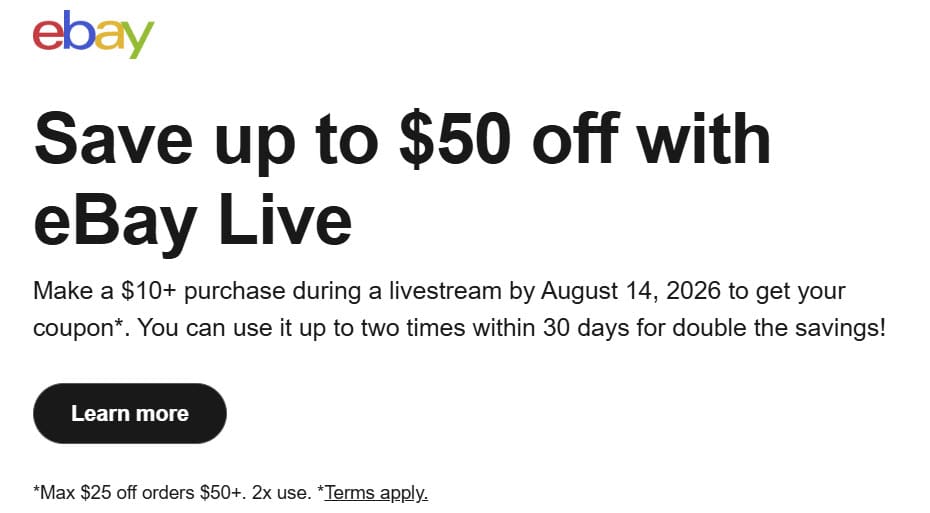
A qualifying $10 Live purchase can therefore incentivize two additional transactions, with eBay funding up to $50 of the subsequent spending.
The promotion follows a similar offer last year, but buyers say receiving the coupons they had earned did not always go smoothly.
 Liz Morton
The new offer also comes as eBay lowers fees for Live sellers, widening the cost difference between livestream sales and transactions through the regular marketplace.
 Liz Morton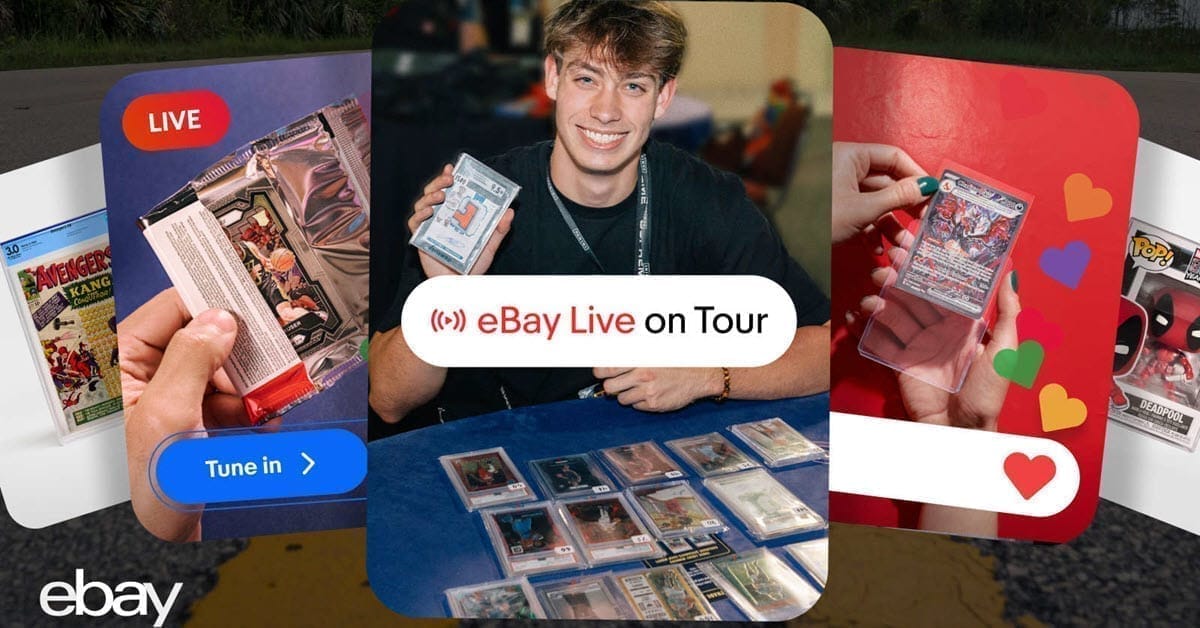
That creates a heavily subsidized environment on both sides of the transaction. Buyers receive company-funded coupons while participating sellers pay lower fees than they would through the regular marketplace.
eBay is also allowing US users to list eligible vehicles for free through July 31.
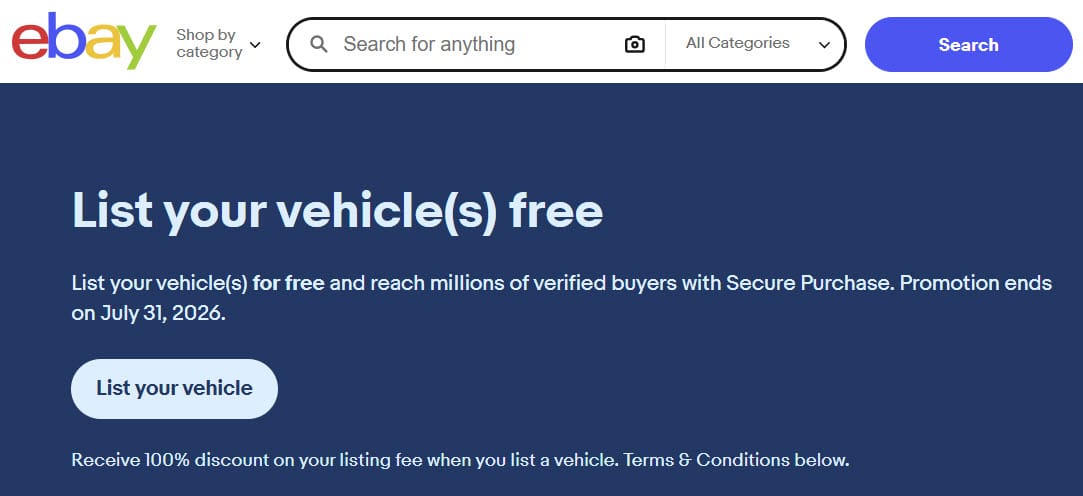
The promotion covers cars, trucks, motorcycles, powersports vehicles, boats and trailers, providing savings of up to $79 per listing. It can be used an unlimited number of times during the promotional period.
Deposit processing fees, optional listing upgrades and Store subscription charges still apply.
Vehicle sellers normally pay an upfront listing fee of about $34 for vehicles priced below $15,000 or $79 for those priced above that amount. Because eBay Motors generally does not charge a final value fee when a vehicle sells, waiving the listing charge removes most of eBay’s direct revenue from a basic listing.
The tradeoff is more inventory in Motors, one of eBay’s designated focus categories. The promotion can also turn an existing buyer into a seller, providing another route to Enthusiast status.
The Live promotion can move buyers toward the same designation from another direction, with the qualifying purchase and two coupon redemptions potentially providing three of the six purchase days needed to meet the frequency threshold.
Neither promotion guarantees that users will remain active once the discounts end, but both can influence the buyer engagement measures eBay highlights for investors.
CEO Jamie Iannone has built much of eBay’s strategy around attracting and retaining “high value” Enthusiast Buyers, particularly in focus categories such as collectibles, luxury, sneakers, refurbished electronics, fashion and Motors.
eBay defines Enthusiast Buyers as those with at least six purchase days, at least $800 in spending during the previous 12 months or activity as both a buyer and seller. Despite significant efforts to grow that group, the total has remained at approximately 16 million since late 2022.
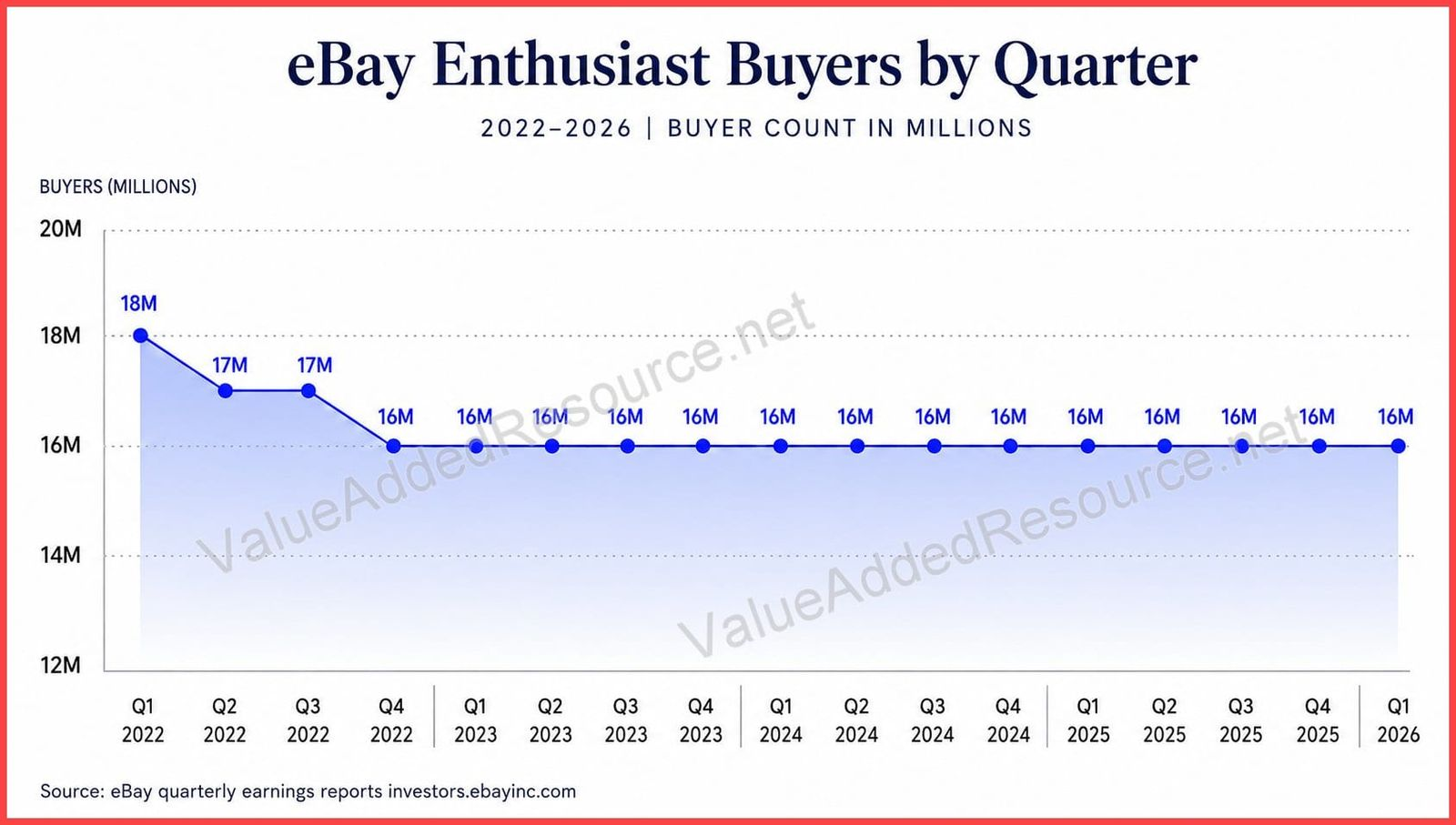
eBay reported 136 million total Active Buyers in the first quarter of 2026, up about 1% year-over-year. Roughly 1 million of those buyers came through the acquisition of Norwegian marketplace Tise, while the Enthusiast count remained unchanged.
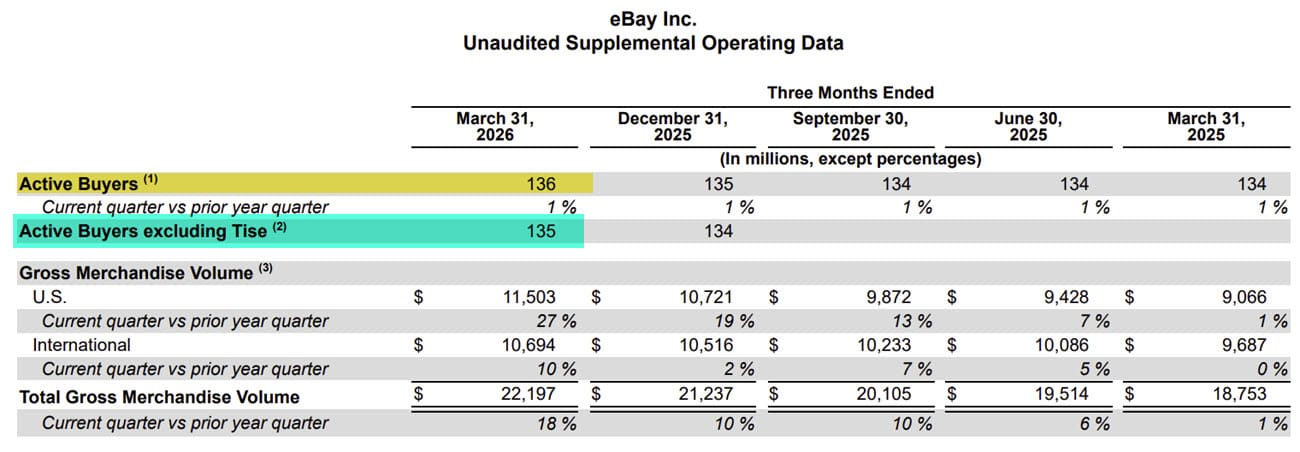
eBay has now reported 16 consecutive quarters with fewer Active Buyers than the restated Q1 2018 total.
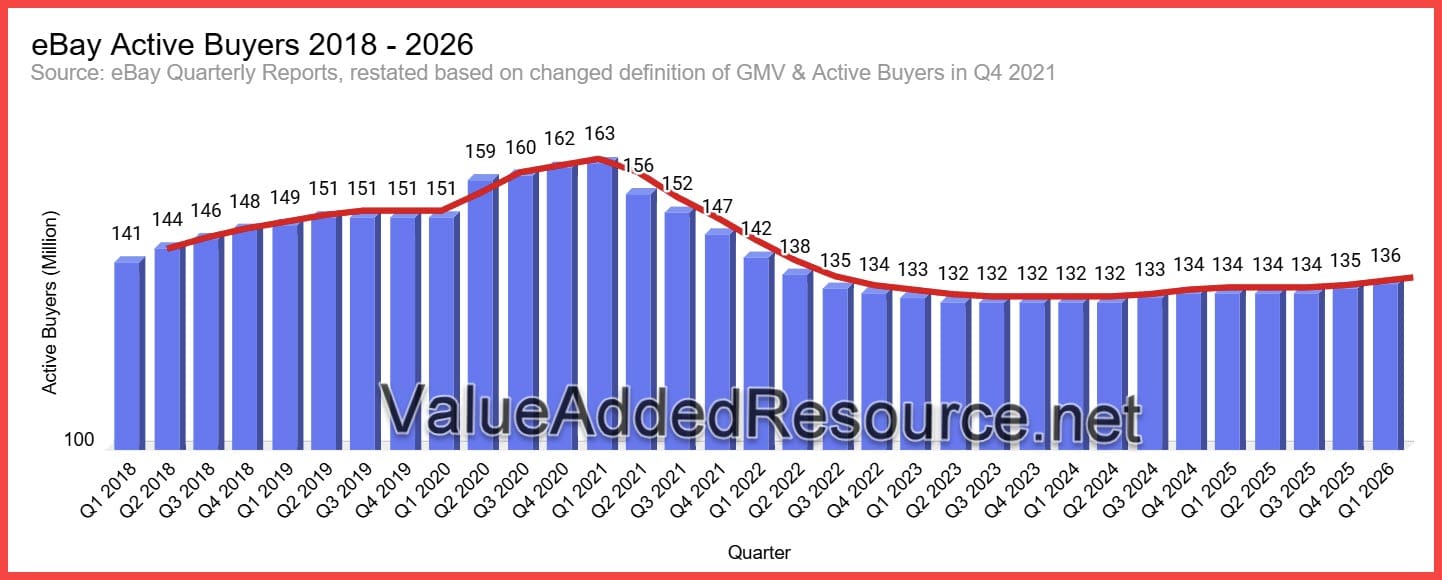
That stagnation makes eBay’s promotional activity increasingly relevant.
Company-funded coupons can induce short-term buyer activity, but eBay provides little information about how many remain active after the subsidies disappear.
The strategy also invites scrutiny given Iannone’s previous criticism of broad discounting under former CEO Devin Wenig.
During 2018 and 2019, eBay regularly offered company-funded discounts of 15% to 20% to boost GMV and buyer activity. Iannone later described those promotions as “legacy tactics” that attracted low-value, infrequent or one-and-done buyers.
Iannone explicitly distanced his strategy from Wenig's approach, telling investors in 2021:
We've discontinued legacy tactics that led to low value, infrequent or one and done buyers...
This is something that I laid out last July when we talked about the tech-led reimagination as being focused on turning buyers into lifelong enthusiasts on the platform and moving away from the tactics that we had in 2019.
eBay has since continued using incentives in more targeted ways, particularly around focus categories, consumer selling and newer products such as Live.
The company has offered buyer coupons tied to livestream purchases, discounts for sellers who also buy, reduced category fees, free selling promotions and other incentives designed to push specific behavior.
 Liz Morton
Iannone's version may be more focused than the marketplace-wide coupon events of the Wenig era, but the underlying risk is similar. Promotions can shift purchases forward, train users to wait for another offer or make a product appear healthier than it would be without company support.
The current Live offer is especially generous. After making a qualifying $10 purchase, buyers receive a coupon providing $25 off two subsequent purchases of at least $50 each, for up to $50 in total discounts on $100 in additional spending.
Discounts and fee waivers may feel different from traditional advertising, but they still carry a financial cost.
Company-funded coupons and other buyer incentives ultimately carry a cost for eBay, potentially reflected in sales and marketing expense or reduced transaction revenue, while waived seller fees reduce the revenue it would otherwise collect.
eBay’s operating expense base has become a central issue in GameStop CEO Ryan Cohen’s campaign to acquire the company.
 Liz Morton
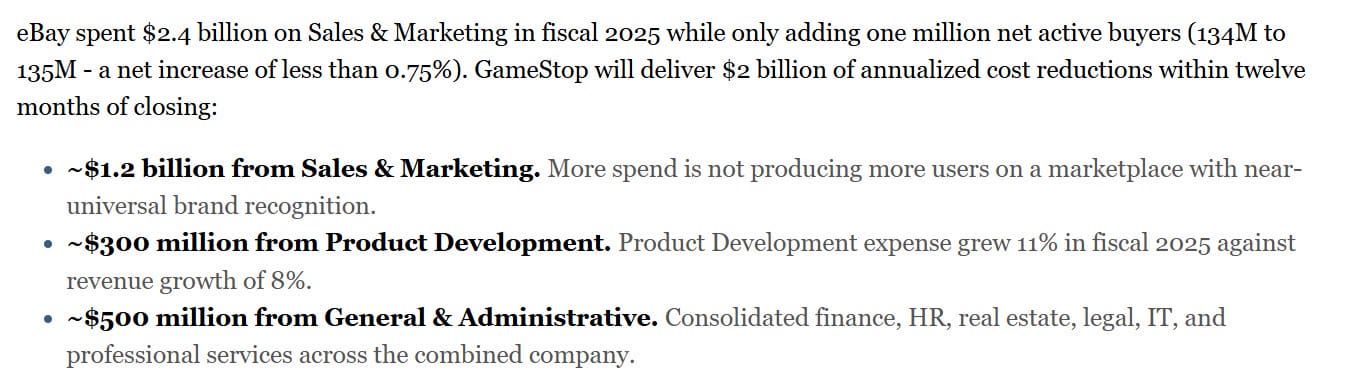
Cohen has criticized eBay’s roughly $2.4 billion in annual sales and marketing spending, arguing it has produced little meaningful buyer growth for a company with near-universal brand recognition.
GameStop’s proposal called for cutting approximately $1.2 billion from that expense line as part of a broader plan to reduce eBay’s annual costs by $2 billion.
The eBay board formally rejected the offer in May, but Cohen says he's willing to take the matter directly to shareholders if needed. With GameStop now directly owning approximately 9.8% of eBay, eBay will likely have to contend with his critiques one way or another.
Cohen’s argument is that eBay should not need to spend so heavily to produce modest growth on a marketplace with enormous reach, traffic and brand awareness.
The current promotions show how that spending works in practice. eBay is advertising Live, lowering seller fees and funding additional buyer transactions. In Motors, it is giving up listing revenue to increase inventory and attract sellers.
There may be reasonable strategic arguments for both. But with long-term buyer growth still limited and the Enthusiast count stuck at 16 million, Cohen and other eBay investors have reason to question whether these growth strategies are producing enough lasting value to justify the cost.