eBay Touts “New” Growth At Goldman Sachs

eBay CEO Jamie Iannone and CFO Peggy Alford highlighted consumer-to-consumer selling, AI, eBay Live and Vehicles as key growth drivers during an appearance at the Goldman Sachs Communacopia + Technology Conference Tuesday, offering a few new details while largely building on themes and metrics the company has already been pushing in recent earnings calls.
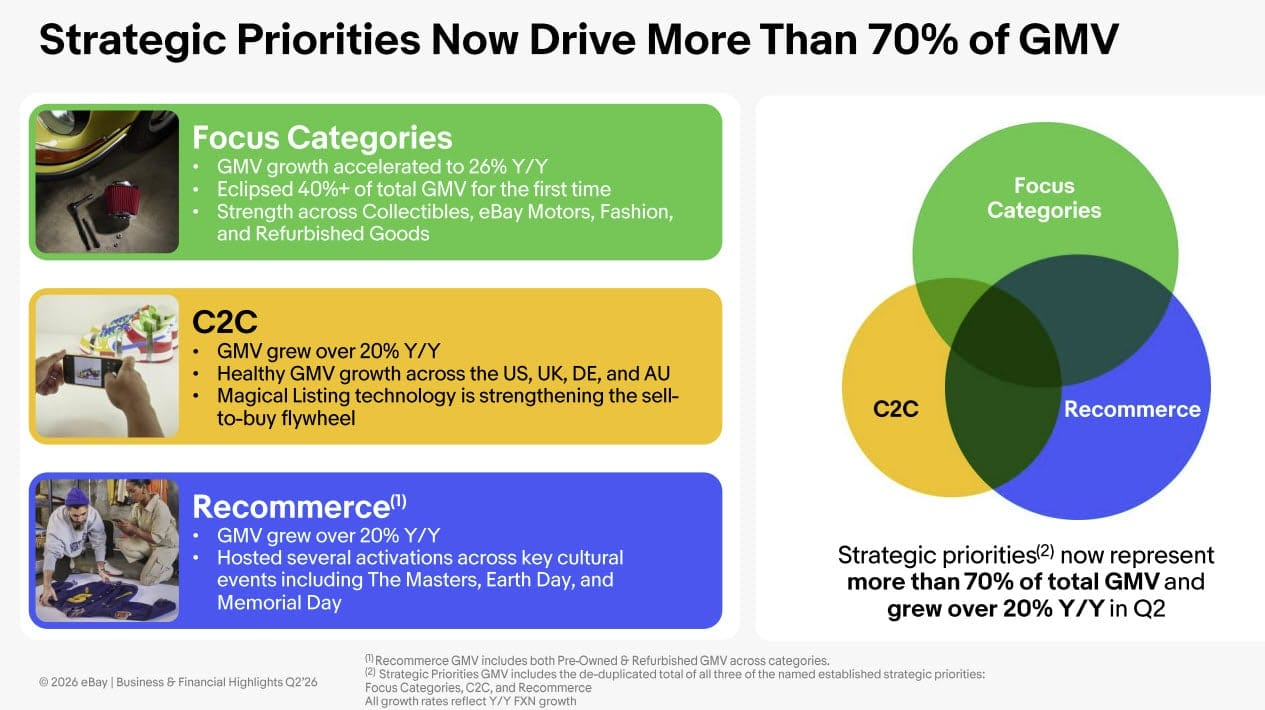
Iannone repeated several stats from the most recent earnings report, saying about 70% of eBay's business now falls into Focus Categories, C2C or recommerce, with each growing about 20% in Q2, while Live and Vehicles were highlighted as newer growth opportunities.
"We also have great new growth vectors in eBay Live and in vehicles," Iannone told Goldman Sachs analyst Eric Sheridan. "Vehicles, while new, has now quickly reached hundreds of millions of USD of run rate on the business."
He returned to the subject later, saying, "Vehicles, we're only a year into it, and we're already at hundreds of millions of dollars of run rate."
That's a strange claim considering that vehicles have been sold on the site for more than two decades. eBay Motors launched in 2000, and by 2006 the company was already celebrating the sale of its two millionth passenger vehicle through the marketplace.
The newer part of the business comes from additional services added following eBay's acquisition of Caramel in February 2025. Caramel brought identity and title verification, financing, insurance, transportation, registration and ownership transfer capabilities, which eBay began integrating through Secure Purchase last year.
Iannone pointed to the recent sale of a $5 million Porsche as an example of the more complete vehicle transaction experience eBay can now provide, though he did not specify exactly what is included in the hundreds of millions of dollars of run rate or how much comes from the newer Caramel-powered services.
 Liz Morton
Iannone also repeated several of the Live growth metrics first disclosed with Q2 earnings, including eightfold year-over-year GMV growth and the company's claim that 90% of sellers who start using Live continue with it.
eBay says those sellers grow about three times faster than comparable sellers who do not use Live, while collectibles buyers who begin watching Live spend about 70% more than comparable buyers, much of it elsewhere on the regular marketplace.
Those figures have helped eBay position Live as another major growth vector, though the company still has not disclosed absolute GMV, revenue or active buyer and seller numbers that would show how large the business actually is.
But much of that growth is also coming as eBay rapidly adds markets, categories and sellers from a relatively small base, with five of the seven countries included in earlier 2026 growth claims having operated Live for less than a year.
 Liz Morton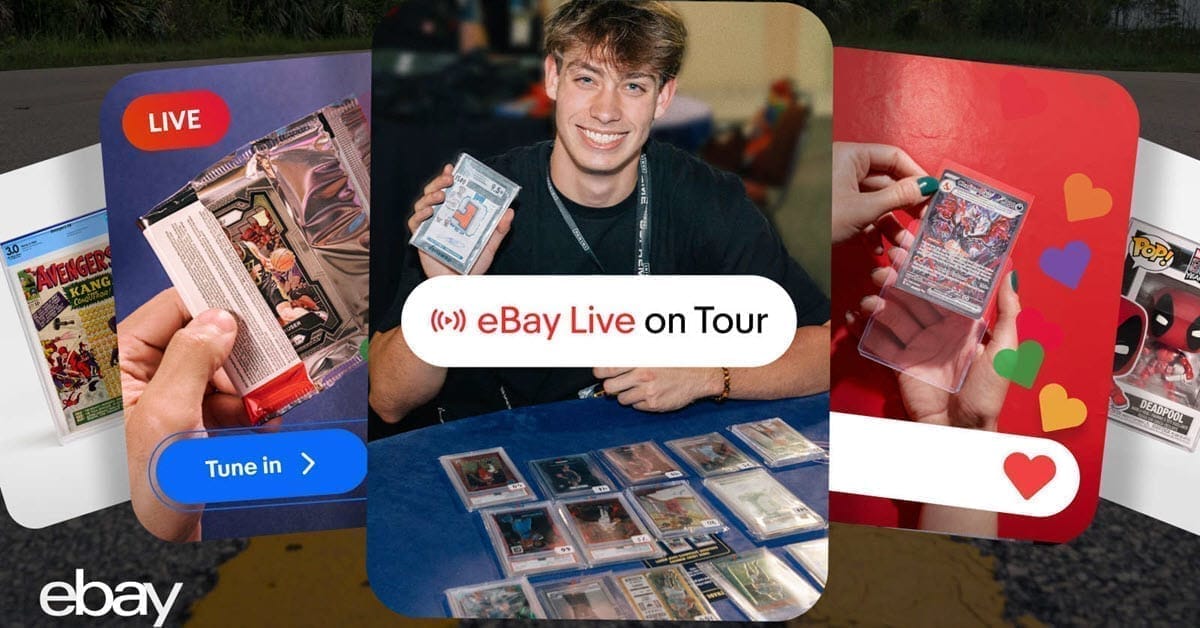
eBay has supported that expansion with coupons, advertising and lower Live selling fees in many categories, making the eightfold growth rate useful for showing direction but less useful for determining Live's contribution to the overall marketplace.
Iannone also said eBay has “just started launching simulcasting,” though the company’s Live policy already allowed sellers to simultaneously stream eBay Live events on non-auction platforms such as YouTube, Twitch and Instagram.
That fits with eBay's broader push to have sellers bring existing audiences onto Live rather than relying entirely on discovery within eBay, particularly as the company opens access to more sellers and competes with platforms where livestreaming communities are already well established.
AI was another major theme, with Iannone calling it a "real structural tailwind" and saying eBay's current growth rates are partly benefiting from investments in Magical Listing, natural language search and other AI-powered experiences.
He said eBay is seeing 50% more listings per lister in the US through its latest Magical Listing technology, along with higher customer lifetime value for new sellers using the experience.
eBay has been testing versions of Magical Listing for years and recently began expanding the latest conversational experience to more occasional and reactivated sellers. Some users have reported that the process still misidentifies items, generates inaccurate information or takes as long as the regular listing flow once corrections are made.
 Liz Morton
Sheridan also asked about agentic commerce, where Iannone acknowledged that transaction volume coming through AI shopping agents is still small but offered one of the more interesting new metrics from the appearance. When eBay's unique inventory brings a new customer to the marketplace through one of those experiences, Iannone said "about half the time, they come back to eBay directly to drive their next purchase."
That gives eBay an early data point to support its argument that AI shopping agents could provide another customer acquisition channel for the marketplace, particularly for used, collectible and hard-to-find inventory that may not be available through more traditional retail searches.
Iannone avoided talking about eBay's on-site agentic AI efforts, which don't appear to have progressed past the very limited testing the company announced early last year.
 Liz Morton
C2C selling received similar attention, with Iannone saying activity is growing more than 20% in the US, UK, Germany and Australia as eBay continues expanding fee-free private selling and other consumer-focused changes.
Germany was the first major market to move to fee-free private selling in 2023, followed by the UK and Australia, while France and Italy joined the strategy this month.
 Liz Morton
Iannone said buyers become 2 to 2.5 times more valuable as buyers after they also begin selling, then gave a particularly direct description of how eBay Balance fits into that strategy.
"Think about it, we have features like eBay Balance, right? Where you go sell a bunch of stuff on the platform, it sits there in your eBay Balance. What do you do? You go splurge on something that you really wanted."
Those models lower or eliminate traditional seller transaction fees while giving eBay other ways to monetize activity through buyer fees, shipping, payments and advertising, with Balance also increasing the opportunity to turn sellers back into buyers before proceeds leave the platform.
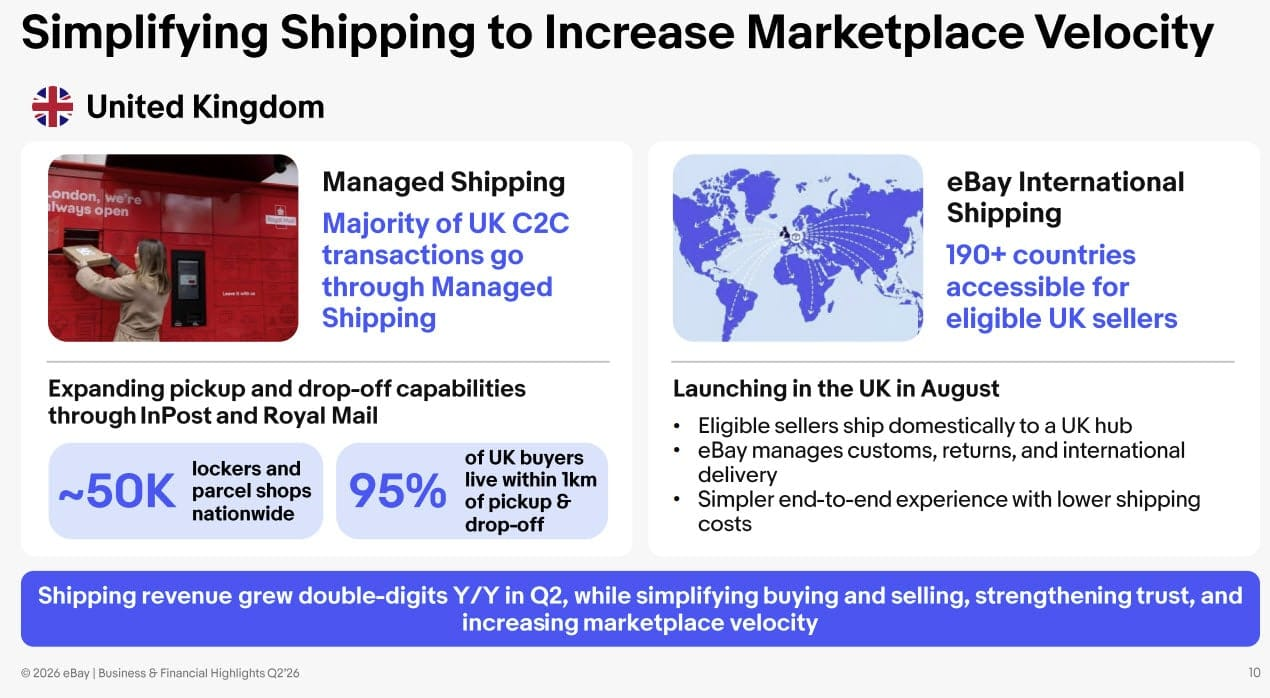
Shipping plays into that strategy as well, with Iannone highlighting Managed Delivery and eBay International Shipping as ways to make selling easier while eBay increasingly takes a larger role in the transaction.
Shipping revenue grew double digits year-over-year in Q2 and was named alongside advertising and payments as a positive contributor to take rate. A majority of UK C2C transactions are now going through managed shipping as eBay tests a similar model in the US and continues pushing more sellers toward labels purchased through the platform.
Advertising provides another increasingly important source of revenue around those transactions. Alford said advertising now represents about 2.8% of GMV, approaching eBay's 3% near-term target, but reiterated that the company does not consider 3% a ceiling.
"We have a lot of opportunities to continue to grow," she said. “We have a new Promoted Offsite product, which enables us to give even more surface to this advertising off of the platform. We recently introduced Promoted Stores as well.”
Again, it's odd to frame either of those ad products as "new" since both Promoted Offsite and Promoted Stores were originally introduced in 2022, though both have had recent updates expanding placements and potential reach.
 Liz Morton
eBay has been working to increase both the number of listings being promoted and the number of sellers using advertising products, while changes to Promoted Listings General attribution earlier this year expanded the circumstances under which an ad fee can be charged after a promoted click.
Depop also came up as Sheridan asked about younger shoppers, with Iannone saying Gen Z and millennials are eBay's fastest-growing demographic and describing the recently acquired marketplace as a strong fit for the company's broader recommerce strategy.
eBay completed the roughly $1.4 billion acquisition on July 30, and Iannone said growth has already accelerated. "What we see now is that we've seen even stronger growth rates than when we've acquired it because of the real opportunity that's creating," he said, without providing a specific growth rate or comparison period.
He also didn't say how much of that growth is coming from giving Depop prominent placement on the eBay homepage and in fashion search results, sending shoppers away from eBay and directly to matching Depop searches.
 Liz Morton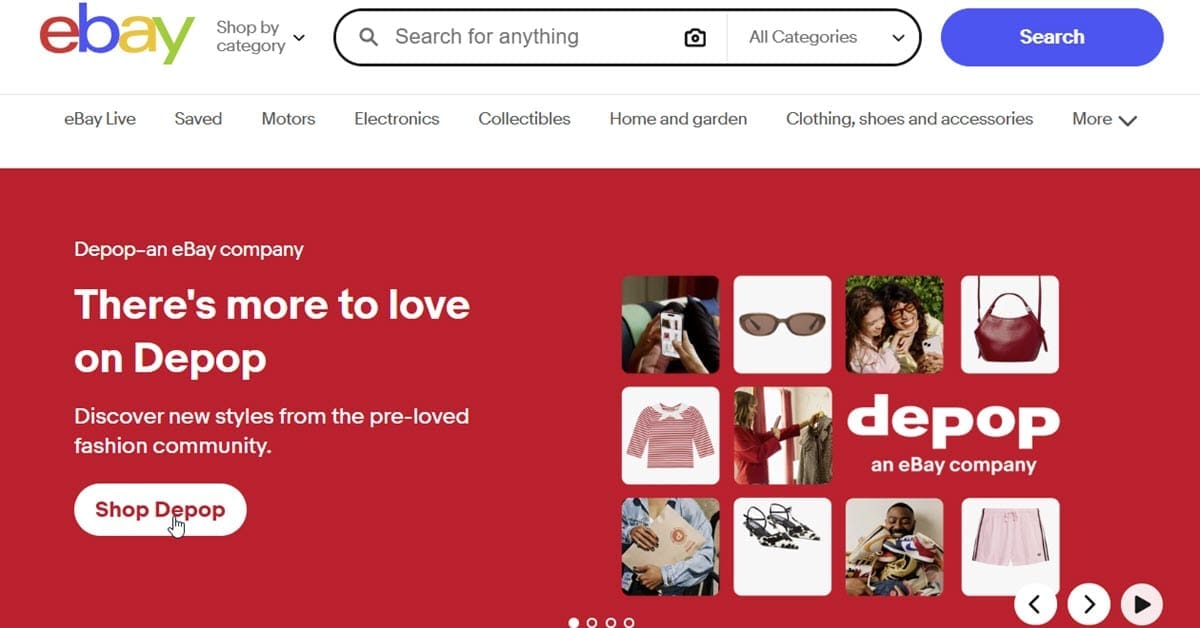
The acquisition is expected to increase consolidated Q3 FX-neutral GMV growth by about 2.5 percentage points and revenue growth by approximately 1.5 points. But comparisons with Depop’s results under Etsy won't be apples to apples, as shown in this slide from Q2 earnings.
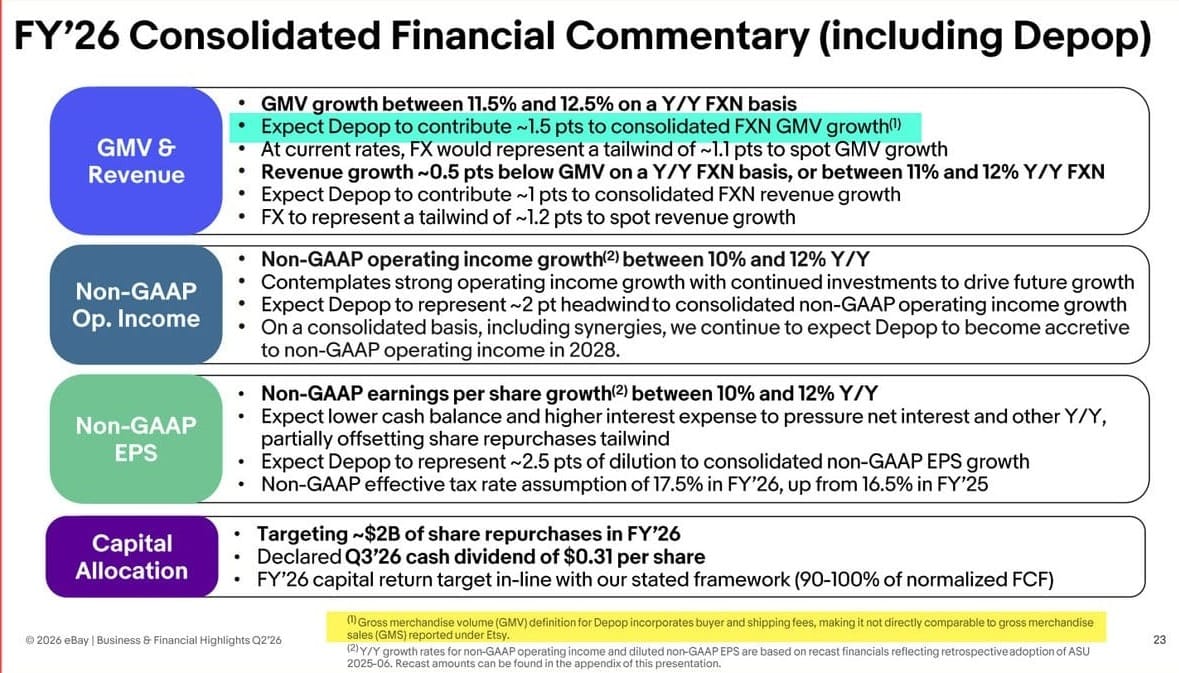
That footnote in tiny print says: Gross merchandise volume (GMV) definition for Depop incorporates buyer and shipping fees, making it not directly comparable to gross merchandise sales (GMS) reported under Etsy.
Under Etsy's GMS definition, Depop's stats included the item price only and deducted refunds. Depop GMV under eBay's definition will count item price, shipping, sales tax and buyer fees, but will not deduct refunds or cancellations, making it even more difficult to determine how much any claimed growth will be due to an actual increase in sales instead of just a change in reporting.
Reported Active Buyers will receive a substantial acquisition-driven boost in Q3 as well, once Depop’s nearly nine million buyers are included.
eBay has struggled to organically grow its buyer base, with Active Buyers below 2018 levels for 17 consecutive quarters, though recent reported growth has also been aided by the acquisition of secondhand fashion marketplace Tise.
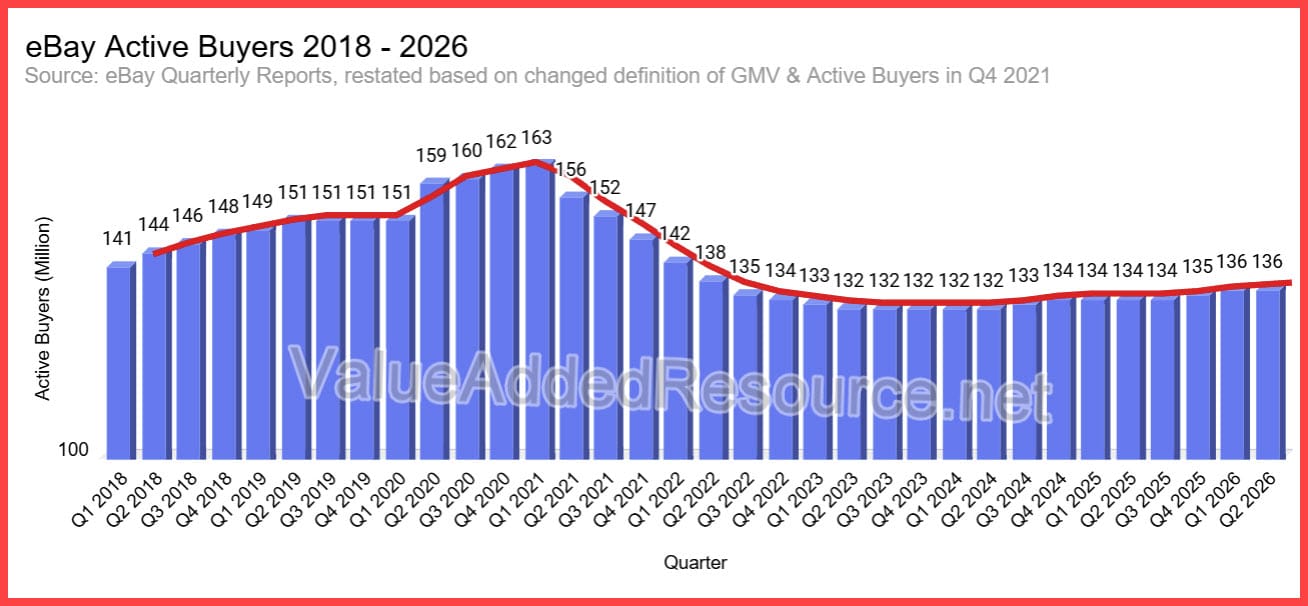
Note: eBay changed the definition of GMV and Active Buyers at the end of 2021 and restated both figures going back to 2018 (chart reflects restated figures per eBay's amended reports.)
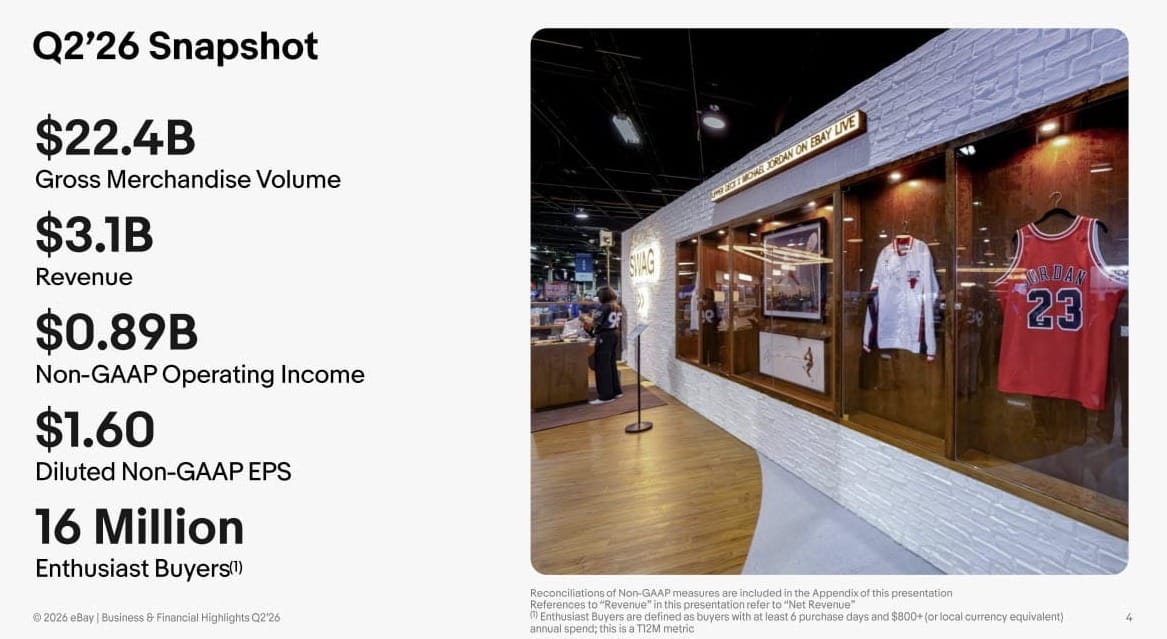
"Enthusiast Buyers" - those with at least 6 purchase days, at least $800 spent in the last 12 months and/or buyers who also sell - are still stuck at 16M, which is where they've been since Q4 2022.
However, like that total Active Buyer count, the US showed stronger growth for Enthusiasts in Q2, up 9% year-over-year. Globally, CFO Peggy Alford said enthusiast buyers grew nearly 3%, even though the rounded total remained at 16 million.
Interestingly, Alford told Goldman Sachs today that acquiring new active buyers is essentially a feeder strategy for creating more enthusiast buyers:
“Enthusiast buyers have always been a focus for us, like those that are buying at a high velocity. Because the majority of our GMV comes from our enthusiast buyers, something like 85% of our GMV is bought by enthusiasts. While we really care about the top of the funnel and getting new active buyers, we are really doing that in service of getting these buyers to become enthusiast buyers."
Alford said Enthusiast Buyers spent an average of about $3,600 over the trailing 12 months in Q2, with eBay also looking to increase their purchase frequency and get them shopping across more categories.