eBay Q2 2026 Earnings: Strong Growth, Rising Costs And An Expensive Bet On Depop

UPDATE 8-6-26
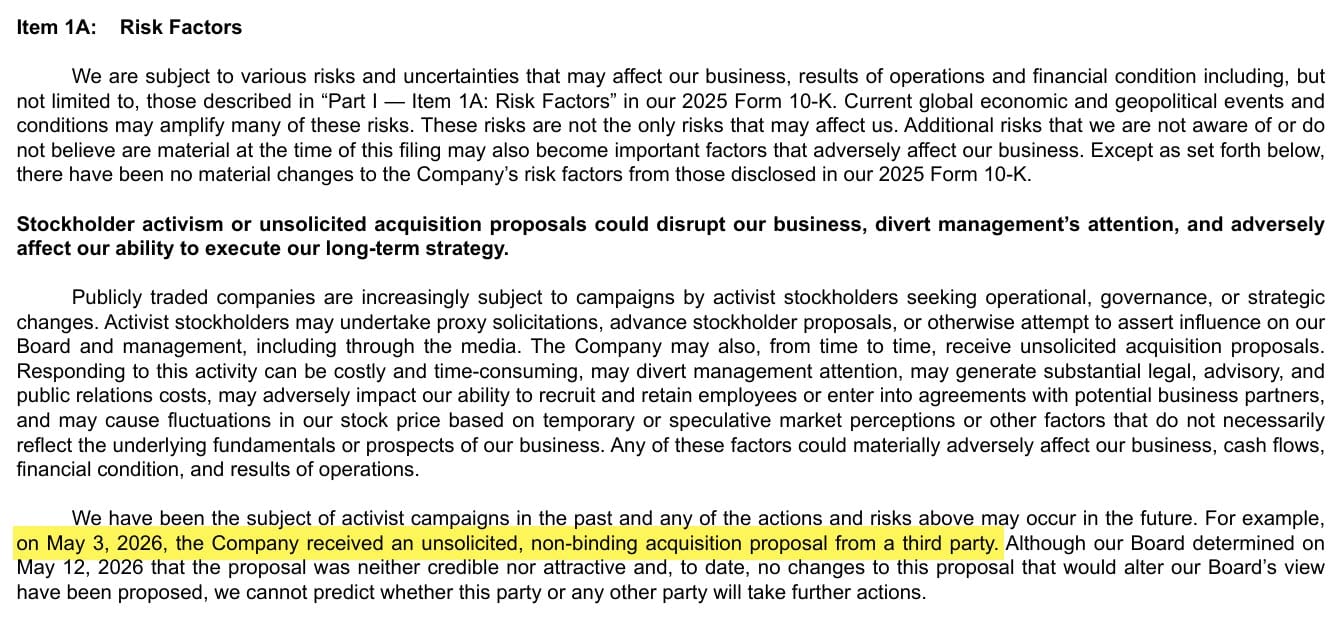
eBay’s newly filed 10-Q adds stockholder activism and unsolicited acquisition proposals as a specific risk factor following the rejected GameStop bid, though it does not mention the company or Ryan Cohen by name.
Instead, eBay says its board still views the May proposal as “neither credible nor attractive,” but acknowledges it cannot predict whether the bidder or another party will take further action.
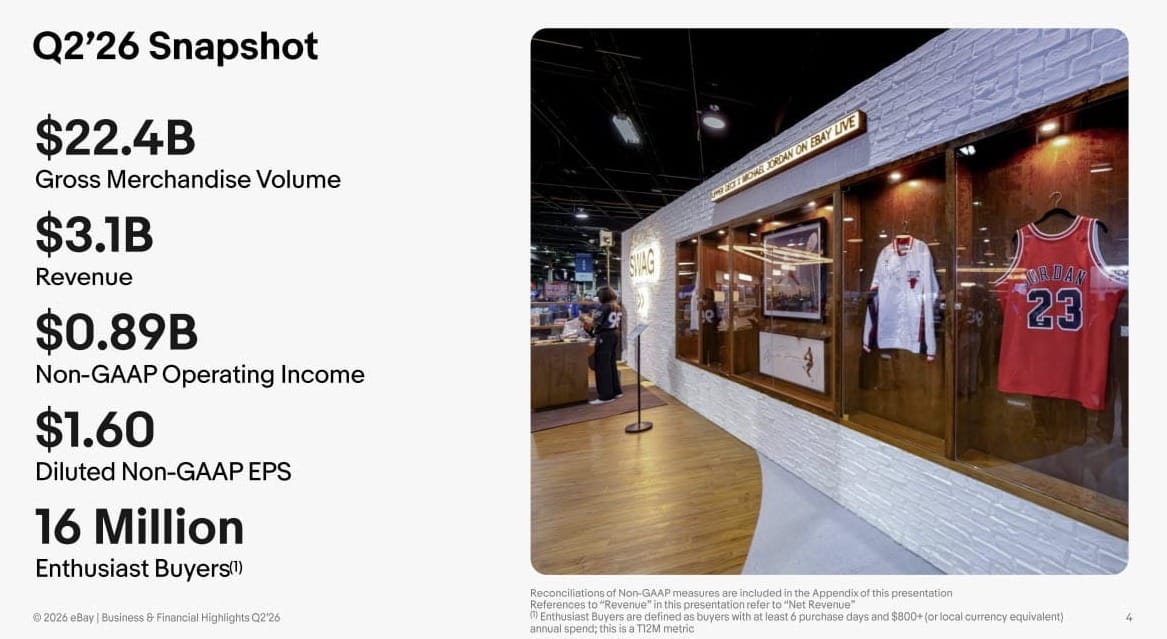
eBay reported stronger-than-expected results for the second quarter, with GMV reaching $22.4 billion and revenue rising to $3.1 billion, both up 15% year over year. Growth was led by the US market, focus categories and C2C activity, while advertising and shipping continued to contribute more to revenue.
GMV exceeded the top of the company’s guidance by roughly $700 million, while revenue came in about $104 million above the high end and non-GAAP earnings per share beat by $0.09.
By eBay’s own forecasts, it was a strong quarter, but the higher GMV and revenue came with increased marketing costs and transaction losses, while Active Buyers were unchanged from Q1 and Enthusiast Buyers remained at 16 million.
Important stats from the press release:
- Revenue of $3.1 billion, up 15% on an as-reported basis and up 14% on an FX Neutral basis
- Gross Merchandise Volume ("GMV") of $22.4 billion, up 15% on an as-reported basis and up 14% on an FX-Neutral basis
- First-party advertising products on the eBay platform delivered $570 million of revenue in the second quarter of 2026, up 25% on an as-reported basis and up 24% on an FX-Neutral basis.
- Returned $448 million to stockholders in Q2, including $310 million of share repurchases and $138 million paid in cash dividends
Total Active Buyers were reported at 136 million, which represents minor year-over-year growth of 2%, but is flat quarter-over-quarter.
Management said US active buyer growth was particularly strong, increasing 6% year-over-year.
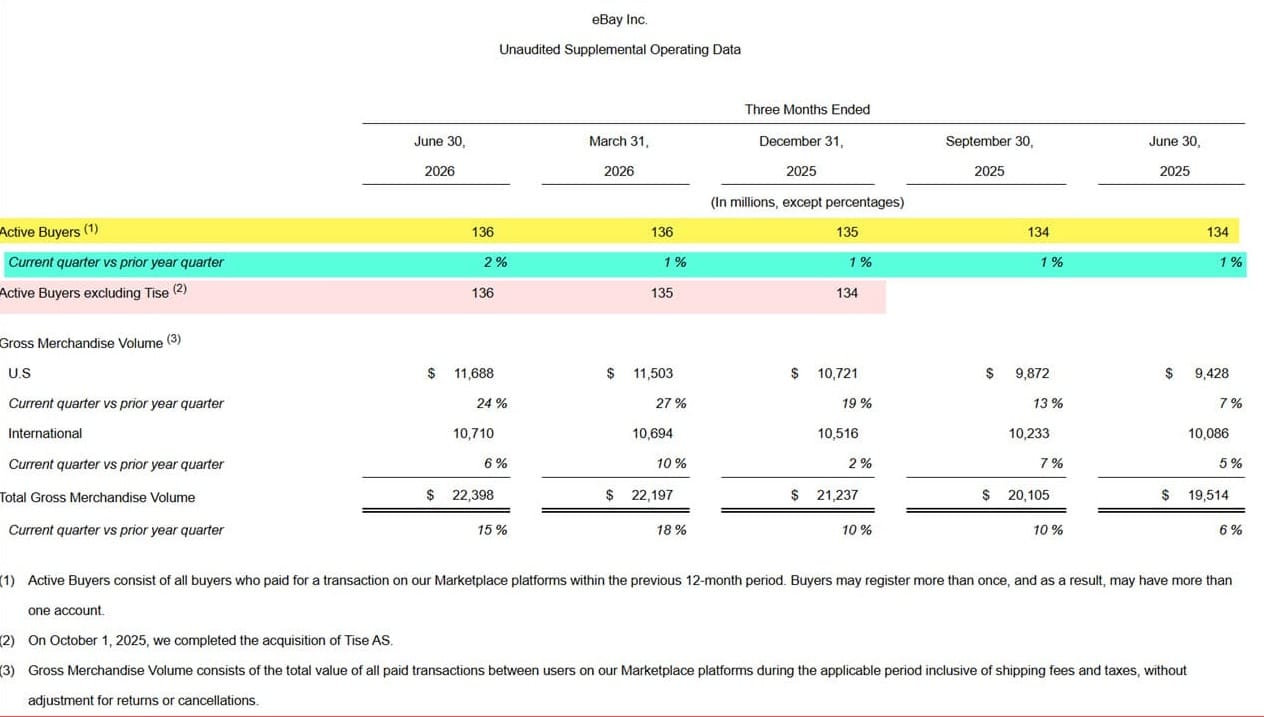
While the figure has risen in recent quarters, it's still worth noting this marks the 17th consecutive quarter where eBay has had fewer Active Buyers than Q1 2018.
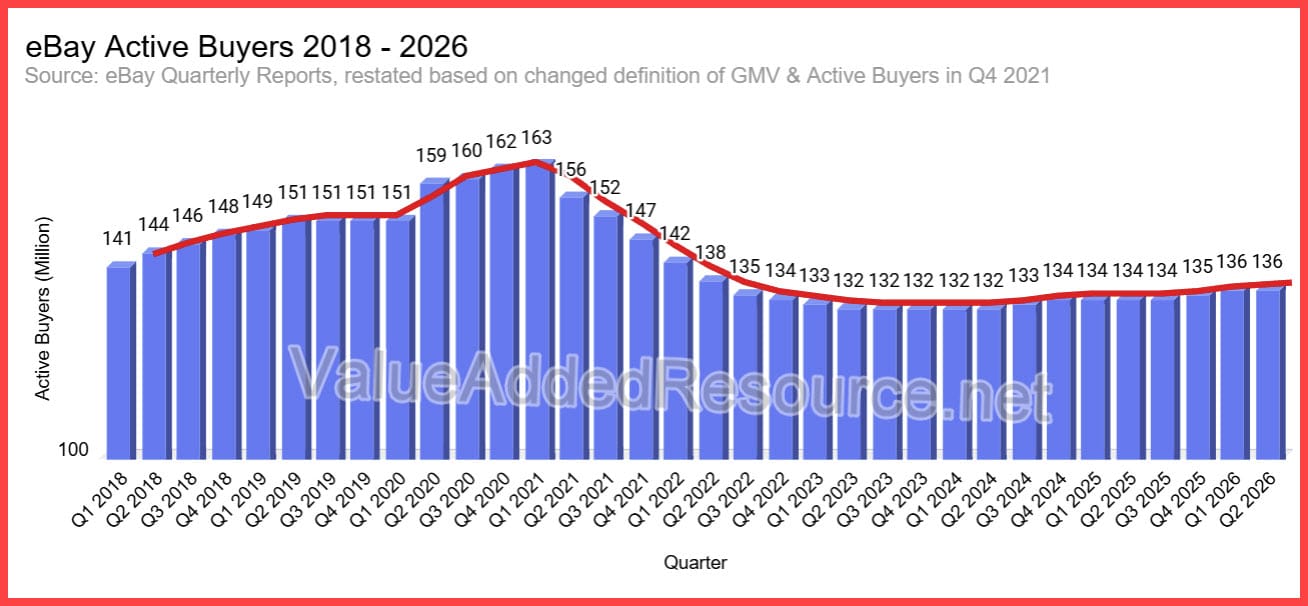
Note: eBay changed the definition of GMV and Active Buyers at the end of 2021 and restated both figures going back to 2018 (chart reflects restated figures per eBay's amended reports.)
Reported Active Buyers will receive a substantial acquisition-driven boost in Q3, when eBay begins including Depop’s nearly nine million buyers. eBay typically separates recently acquired buyer figures, as it has with Tise, so the key question will be whether the core marketplace continues gaining buyers independently.
Once again, eBay declined to provide specific Active Seller figures, which were last officially reported at 17 million in Q4 2021 - though a recent job ad indicates that number may be closer to 18 million today.
"Enthusiast Buyers" - those with at least 6 purchase days, at least $800 spent in the last 12 months and/or buyers who also sell - are still stuck at 16M, which is where they've been since Q4 2022.
However, like that total Active Buyer count, the US showed stronger growth for Enthusiasts, up 9% year-over-year. Globally, CFO Peggy Alford said enthusiast buyers grew nearly 3%, even though the rounded total remained at 16 million.
While double-digit GMV growth looks impressive on paper, the underlying drivers can be more complicated.
Gross Merchandise Volume is defined as "the total value of all paid transactions between users on our Marketplace platforms during the applicable period inclusive of shipping fees and taxes, without adjustment for returns or cancellations."
That means GMV can rise through higher prices, shipping increases and taxes without an equivalent increase in items sold.
Presales may also be counted months before fulfillment and remain in reported GMV even if orders are later cancelled, as will any other transaction that is ultimately refunded due to returns or disputes.
 Liz Morton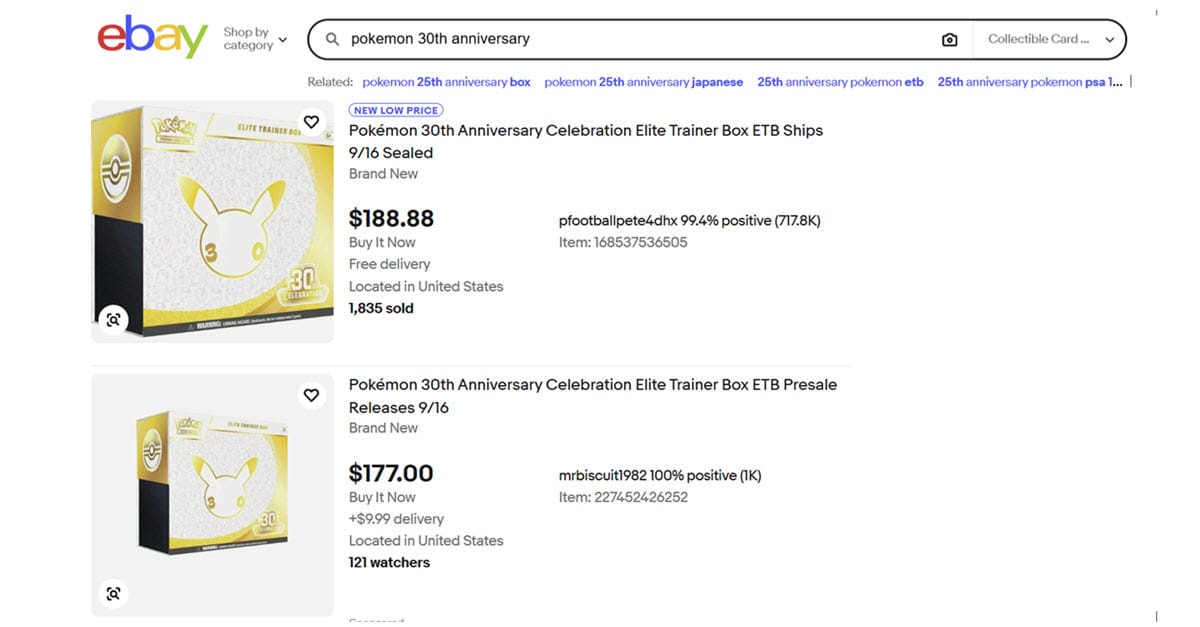
The headline GMV figure also masks a substantial difference between eBay’s US and international businesses.
US GMV rose 24% year-over-year to $11.7 billion, while international GMV increased just 6% to $10.7 billion. The US therefore produced roughly four-fifths of eBay’s total dollar GMV growth during the quarter.
The US results provide real evidence of a turnaround, but the 15% headline growth rate was far from evenly distributed. International markets generated 44% of revenue in Q2, down from 49% a year ago, as more of eBay’s growth shifted toward the US.
Promoted Listings Ads
Promoted listings comprise nearly 1.3 billion of the 2.6 billion total listings on eBay with 5.7 million sellers using at least one advertising product during the quarter. And despite total advertising revenue already reaching a record 2.7% of GMV, management said its 3% target is only a midterm milestone - not a ceiling.
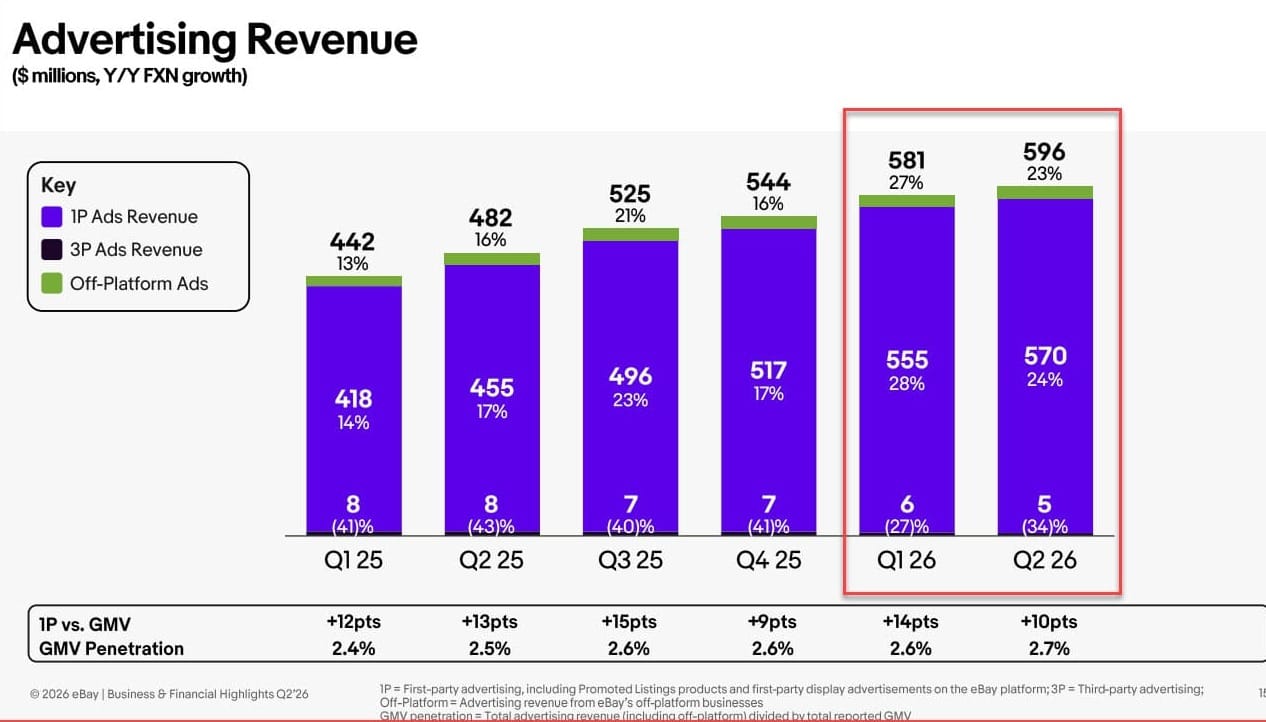
What those numbers don't show is how much of the growth came from greater seller demand versus eBay’s expanded attribution rules. Starting in January, eBay began charging a Promoted Listings General fee when any buyer clicked the promoted version within the previous 30 days, even if a different buyer ultimately completed the purchase.
 Liz Morton
That makes more sales eligible for ad fees, so the number of promoted listings and participating sellers should not automatically be read as proof of incremental sales. eBay did not disclose how much of Q2’s ad growth came from the attribution change, whether seller return on ad spend improved or how many promoted sales would have occurred organically.
Advertising remains one of eBay’s most reliable revenue levers, but the company still provides no data showing how many promoted sales were truly incremental or whether sellers received a better return on that spending.
Focus Categories & Consumer-To-Consumer Selling
Focus Categories continued to account for an increasing share of eBay’s business, growing 26% year-over-year on an FX-neutral basis and surpassing 40% of total GMV for the first time.
When combined with C2C and recommerce, eBay says its three established strategic priorities now represent more than 70% of marketplace GMV and grew over 20% during the quarter. The 70% figure is de-duplicated, since a single transaction may qualify as C2C, recommerce and part of a Focus Category at the same time.
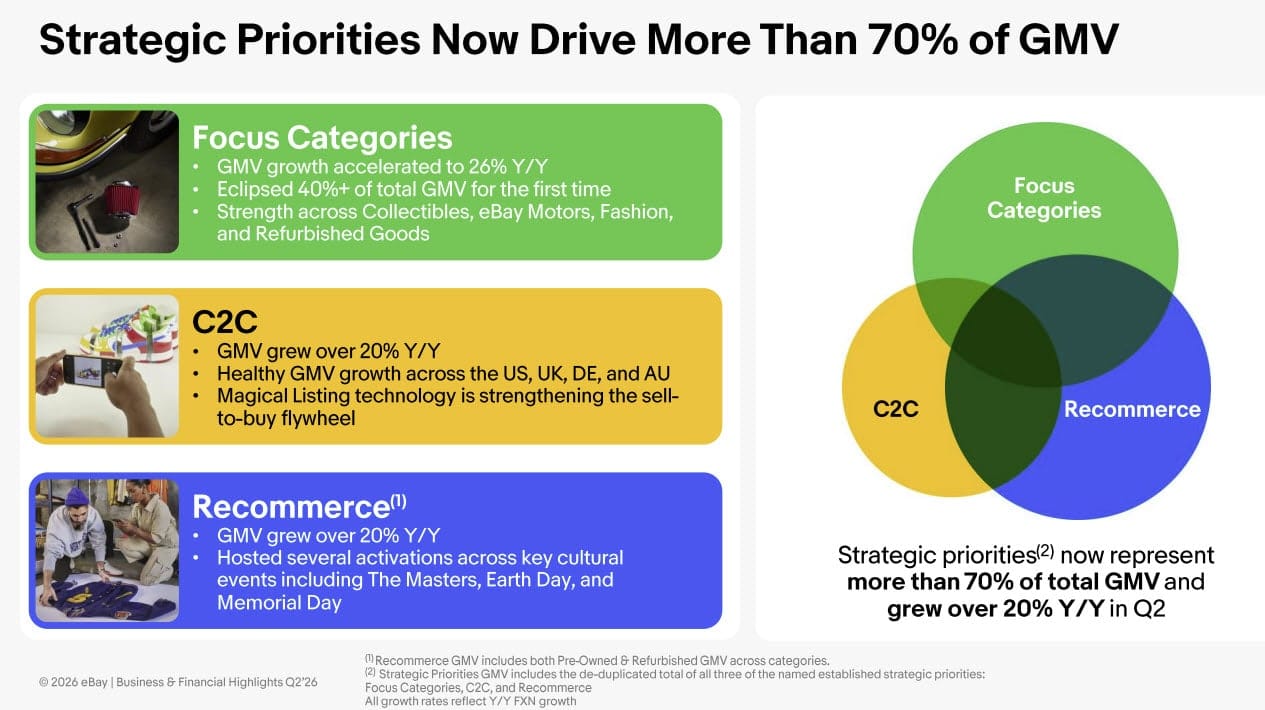
Once more than 70% of GMV falls under the label, “strategic priorities” starts to mean most of eBay rather than a separate part of the business. eBay did not disclose comparable growth for the roughly 30% outside those priorities or for the non-focus portion of the marketplace, making it difficult to tell how broadly the recovery extends.
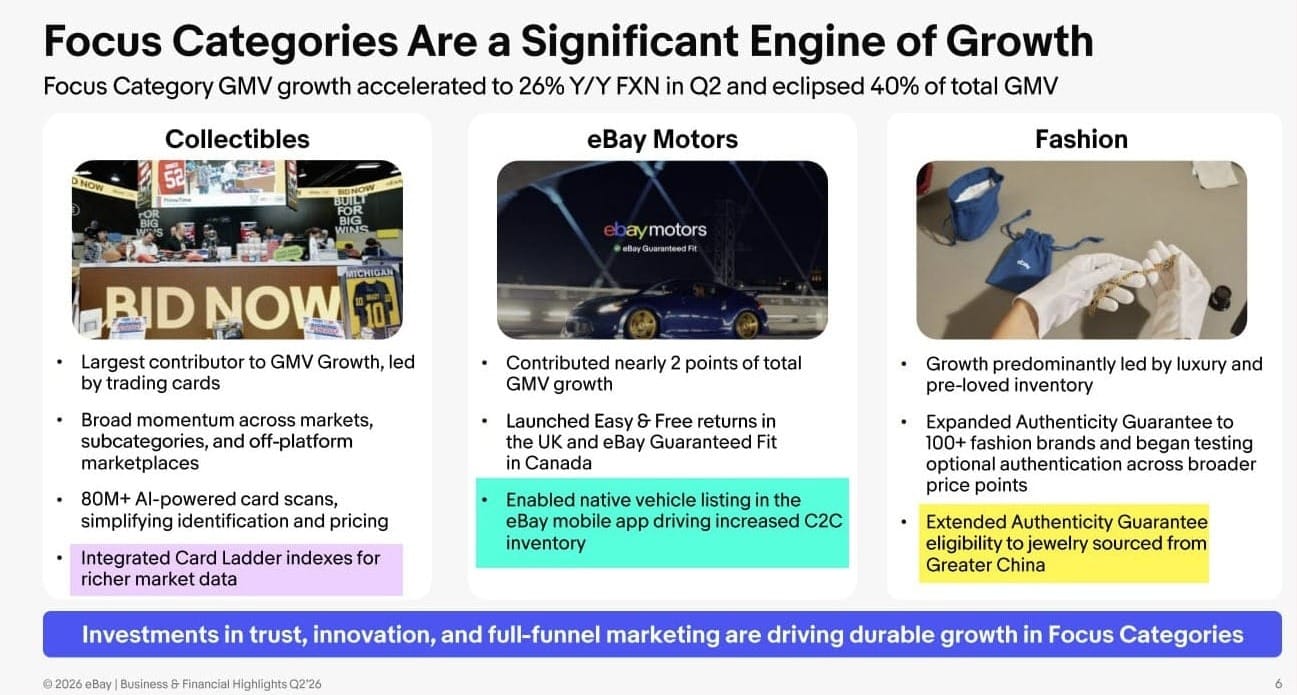
Collectibles was the largest contributor to growth, led by trading cards, while Motors contributed nearly two percentage points, primarily through Parts & Accessories. Fashion growth was led by luxury and pre-owned inventory.
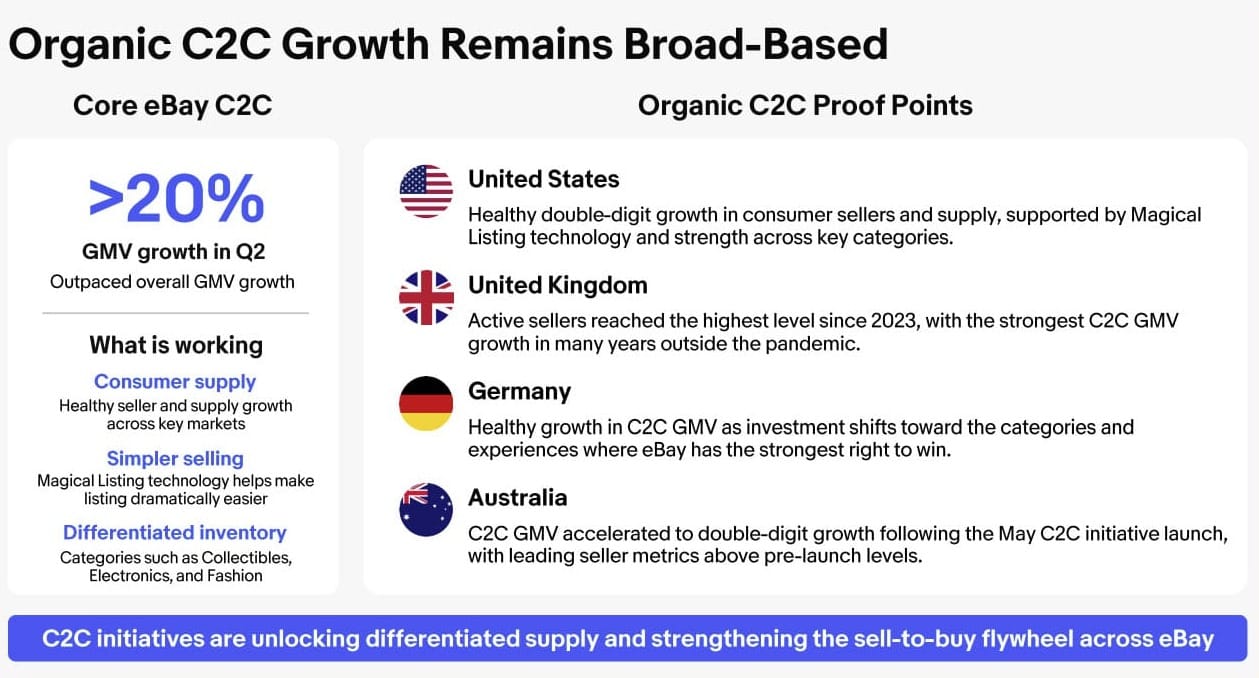
Core eBay C2C GMV grew more than 20% during the quarter, outpacing the marketplace as a whole.
The company reported double-digit growth in US consumer sellers and supply, while UK Active Sellers reached their highest level since 2023. Australia also moved into double-digit C2C GMV growth following the May launch of eBay’s latest consumer-selling initiative.
Management credited Magical Listing with faster listing times, stronger repeat behavior and more sold items and GMV per listing attempter, but provided no percentages or baseline figures for any of those claims.
Iannone said the latest version is now available to new and reactivated sellers in the UK and Germany and is being tested more broadly with Australian C2C sellers, but did not give a schedule for wider availability.
eBay’s investor presentation was more confident than the experience VAR found in testing, where the tool could still misidentify products and require substantial manual correction.
 Liz Morton
eBay did not disclose how much revenue has been lost through fee-free private selling in the UK and Germany, how much is being recovered through buyer fees and shipping, or how heavily the company is subsidizing new seller and buyer activity.
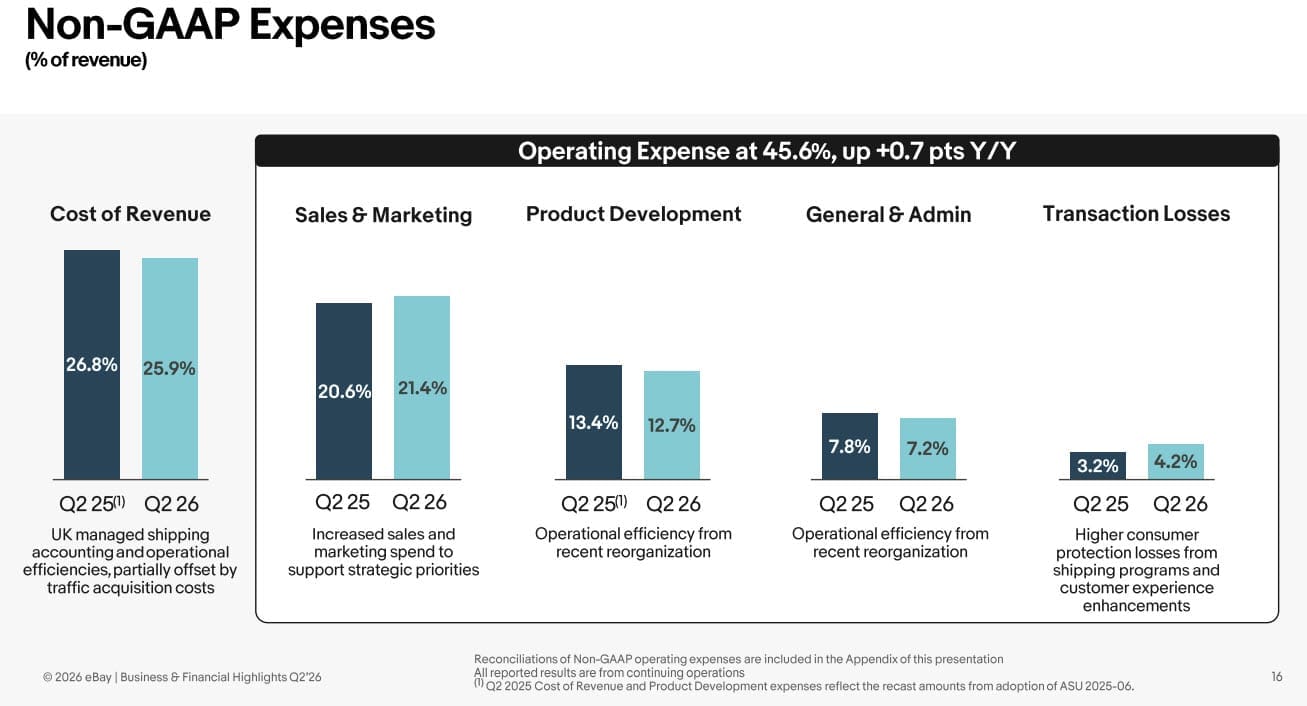
Sales and marketing expense rose from 20.6% to 21.4% of revenue as eBay increased spending to support these strategic priorities.
During the earnings call, Iannone said eBay currently has no plans to bring similar fee changes to the US marketplace. The wording leaves the door open to future changes, but for now US sellers should not expect the international buyer-fee model to be rolled out domestically.
Shipping
Shipping is becoming a larger part of both eBay’s buyer experience and its revenue strategy.
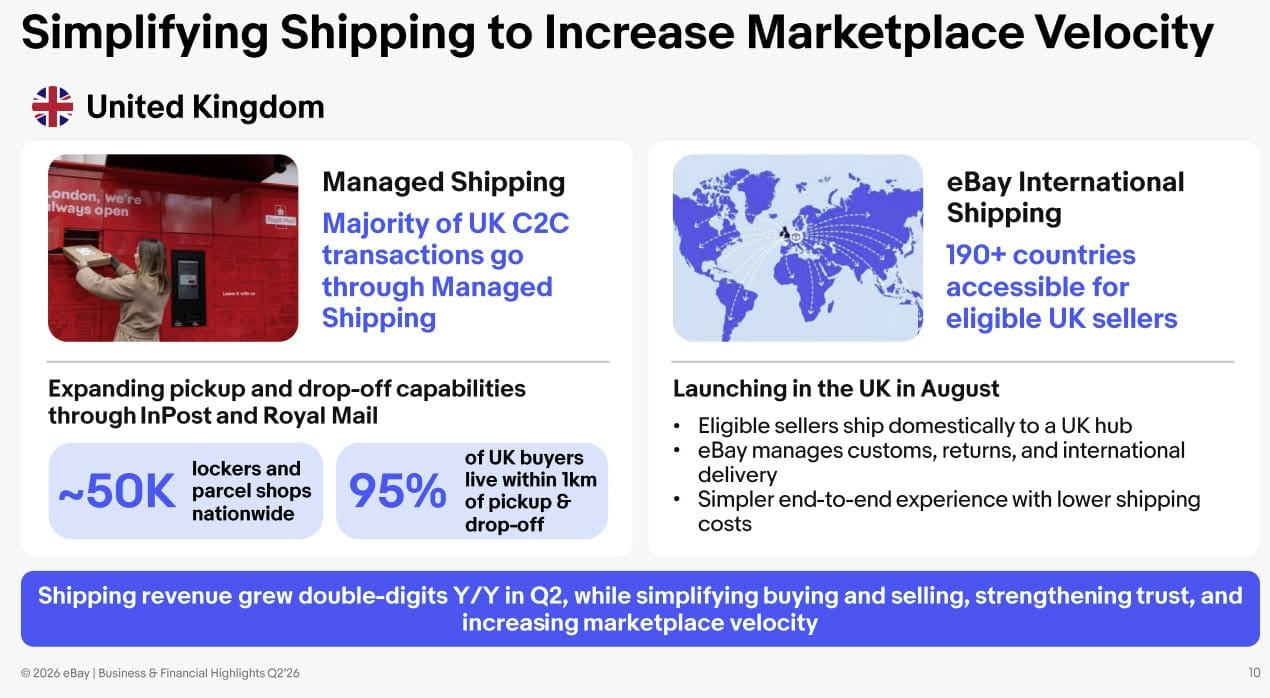
Shipping revenue grew double digits year-over-year in Q2, and eBay says the majority of UK C2C transactions are now processed through Managed Shipping.
eBay International Shipping is also launching in the UK, allowing eligible sellers to send orders to a domestic hub while eBay handles customs, international delivery and returns. The service will provide access to buyers in more than 190 countries.
eBay’s presentation explicitly identifies advertising, shipping and payments as positive contributors to take rate in Q3. These programs are often presented as efforts to simplify buying and selling, but they also allow eBay to collect revenue from more parts of the transaction beyond the traditional final value fee.
Management did not address the limited Managed Shipping test currently running in the US.
 Liz Morton
Transaction losses rose from $86 million in Q2 2025 to $133 million this quarter, an increase of almost 55%, which eBay attributed to higher consumer protection losses from shipping programs and customer experience enhancements.
As a percentage of revenue, non-GAAP transaction losses increased from 3.2% to 4.2%. Management said losses improved sequentially from Q1, but did not break down which shipping, protection or customer-service programs drove the increase.
eBay Live
eBay Live posted another record quarter, with GMV growing approximately eight times year-over-year.
eBay also said more than 90% of established Live sellers increased their total marketplace GMV, while first-time Live buyers in Collectibles spent about 70% more than a comparison group.
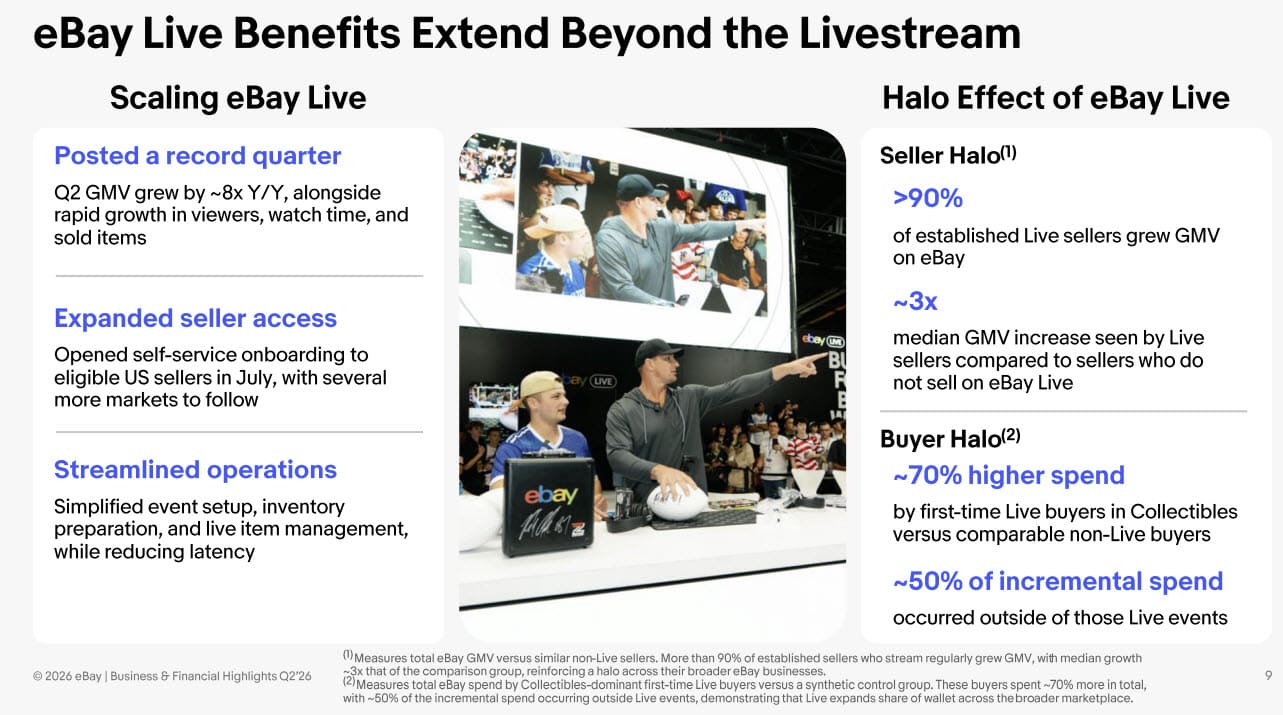
Despite those figures, eBay still did not disclose total Live GMV, active buyers or sellers, revenue, profitability or its share of the marketplace.
 Liz Morton
Iannone also said self-service onboarding opened to eligible US sellers in July, though eBay’s public help page still describes an application and approval process for select sellers.
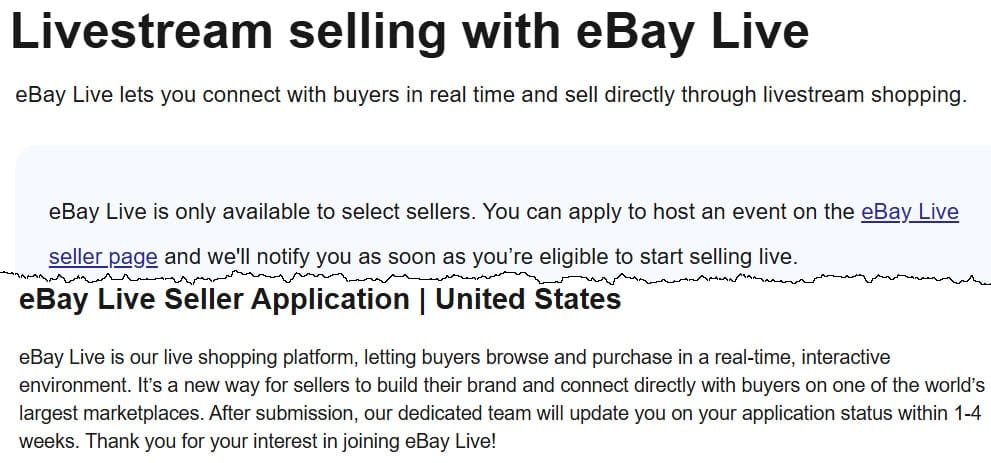
That may mean “self-service” applies only after eBay has approved a seller, rather than representing open enrollment. Until eBay explains the eligibility requirements and approval process, the claimed expansion appears more limited than the phrase suggests.
Depop
eBay completed its acquisition of Depop on July 30, after the end of the quarter.
While the announced deal value was $1.2 billion, eBay ultimately paid approximately $1.4 billion in cash, including preliminary purchase price adjustments that are still subject to finalization.
eBay says it plans to maintain Depop’s separate brand, community and product experience while applying its own capabilities in areas like shipping, trust, safety and customer reach.
The acquisition is expected to increase consolidated Q3 FX-neutral GMV growth by about 2.5 percentage points and revenue growth by approximately 1.5 points.
However, Depop will also create a three-to-four-point headwind to non-GAAP operating income growth and mid-single-digit dilution to non-GAAP EPS growth during the quarter.
Comparisons with Depop’s results under Etsy will require caution because eBay’s GMV definition will include buyer and shipping fees and will not be directly comparable with Etsy’s previously reported GMS. Roughly a quarter of the low end of Q3 consolidated GMV growth will come from adding Depop rather than organic marketplace growth.
In an indirect nod to concerns which led analysts to downgrade the stock ahead of earnings, Alford said some of the investment in Depop will come from existing eBay C2C and fashion marketing budgets rather than entirely new spending.
 Liz Morton
That may limit how much incremental marketing expense Depop adds, but it also means at least some Depop spending will come from budgets that had supported eBay’s own C2C and fashion businesses.
eBay also plans to invest in making shipping more affordable on Depop. CFO Peggy Alford said a significant portion of that spending will be recognized as contra-revenue and that the company is testing tiered incentives intended to reduce buyers’ total purchase costs and improve conversion.
The price is still difficult to square with Depop’s financial performance under Etsy. Depop generated about $186.6 million in revenue in 2025 but posted a $108.9 million operating loss, with marketing expense alone exceeding gross profit. Based on eBay’s roughly $1.4 billion cash payment, that works out to about 7.5 times annual revenue for a business that is still losing money.
eBay may be able to improve the economics through its scale, shipping and advertising products, but Depop will dilute earnings in the near term and is expected to become accretive to non-GAAP operating income in 2028.
On Depop’s current numbers, eBay paid a steep price for a business that still needs several years of improvement before it contributes to earnings.
GameStop Bid Goes Unaddressed
One major issue hanging over eBay was absent from both the prepared remarks and analyst questions.
eBay’s board rejected GameStop’s unsolicited $125-per-share cash-and-stock proposal in May, but GameStop has continued pursuing the company and has since increased its reported stake to approximately 9.8%.
The earnings beat gives eBay more evidence that its current strategy is producing results, though it does not answer Cohen’s broader criticism of the company’s costs and long-term execution.
It also raises the question of why it took six years under Iannone to produce this level of growth - and whether the improvement can be sustained.
Management offered no update on the proposal during the earnings call, leaving shareholders without any new indication of how eBay plans to respond if Cohen escalates the campaign.
Outlook
Following the Q2 outperformance and completion of the Depop acquisition, eBay raised its full-year outlook.
The company now expects:
- FX-neutral GMV growth of 11.5% to 12.5%
- FX-neutral revenue growth of 11% to 12%
- Non-GAAP operating income growth of 10% to 12%
- Non-GAAP EPS growth of 10% to 12%
- Approximately $2 billion in share repurchases
For Q3, eBay expects FX-neutral GMV growth of 10% to 12%, but only 7% to 9% organically once Depop is excluded. Revenue is expected to show the same split.
Management cited tougher comparisons in Pokémon, Klarna, bullion and prior marketing gains, while Depop will add nearly nine million buyers and lift reported GMV and revenue.
That means eBay’s headline growth may remain strong even as the underlying comparisons become harder to read. Q2 showed real improvement in the core business; beginning next quarter, separating that improvement from acquisition growth will be the more important number.