eBay Promotes Existing Magical Listing AI As "New," Then Backtracks With Revised Press Release

eBay is generating another round of headlines about supposedly new Magical Listing AI technology with a press release promoting features that have already been available for months, as more sellers are forced into the camera-first listing experience and continue reporting the same accuracy and workflow problems that have plagued previous rollouts.
The November 11 announcement, originally titled "eBay makes selling easier with a new camera-first experience," describes technology that allows sellers to simply take pictures of an item and have AI automatically identify it, fill in listing details and create a draft for review before publishing.
There's just one problem - that's exactly what eBay announced during its Q4 2025 earnings call in February 2026, when CEO Jamie Iannone touted the next generation of Magical Listing as "a true breakthrough."
After receiving a promotional pitch about the supposedly new experience from eBay's outside PR firm Edelman, Value Added Resource asked what had actually changed from the version that had been available since February, specifically questioning whether there had been improvements to functionality, accuracy or listing workflow, or if the announcement was primarily about expanding availability of the existing tool.
The representative responded, "This week's announcement focuses on expanding availability of the next-generation Magical Listing experience to more sellers."
The company subsequently revised the press release, changing its original headline to "eBay makes selling easier with enhanced camera-first experience," along with similar wording in the body. A version archived at 6:20 PM Eastern still described the technology as a "new magical listing experience" and a "new camera-first listing experience," but those references have since been removed as well.
The changes were made without any correction or update notice acknowledging the original language had been revised.
Iannone first demonstrated Magical Listing to investors in September 2023, promising sellers would be able to "just take a picture and let AI do the rest." The mocked-up demonstration showed AI identifying a product from an image and automatically generating the title, description and other listing details, but it took another year and a half before eBay finally began rolling out the technology to sellers in March 2025.
 Liz Morton

Even then, the actual experience fell short of what had been promised, requiring sellers to manually enter a title or keywords before the AI could attempt to identify the product and fill in additional information. Testing the tool at the time revealed it struggled with item identification, inaccurate category recommendations and irrelevant product matches.
During the February 2026 earnings call, Iannone announced what he called a true breakthrough, saying the next generation of Magical Listing would move beyond adding AI functionality to existing listing workflows and instead use AI agents to autonomously build listings from images alone.
That actually was a meaningful change from the previous version, eliminating the requirement for sellers to provide a title before AI could generate the listing. Subsequent testing found the redesigned experience was generally better and more functional than the original implementation, although its ability to correctly identify products remained inconsistent and some supposedly automated tasks still required manual intervention.
 Liz Morton

The international rollout touted in this week's announcement isn't new either. During eBay's Q1 earnings call in April, Iannone said the next-generation experience was already being expanded to new and reactivated sellers in Germany, following its initial US launch. By the Q2 earnings announcement in August, eBay had expanded it to new and reactivated sellers in the UK, Germany and Australia, with Australia becoming the first market to make the experience available to all consumer-to-consumer sellers.
On October 28, eBay reported that the technology had reached all new and reactivated sellers in the US, UK, Germany, Australia, France and Italy, with all nonprofessional sellers in Australia, France and Italy also receiving access. The company said it was continuing to expand the tool to established seller groups in the US, UK and Germany.
eBay's original November 11 press release, framing the months-old feature as a new experience, has already carried over into media coverage, with investor-focused GuruFocus reporting an "AI-Powered Listing Upgrade" and Seeking Alpha describing a new feature to do the "heavy lifting" for sellers. Marketplace industry publication ChannelX similarly promoted a "New Camera-First Experience," closely following the language of eBay's announcement.
The release also recycles previously disclosed AI usage statistics, claiming more than 10 million unique sellers have used eBay's AI features and more than 800,000 new listings are being created with AI every day, without clarifying that those figures encompass the company's broader range of AI tools rather than the specific camera-first Magical Listing experience being promoted.
A seller who uses eBay's AI-powered background removal or enhancement tools can contribute to those aggregate figures without ever using Magical Listing, as can sellers who use the traditional listing form and select the option to generate a description with AI. And even if eBay disclosed how much of that usage was specifically attributable to Magical Listing, it wouldn't establish whether sellers actually prefer the experience when the company is forcing more accounts into the camera-first workflow in the app without an obvious way to opt out except switching to the desktop web listing flow.
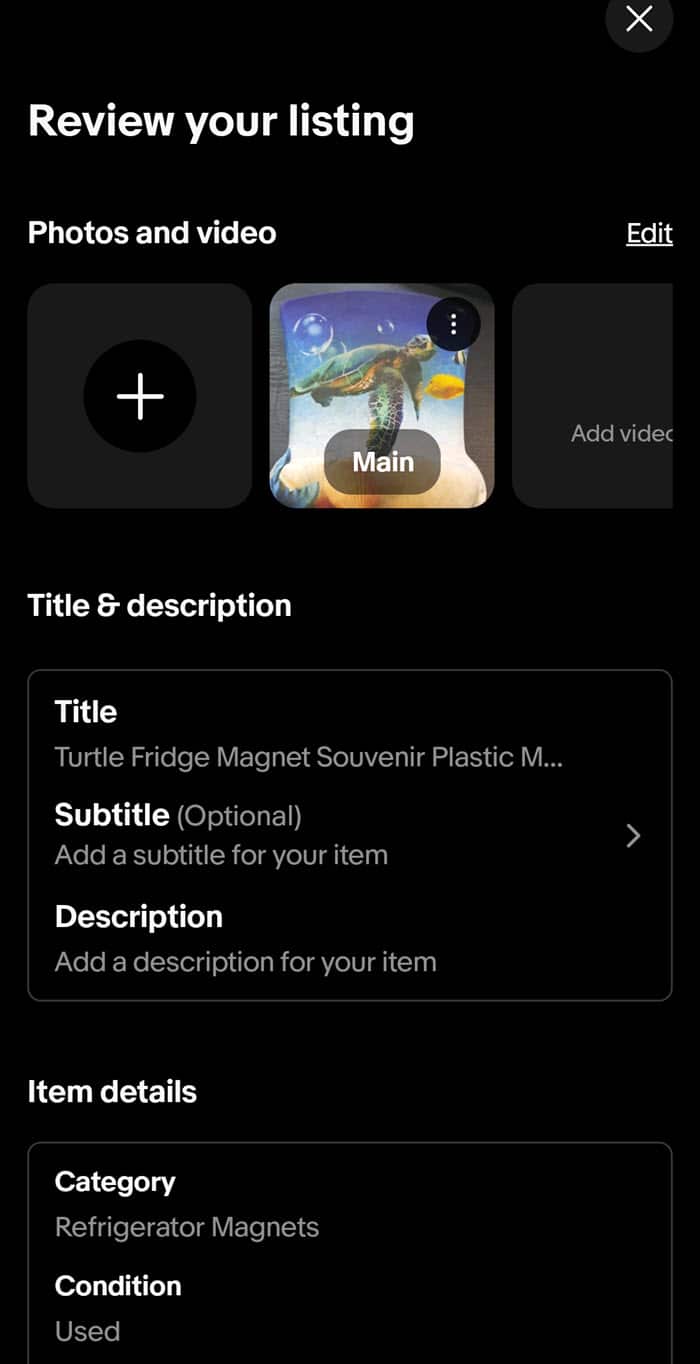
When testing the next-generation Magical Listing in February, the AI initially identified a sea turtle-themed mousepad as a ceramic decorative plaque, generating an incorrect title and item details based on that identification. After deleting the draft and trying again with a different photo of the same item, eBay instead decided it was a refrigerator magnet.
Testing that same item again on November 11 produced almost identical incorrect results, with eBay once again identifying the mousepad as a turtle refrigerator magnet, automatically generating a title reflecting that wrong identification and selecting the Refrigerator Magnets category. The AI correctly suggested the condition was Used, but the description field was still blank, requiring the seller to manually correct the information and complete the listing despite the company's claims that the technology eliminates manual data entry.

Those accuracy problems have practical consequences for sellers who are being moved into the experience whether they want to use it or not, and another round of complaints appeared on Reddit on November 10 from sellers who said they suddenly found themselves unable to create listings through their usual mobile workflow. Some reported the AI generating inaccurate information or selecting incorrect categories, while others complained about having to make additional corrections or find workarounds to access familiar listing features.
These reports closely mirror the complaints Value Added Resource documented during earlier expansions in August and September, when established sellers said the camera-first process was being forced on them without warning, disrupting listing routines they had already developed and sometimes creating more work instead of saving time.
 Liz Morton

The September complaints coincided with Iannone telling investors at the Goldman Sachs Communacopia + Technology Conference that Magical Listing was responsible for 50% more listings per lister in the US, a metric that says nothing about whether sellers actually prefer the experience or how much time they spend correcting AI-generated mistakes.
 Liz Morton

For a company that has been promising sellers they can simply take a picture and let AI do the rest since 2023, eBay has been more successful at repeatedly repackaging Magical Listing as something new than getting the technology to consistently deliver on that promise.