Mercari US Growth Stalls As Rival Shipping Promotions Hit Fashion Sales

Mercari US Gross Merchandise Volume (GMV) growth slowed to just 0.3% in the first quarter of fiscal 2027 (July–September 2026) as aggressive shipping promotions from competing resale marketplaces hurt fashion sales, putting the company behind its growth targets just three months after reporting signs of a turnaround.
According to financial results released November 12, US GMV reached $194 million for the quarter ended September 30, down from $208 million and 15% year-over-year growth in the previous quarter. Monthly Active Users (MAU) declined 2% year-over-year to 4.2 million, reversing the 4% growth reported in Q4, while revenue increased 3.7% to ¥9.9 billion and core operating profit fell to ¥91 million, compared to approximately ¥400 million in Q4 and ¥600 million in the year-ago quarter.
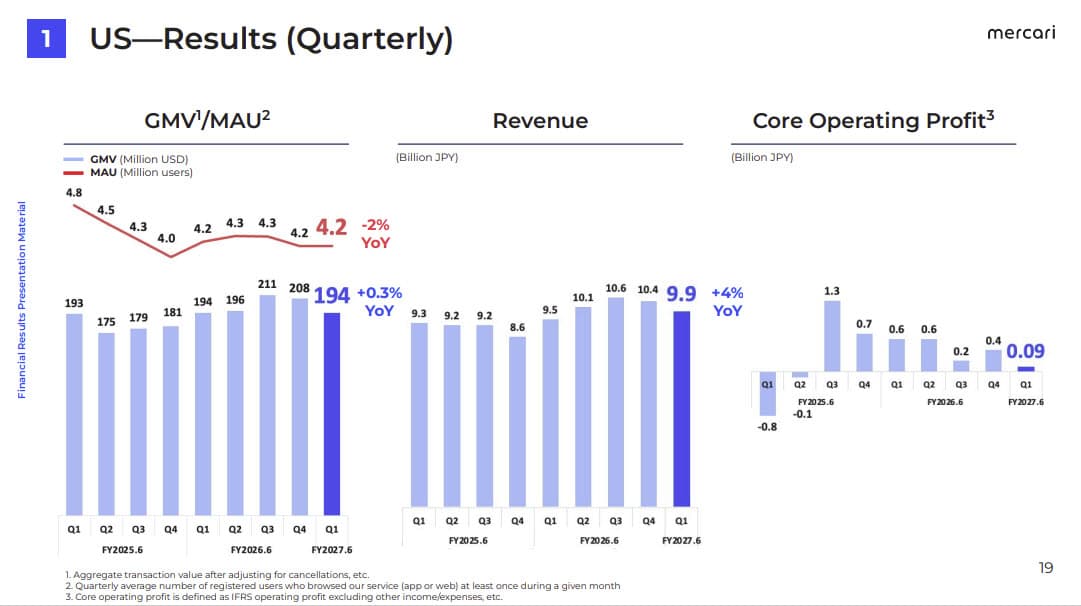
Mercari had finally begun showing simultaneous growth in GMV and active users after more than two years of fee changes, layoffs and leadership turnover. The company closed fiscal 2026 with an 11% increase in full-year GMV to $810 million and its second consecutive profitable year, though sales volume remained approximately 20% below the $1.015 billion recorded in fiscal 2023.
 Liz Morton

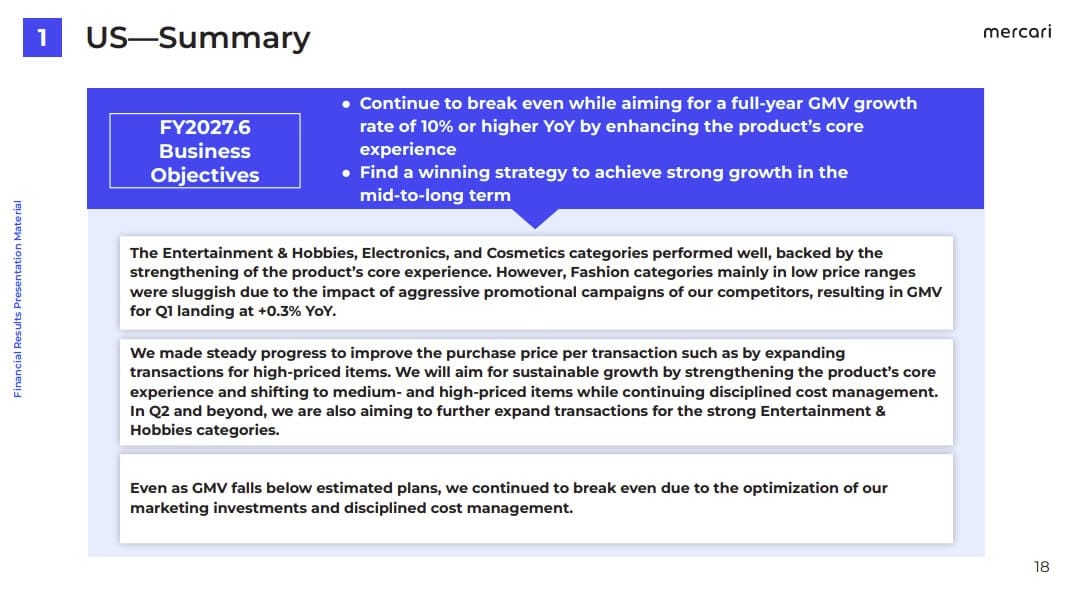
Mercari entered fiscal 2027 targeting at least 10% US GMV growth while maintaining roughly break-even profitability, but management acknowledged in its latest earnings Q&A that the business is already falling short of expectations.
The GMV growth rate for Q1 is virtually flat YoY, and Mercari US is behind on its targets. Although Entertainment & Hobbies, our major category, continued to perform well, the Fashion categories were impacted by our competitors' promotional campaigns more than what we had expected.
Mercari said competitors began offering aggressive shipping promotions partway through the previous quarter, with the impact continuing throughout all three months of Q1. Rather than matching those discounts across the board, management said it "narrowed our focus down to the categories that we could expect to yield results while carefully assessing return on investment."
While Mercari did not identify the competitors by name, Vinted and Depop have spent much of 2026 offering free and deeply discounted US shipping, particularly on lower-priced secondhand fashion purchases where delivery charges can make up a significant portion of the buyer's total cost.
Vinted began offering widespread free shipping in March before shifting many existing buyers to $0.99 rates in August, followed by more variable pricing in September that still offered delivery starting as low as $0.49 through SpeedX. Depop similarly offered widespread free shipping in May, discounted rates beginning in July and another $0.99 promotion in September for qualifying purchases under $10.
 Liz Morton

eBay completed its $1.4 billion acquisition of Depop in July and says its existing carrier agreements have already lowered Depop's shipping costs, with CFO Peggy Alford acknowledging during the company's October earnings call that shipping subsidies are reducing Depop's reported take rate. eBay is also developing a lower-cost pickup and drop-off network for its core marketplace and Depop, specifically targeting cheaper delivery options that could increase sales of lower-priced merchandise.
During ThredUp's recent Q3 earnings call, CEO James Reinhart criticized what he called "wholly irrational" spending by peer-to-peer resale rivals, estimating that competitors could spend as much as $500 million on marketing and order subsidies in the second half of 2026 alone, plus additional shipping subsidies.
 Liz Morton

Reinhart specifically pointed to Vinted and Depop, though ThredUp did not disclose the underlying data for its spending estimate or provide a breakdown by competitor. Despite those pressures, ThredUp reported 20% year-over-year GMV growth in Q3, compared with Mercari's virtually flat performance.
Mercari itself credited shipping discount promotions with helping drive its fiscal 2026 recovery. During the company's August earnings presentation, management identified category-specific marketing, shipping discounts and strong Entertainment & Hobbies demand as contributors to double-digit GMV growth, while discussing the difficulty of making lower-priced purchases economical when shipping costs represent such a large portion of the transaction.
In September, the company introduced free First-Class Envelope shipping for eligible trading cards and paper collectibles weighing up to one ounce, while extending its existing discounted 49¢ rate for qualifying two- and three-ounce shipments through January 4, 2027.
 Liz Morton

Mercari subsequently increased prepaid shipping rates across USPS, UPS and FedEx effective October 19, including significant increases to some discounted Best Rate options, before launching a separate free holiday shipping promotion on qualifying purchases of $50 or more beginning October 22.
 Liz Morton

The holiday offer applies to eligible individual items and bundles from the same seller weighing up to five pounds, encouraging larger orders rather than matching competitors' deeply discounted shipping on inexpensive individual purchases. Mercari is also bringing back its Fashion Exchange program for the holidays, allowing buyers to return qualifying clothing, shoes and bags for Mercari credit while sellers still receive their full payment.
Those changes occurred after the September quarter ended and did not affect the reported results, but they reflect priorities Mercari established in August, including increasing average purchase amounts and encouraging bundles. In its latest earnings presentation, the company said it has made progress increasing purchase prices per transaction and will continue focusing on medium- and higher-priced merchandise and its stronger Entertainment & Hobbies categories.
Mercari US remained marginally profitable despite missing its GMV targets, with core operating profit of ¥91 million, but that was substantially below the previous quarter and year-ago period.
According to the company's consolidated financial filing, US delivery revenue declined from ¥5.36 billion to ¥5.22 billion year-over-year, even as total US revenue increased from ¥9.56 billion to ¥9.92 billion. Revenue excluding delivery increased approximately 12%, though Mercari does not separately explain how much of that change came from marketplace fees, transaction mix or other factors.
Mercari recognizes delivery revenue at the full amount collected from customers, with delivery accounting for more than half of reported US revenue. Its 10% seller fee and 3.6% Buyer Protection fee are also calculated on the item price plus buyer-paid shipping, allowing higher shipping charges to generate additional fee revenue even without an equivalent increase in merchandise sold.
In Japan, marketplace GMV increased 22.8% year-over-year to ¥332 billion, supported by strong Entertainment & Hobbies sales and continued cross-border growth. Mercari's consolidated revenue increased 27.5% to ¥63.1 billion, while core operating profit rose nearly 60% to ¥15 billion.
Mercari has maintained its US objective of at least 10% GMV growth for fiscal 2027, with management saying it will update its guidance as necessary depending on competitive conditions. Reaching that target would require approximately 13% year-over-year GMV growth across the remaining three quarters combined, compared with just 0.3% in Q1.