Mercari US GMV Up 15% As Active Users Return To Growth

After more than two years of fee changes, layoffs and leadership turnover, Mercari US closed fiscal 2026 with a combination it has struggled to deliver during the turnaround: GMV and active users both grew year over year in Q4.
US marketplace GMV increased 15% to $208 million, while Monthly Active Users reached 4.2 million, up 4% from the year-ago quarter. Revenue increased 21% to ¥10.4 billion and the US business posted ¥400 million in core operating profit.
When Value Added Resource looked at Mercari US results in February, GMV was already improving, rising 12% year over year, but MAU was still down 4%. Mercari was getting more transaction volume from a smaller active audience, leaving user growth as a missing piece of the recovery.
 Liz Morton
Q4 finally put MAU back into positive year-over-year territory, though activity softened slightly from the previous quarter. GMV dipped from $211 million in Q3 to $208 million, MAU moved from 4.3 million to 4.2 million and revenue slipped from ¥10.6 billion to ¥10.4 billion. Core operating profit improved from ¥200 million to ¥400 million.
For the full year, Mercari US GMV reached $810 million, up 11%, while US revenue increased 12% to ¥40.7 billion and core operating profit more than doubled to ¥2 billion. Mercari credited improvements to the core marketplace experience, category-specific CRM marketing, shipping discount promotions and strong demand in Entertainment & Hobbies.
Mercari said recent product changes delivered results faster than expected, helping the US business meet its guidance while remaining profitable.
Fiscal 2026 also marks a second consecutive profitable year for Mercari US after years of losses, though the marketplace has not yet recovered the scale it had before the downturn.
Full-year GMV remains well below the $1.015 billion recorded in fiscal 2023, before dropping to $913 million in 2024 and $728 million in 2025. This year's $810 million recovers some of that lost ground, but still leaves Mercari US roughly 20% below where it was three years ago.
The recovery follows a turbulent stretch for Mercari US, beginning with its 2024 decision to shift fees from sellers to buyers. The change sparked complaints about higher checkout costs and abandoned carts without producing the growth Mercari had hoped for.
The company later laid off 45% of its US staff, former CEO John Lagerling resigned and Mercari changed the fee structure again in January 2025, splitting fees between buyers and sellers.
Entertainment & Hobbies continues to drive much of the improvement, particularly collectibles and trading cards, while fashion has also been a focus.
Mercari specifically credited shipping promotions with helping fiscal 2026 results and has offered several temporary discounts on prepaid labels. The company also recently announced it will absorb half of the new $50 USPS HAZMAT noncompliance fee, leaving affected sellers responsible for $25.
 Liz Morton
Shipping can be a particular problem on lower-priced items, where postage makes up a large share of the buyer's total cost.
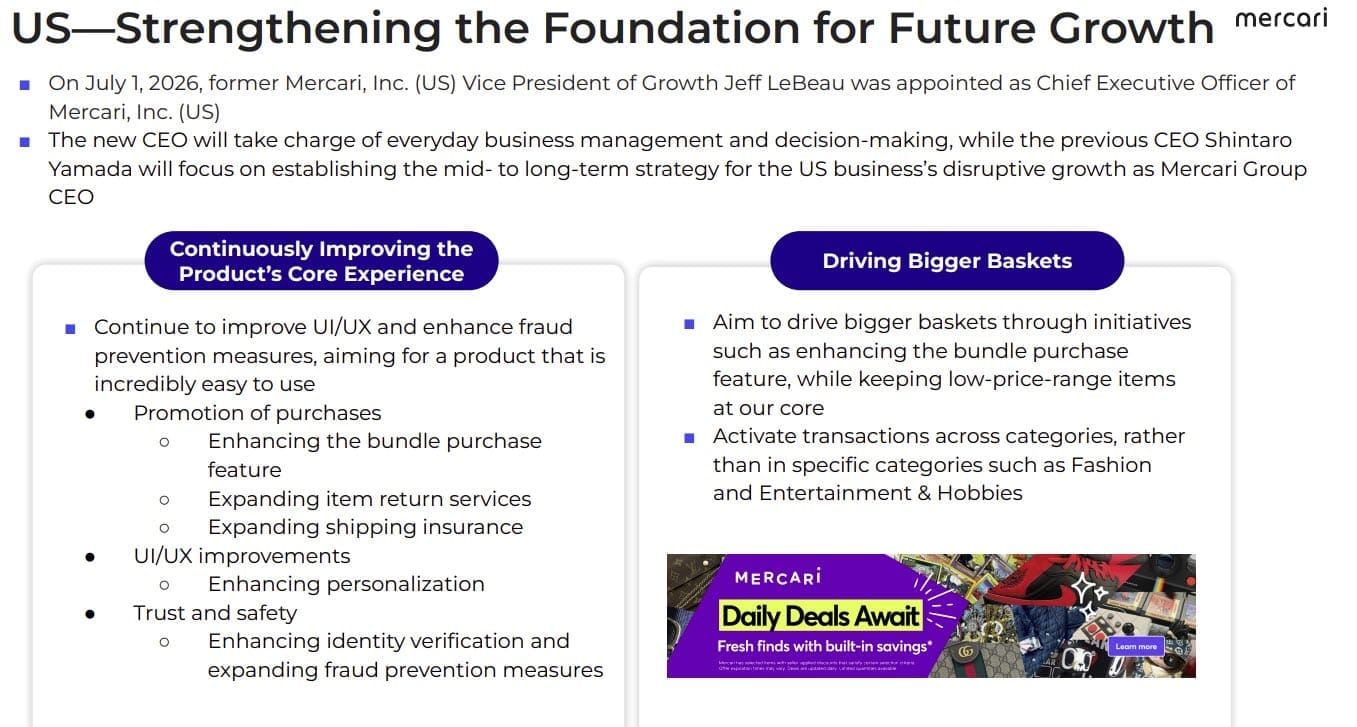
Increasing average purchase amount is one of Mercari's priorities for fiscal 2027. The company is targeting at least 10% US GMV growth while continuing to operate around break-even, with improvements to the core marketplace experience also among its main priorities.
Management provided more detail during the earnings Q&A, discussing bundle purchases as a way to spread shipping costs across multiple items instead of paying separate shipping costs on each lower-value purchase.
eBay has been pursuing a similar strategy, recently adding Bundle Discounts to encourage buyers to purchase multiple items in one order.
Mercari wants to generate more activity outside the Entertainment & Hobbies and fashion categories that have received much of its recent attention.
On the product side, smaller AI-assisted teams will work on new features and updates to the US UI and UX, along with continued improvements to customer service and fraud prevention.
While fiscal 2027 guidance calls for at least 10% GMV growth, management said during the Q&A that it eventually wants the US business growing 20% to 30% or more and is exploring partnerships that could accelerate growth.
Jeff LeBeau took over as Mercari US CEO on July 1 after previously serving as Vice President of Growth. Group CEO Shintaro Yamada will focus more on longer-term US strategy, with LeBeau and the local team taking greater responsibility for day-to-day operations and potential partnerships.
 Liz Morton
For sellers, though, stronger GMV and active user numbers only mean so much if they're translating into more sales.
Are you seeing more buyers and sales on Mercari as the company's numbers improve, or has activity stayed about the same for you? Let us know in the comments below.