Vinted Expands Third-Party Display Ads Across US Marketplace

Vinted is expanding third-party display advertising across its US marketplace, with shoppers reporting ads appearing between product listings, in messages and other areas of the app.
Shoppers began reporting the new placements in late October with one user sharing a screenshot of a Campbell's Chunky soup ad positioned just above the bottom navigation bar in their message notifications, complaining that it was too easy to accidentally click. Others reported seeing ads for fast-fashion retailer Shein or encountering video advertisements that interrupted audio playback on their phones, while some said they hadn't seen any advertising at all. Not everyone objected to the change, with one commenter saying they were willing to tolerate the ads "if it keeps shipping low."
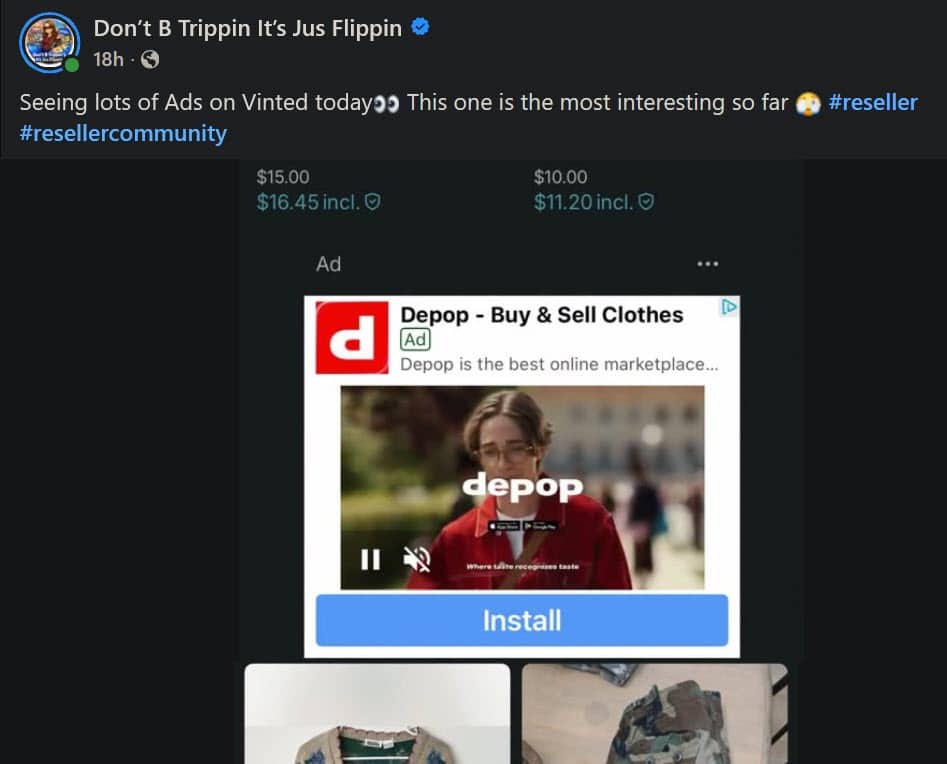
More reports surfaced this week, including advertisements for rival resale marketplace Depop appearing directly among Vinted's clothing listings. A screenshot shared on Facebook shows a Depop video ad with a prominent Install button, encouraging shoppers to download the competing app even as Vinted and Depop continue their aggressive battle for US buyers and sellers through free and discounted shipping promotions.
Vinted has been actively seeking advertisers for its US expansion, with a dedicated advertising inquiry page and a recent Ad Operations Manager job listing describing an advertising team selling programmatic inventory across its apps and websites. Company employees have been sharing a LinkedIn post touting Vinted's position as the number one free app in the US App Store and inviting brands and agencies to reach its growing audience.
We're launching Vinted Ads in the US: agencies and advertisers, let's talk.
By contrast, rival eBay has spent years deliberately reducing third-party display advertising while building a much larger business around seller-paid promotion of merchandise already listed on its own marketplace.
During eBay's Q1 2019 earnings call, then-CEO Devin Wenig said the company was reducing third-party ads as Promoted Listings expanded, describing the outside advertising as "not accretive to our ecosystem." Interim CEO Scott Schenkel reiterated in Q3 2019 that third-party display ads would continue declining as eBay prioritized its first-party advertising business.
At eBay's March 2022 Investor Day, CEO Jamie Iannone said the company had retired legacy ad products that "compromise the buyer experience," while VP Advertising Alex Kazim specifically credited Promoted Listings with allowing eBay to reduce its reliance on third-party ads that "take buyers off the site."
eBay's own financial results show how dramatically that advertising business has changed. In 2019, the company generated $313 million from what it then classified as "other ads," consisting primarily of third-party display and text advertising, according to historical figures published by eBay. By 2025, annual third-party advertising revenue had fallen to just $30 million, and the decline has continued, with Q3 2026 results showing just $4 million, down 44% year-over-year, compared to $575 million from first-party advertising.
That shift hasn't meant fewer ads competing for shoppers' attention on eBay, or less pressure on sellers to pay for visibility. Nearly 1.3 billion of the marketplace's 2.7 billion listings are now promoted, approximately six million sellers use at least one advertising product, and eBay recently introduced an AI-powered system that dynamically adjusts ad density in search results. While those ads promote merchandise sold on eBay rather than directing shoppers to outside advertisers, they also create more paid competition for placement among sellers already using the marketplace.
eBay's emphasis on keeping shoppers within its own marketplace has become more complicated following its acquisition of Depop. The company is now inserting Depop listings directly into eBay search results, sometimes above sponsored placements that independent sellers must pay additional advertising fees to access. Shoppers following those listings may end up completing their purchases on Depop rather than eBay, but the transactions still benefit the same parent company.
Vinted is expanding its advertising business beyond the new display placements, announcing on November 12 that it's bringing its existing post-purchase advertising partnership with Rokt into the US, following earlier rollouts in the UK and six European markets. Rokt uses machine learning and Vinted's first-party customer data to select personalized offers from outside brands after a buyer completes checkout. Vinted says the integration has been used across hundreds of millions of European transactions, generating an average customer engagement rate of 4%.
The companies began testing the service in 2023, before publicly announcing it in August 2024, when Rokt explicitly connected the additional advertising revenue to supporting Vinted's low-cost marketplace model.
But not all US shoppers are convinced the additional advertising will help keep costs down. "I hoped when I saw ads on the app that they would be returning back to lower and consistent shipping rates," one user wrote last month. "Now that they've raised them and increased their fees and reduced the amount of time you have to ship, we have to deal with ads on top of it?"