USPS Proposes New 20% Postage Error Fee, Expands Package Compliance & Nonstandard Charges

The US Postal Service is proposing a new fee that would add 20% to postage underpayments caused by inaccurate package weights or dimensions, while withholding the same percentage from refunds when shippers overpay.
The new Repricing Fee was not mentioned in USPS's November 12 press release, which focused on average domestic shipping increases of 5.9% and plans to replace the temporary 8% transportation-related increase with a permanent fuel surcharge starting at 11%. But the full regulatory filing reveals additional changes that would increase the cost of postage errors and shipping label compliance for Priority Mail Express, Priority Mail, USPS Ground Advantage and Parcel Select customers beginning January 17, 2027.
Under the proposal, USPS would collect an additional 20% of the postage difference when incorrect weight or dimension information results in an underpayment, while deducting the same percentage when an overpayment is identified. For example, a seller who underpaid postage by $5 would owe $6 after the additional fee, while a seller who overpaid by $5 would receive only a $4 refund, subject to existing USPS refund rules and limitations.
USPS says the fee is intended to encourage shippers to provide accurate package information and compensate the agency for administrative costs associated with correcting postage discrepancies.
The Postal Service has operated its Automated Package Verification (APV) system since 2017, using automated equipment to compare package weights and dimensions against the information submitted when shipping labels are purchased, then collecting additional postage or issuing refunds when discrepancies are identified. APV has collected more than $1.4 billion in underpaid postage and issued approximately $300 million in overpayment refunds since the program began, generating roughly $1.1 billion in net additional revenue for USPS.
In January, USPS proposed requiring accurate dimensions for all covered commercial parcels included in electronic shipping manifests, regardless of size, expanding requirements that previously applied primarily to packages exceeding one cubic foot or 22 inches in length.
Those requirements affect sellers purchasing labels through marketplaces like eBay, Etsy and Amazon, as well as third-party shipping services, since the commercial shipping manifests submitted by those providers must contain the required package information even when an individual seller isn't submitting the data directly to USPS.
Following objections from commercial shippers, USPS split implementation into two phases, with the expanded dimension-reporting requirement taking effect July 12 and broader enforcement of the existing $3 Dimension Noncompliance Fee delayed until 2027 while the agency addressed concerns about measurement accuracy, equipment certification, dispute procedures and other technical issues.
 Liz Morton
The November filing now proposes restructuring that fee, renaming it the Dimension and Weight Noncompliance Fee and expanding it to cover missing package weights as well as dimensions, regardless of package size. The $3 amount would remain unchanged, but the fee would be limited to missing information in commercial shipping manifests, with inaccurate weights or dimensions resulting in postage corrections instead subject to the new 20% repricing fee.
The filing does not explain whether USPS has finalized the measurement and dispute protocols discussed when expanded enforcement was delayed earlier this year, or how those procedures will apply to the new repricing charges. USPS already has an established process for disputing APV adjustments, but its automated verification systems have also experienced documented problems affecting both additional postage collections and refunds.
A July USPS Inspector General investigation found that a coding error caused APV to ignore millions of package measurements, preventing the agency from identifying an estimated $22.6 million in underpaid postage and $6.1 million in potential refunds between March and May 2026. USPS corrected the error in June.
 Liz Morton
The regulatory filing also introduces a new $5 Shipping Label Noncompliance Fee for commercial parcels bearing incorrect barcode formats or construction that prevent USPS equipment from scanning them. USPS says these barcode problems create additional operational and administrative burdens, though the proposal specifically addresses incorrect barcode symbology or construction rather than every instance of a damaged or unreadable label.
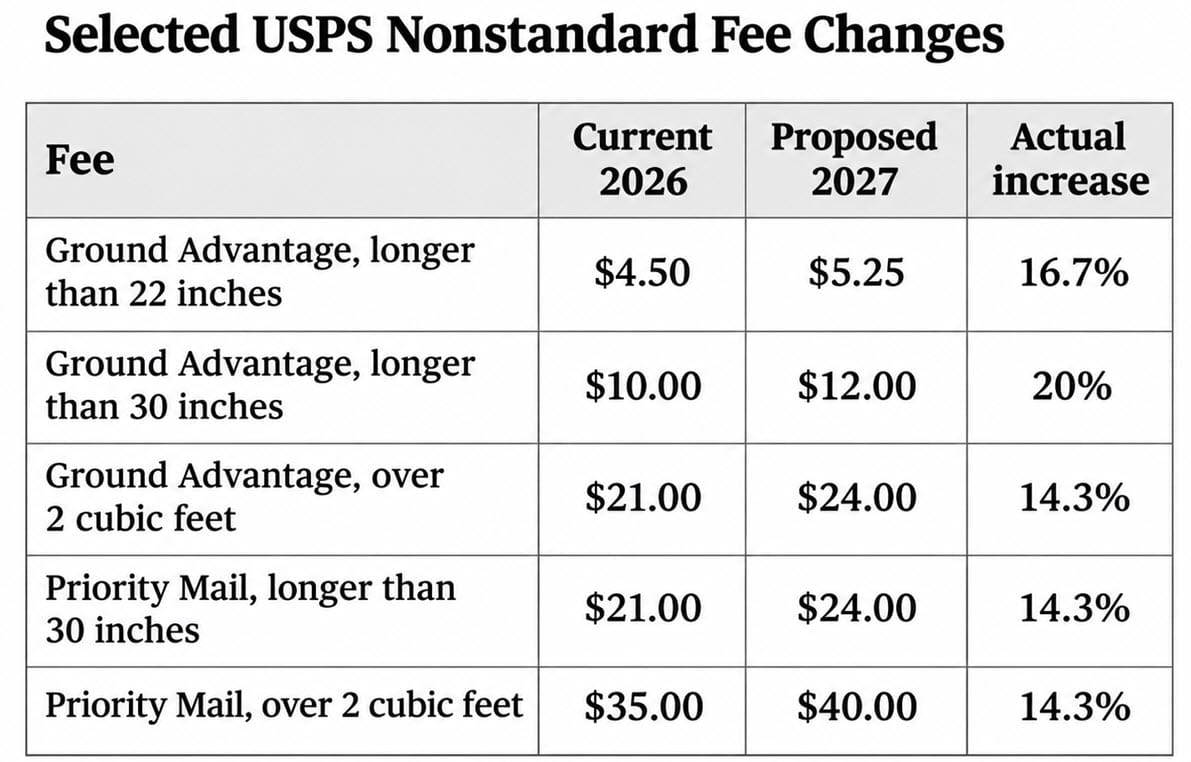
Other proposed increases include doubling the charge for certain nonmailable overweight or oversized packages from $200 to $400, affecting shipments found in the postal network that exceed 70 pounds or 130 inches in combined length and girth. USPS is also raising nonstandard fees for unusually large or difficult-to-handle packages, including increasing the Ground Advantage charge for parcels longer than 30 inches from $10 to $12 and the fee for packages exceeding two cubic feet from $21 to $24.
Online sellers have long been subject to USPS postage adjustments and compliance fees passed through by marketplaces and third-party shipping providers, though individual platforms have historically handled these charges differently. Whatnot recently stopped covering USPS weight-based adjustments while continuing to absorb certain other carrier charges, and Poshmark ended its protection against USPS hazardous materials noncompliance fees in October after previously subsidizing those penalties for sellers.
The additional charges come as USPS is already preparing to raise domestic shipping rates again in January, converting the temporary 8% transportation-related increase into a permanent fuel surcharge initially set at 11%, with plans for weekly adjustments at a later date. The Postal Service has increasingly relied on higher shipping prices to offset declining package volume, reporting a $1.7 billion increase in Shipping and Packages revenue for fiscal 2026 despite handling 359 million fewer packages.
 Liz Morton
The proposed fees and classification changes have been approved by the USPS Board of Governors and remain subject to Postal Regulatory Commission review, with implementation scheduled for January 17, 2027 under Docket No. CP2027-1.