Sellers Learn Hard Lesson As USPS APV Catches Overstated Package Weights

UPDATE 7-24-26
eBay is making more updates to USPS Ground Advantage rates, giving sellers only 1 day notice of increase for 3-5 lb labels purchased through the platform.
 Liz Morton
Online sellers who thought they could game the system on new discounted USPS rates are finding out the hard way how the Automated Package Verification system works as packages with over-declared weights hit with rate adjustments.
The confusion started last week as shippers who purchase labels through eBay, Etsy, and third-party providers like Pirate Ship noticed new steeply discounted rates for 3-5 lb Ground Advantage packages that made these shipments significantly cheaper than lower weight packages.
 Liz Morton
When sellers questioned the rates, label providers confirmed that the new rates were correct and would apply to most packages in that weight range, though it appears to be limited by zip code with some rural areas not receiving the steeper discount.
Importantly, USPS Ground Advantage rates are calculated by the pound and round up for anything over a whole number, so packages that are 1 lb 1 oz - 1 lb 15 oz will be charged the still higher 2 lb rate while packages that are 2 lb 1 oz - 2 lb 15 oz will be charged the now more deeply discounted 3 lb rate.
Predictably, when some sellers realized that it would cost less to ship a 3 lb package than a 1 lb package, they simply changed the entered weight when printing a label to get the lower rate, assuming USPS would not charge for the overstatement.
Also predictably, some of those are now reporting that the APV system which automatically weighs and measures packages in transit caught at least some of those packages and charged them the difference between the lower 3 lb rate and the rate they should have paid for the actual weight.
Some sellers on Reddit and elsewhere are now discussing possible ways to still game the system, including adding additional items or packing material to bring smaller/lower weight packages above 2 lbs to get the lower rates.
It’s official, USPS wants us to actually put rocks in packages
I actually had faith that USPS wasn’t stupid enough to incentivize sellers to make shipping less efficient, but here we are.
I’m sure I’ve got about 50 more of these adjustments on the way. Neighbors will think I’ve gone crazy when I’m out in the yard every day collecting rocks.
IRS will question why bags of river rock are being categorized under shipping materials.
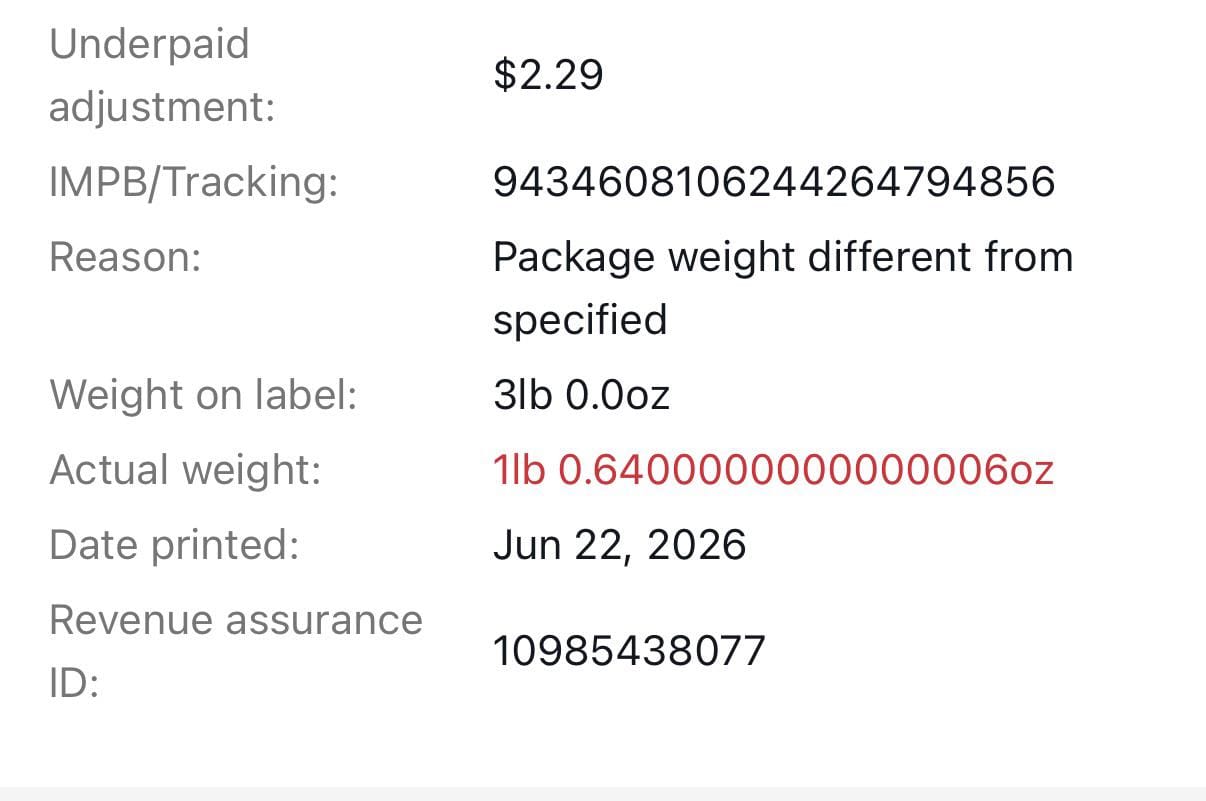
However, adding filler items or additional packing material could risk creating a negative buyer experience - possibly even leading to bad feedback or return requests - leaving sellers like this between a bag of rocks and a hard place.
Sellers in the eBay community forum also noted that Pirate Ship labels for lighter items are showing 3 lbs when the label is printed, but still being charged the correct rate for the lower weight.
 nerdgasmcollectibles
Anyone else having an issue with Pirateship or other shipping service labels with USPS? All of my Ground Advantage packages today were 7 or 8 ounces each and entered in correctly. When the shipping labels printed out on all of them, it says 3 lbs on the labels.
I checked with a clerk at the local post office and they said when they look it up in their system, it is listed as being 3lbs.
The price I paid is correct for the 7 and 8 ounce weights, but I don't want to drop these off as is because I'm not sure if I'll get charged back later for the higher weight even though the packages don't way anything close to what it says on the label.
And some on Reddit noticed the same issue when printing labels from Pirate Ship.
Some people have said pirate ship automatically defaults to the 3 lb rate. If that's true a lot of people are going to be getting shipping adjustments.
But wait, it gets even worse. Starting July 12th, it's going to cost more to ship a 4 oz package than it costs to ship a 3 lb package. That means I either have to figure out how to make these packages weigh 2.1 lb or start using FedEx.
Longtime seller and Reddit/forum contributor WastingTime101 cautioned that USPS may still see the seller declared weight on the manifest.
I believe on the back end, USPS will see the seller's declared weight and it's only the label with a visual display error. So if it's scanned by the USPS APV system, APV will see the label manifest which says the seller declared 8 oz and use that to make the determination.
But either way, if 8 oz and 3 lb are the same rate based on the other package specs (to/from zips, dimensions), then there is no adjustment to make. System could see over-declared weight and flag it, but when the system goes to make the adjustment it will be a wash at $0.00.
USPS has come under fire for significantly ratcheting up shipping rates as it looks for solutions to ongoing financial woes, with a controversial 8% "transportation-related time-limited price change" added in April ahead of regular annual changes planned for July 12, 2026.
Notably, USPS is lowering the dimensional weight (DIM weight) divisor from 166 to 139 as part of the July update, making many larger lightweight items more expensive to ship.
 Liz Morton
The July changes suggest USPS is increasingly focused on either generating more revenue from larger packages or discouraging shippers from using USPS for those shipments, with a new rule that will also go into effect July 12, requiring accurate length, width, and height on all manifested parcels shipped via Parcel Select, USPS Ground Advantage, Priority Mail, and Priority Mail Express - and punitive non-compliance fees coming in 2027.
 Liz Morton
Along those same lines, USPS appears to have carefully selected the 3-5 lb weight range to incentivize higher volume within specific size, weight, or zone ranges, possibly in an effort to try to compete with UPS and FedEx for that business.
While that may be understandable from the perspective of the Post Office, it's also needlessly confusing for shippers and creates negative incentives to try to game the system.
For sellers trying to navigate these changes, the best advice remains: enter accurate weight and dimensions for all shipments and make sure you've charged the buyer accordingly for the proper service and shipping rates.