FTC, 22 States Say Amazon Secretly Charged $20B+ In Ad Auction Surcharges

The Federal Trade Commission and 22 states are suing Amazon, alleging the company secretly manipulated its advertising auctions for years to charge more than one million brands and sellers higher prices while continuing to tell them they were participating in a competitive second-price auction.
The complaint, filed Monday in the U.S. District Court for the Western District of Washington, says Amazon's undisclosed advertising surcharges have likely extracted more than $20 billion from approximately 1.2 million U.S. advertising customers since 2019, including more than 500,000 small and medium-sized businesses.
Amazon sells Sponsored Products, Sponsored Brands and Sponsored Display ads through auctions that determine which advertisements appear alongside search results and on product pages. Sponsored Products is by far the largest of those businesses, and Amazon sellers make up the vast majority of the company's advertising customers. The complaint says placement in search results is critical for sellers looking to gain visibility and drive sales on the marketplace.
Amazon has long described the process as a generalized second-price auction, where advertisers submit the maximum amount they are willing to pay for a click but the winner only pays enough to beat the next highest-ranked ad.
Training materials used a simple example: three sellers bid $0.75, $0.60 and $0.45 for related keywords. The seller bidding $0.75 wins but pays approximately $0.61.
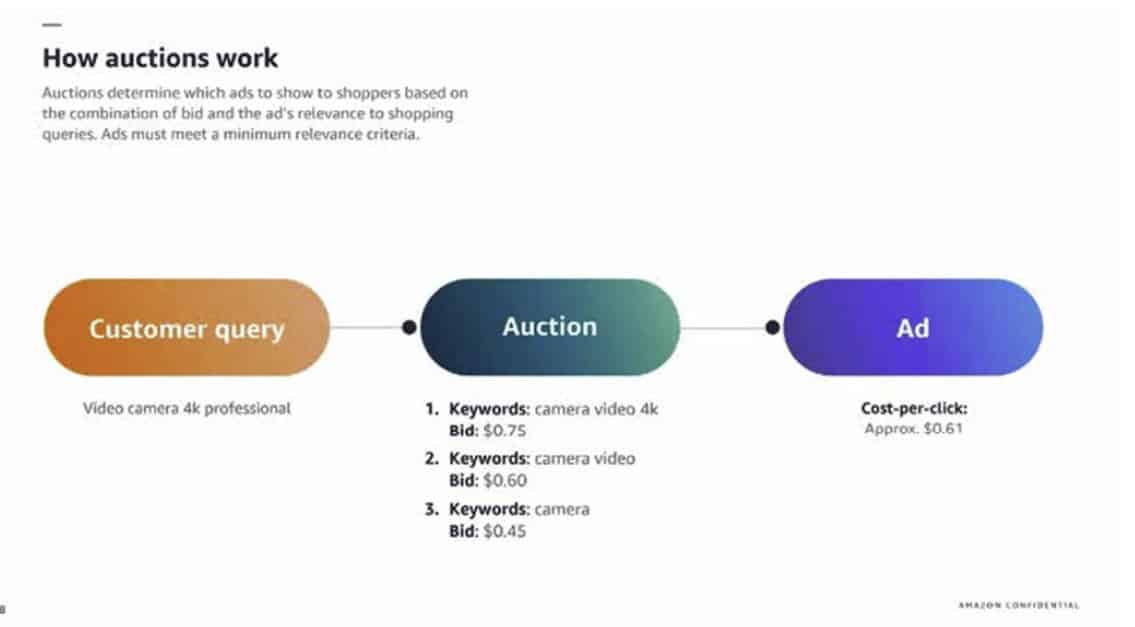
Those representations appeared on Amazon's advertising website, in training courses and videos and in presentations given directly to advertisers. The complaint says Amazon continued describing the auctions that way through 2026, years after the FTC alleges the actual pricing process had changed.
Amazon began experimenting with undisclosed "soft reserve" pricing for Sponsored Brands in 2018 before expanding similar pricing to Sponsored Products in 2019 and Display Ads by 2023.
Unlike a normal reserve price, which establishes a minimum bid before an auction, Amazon's soft reserve was calculated after the auction had already determined the winner and competitive price. If the soft reserve was higher, Amazon could charge that amount instead.
Internal documents cited in the complaint referred to the resulting price as a "surchargedSecondPrice" with "a surcharge hidden in it." Another explained why Amazon wanted to make the change:
"Reserve prices are good for Amazon because they don't change the allocation [of ads] and advertisers must pay more for the same advertising. Obviously, the benefit to Amazon comes at the cost of advertisers."
The FTC says Amazon was dissatisfied with the amount advertisers were paying under its regular second-price auctions and saw an opportunity to close the gap between the winning advertiser's maximum bid and the lower amount generated by competition.
An internal document explained that reserve pricing allowed Amazon to adjust cost-per-click prices "beyond what would be organically achieved through advertiser competition." The executive in charge of Amazon Ads reportedly described the second price as a "proxy 2nd price that we calculate," while an Amazon Senior Scientist referred to an "invented auction participant representing how much Amazon thinks that particular ad slot is worth."
The complaint compares that kind of intervention to the longstanding problem of shill bidding, where a seller inserts a fake bid below the winner to drive up the price.
By 2024, the complaint says Sponsored Products advertisers were being charged their own winning bid close to 80% of the time, up from between 30% and 40% in 2021 and 70% in 2022. Sponsored Brands advertisers were charged their winning bid about half the time.
Internal documents cited in the complaint also show Amazon knew advertisers had developed their bidding strategies around the second-price system the company told them it was using.
A 2023 internal document said many advertisers set bids as high as "$100 or $1000 because they trust Amazon is not running a first price auction," while a Sponsored Products manager wrote in 2024 that "many advertisers bid far higher than what they are willing to pay" because they assumed Amazon was running a generalized second-price auction.
Another employee wrote later that year:
"We don't tell them about the surcharge, we let them assume GSP-based."
Amazon repeatedly tested higher surcharge limits to see how advertisers would react. A 2023 pricing experiment was extended after the company saw no significant changes in advertiser bids or budgets, and Amazon ultimately made the higher surcharge limit permanent.
The company had been cautious about advertiser reaction from the beginning. A 2019 Sponsored Products document warned that pricing experiments had to minimize the risk of "irrevocable damage to advertiser trust," while acknowledging the "huge opportunity" to increase advertising revenue.
Senior Amazon Ads executives were still discussing the practice in 2024. After an August Quarterly Science Review, the head of Amazon Ads and Amazon's Vice President and Chief Digital Economist discussed soft reserve pricing, which was described internally as an "incredibly effective way to drive revenue." The Chief Digital Economist called the soft price a "clever non-transparent way to charge first price in some cases," while raising concerns that greater use could prompt advertisers to lower their bids.
Amazon also allegedly limited the auction information available to advertisers. The complaint says customers could not see CPCs, original bids or other performance data for individual clicks, with invoices instead showing averages that combined multiple auctions and placements.
One employee explained internally that advertisers did not see the surcharge over the normal second-price result and would instead attribute higher CPCs to competition, adding: "This also helps with external communication."
Amazon often increased surcharge limits during Prime Day, Black Friday and other major shopping events, with the complaint alleging the company believed normal seasonal changes in advertising demand would make its own price increases harder to identify.
During Prime Day 2023, the head of Sponsored Products auctions wrote that advertisers would likely assume higher CPCs were caused by competitors increasing their bids and said Amazon could relax its surcharge constraints when there were enough other factors, including seasonality, to make the effect difficult to detect.
Amazon received nearly two dozen complaints after a sharp CPC increase during the 2021 holiday season and more complaints after surcharges more than doubled CPCs for some advertisers during Prime Day 2023. The FTC says Amazon blamed higher shopper and advertiser activity rather than its own pricing changes, then added surcharge alarms and caps intended to avoid similarly "egregious CPC increases."
The complaint says Amazon learned about the FTC investigation in September 2024, but its reserve pricing continued.
The day after Thanksgiving that year, the Vice President of Sponsored Products and members of the auction team discussed increasing reserves because advertising revenue had come in below Amazon's financial plan. Rather than make a rapid change on Black Friday that could cause another obvious CPC spike, the team planned a slower ramp leading into Cyber Monday.
An internal chat later described how the decision was made:
"[the Vice President of Sponsored Products] wanted to not do pricing intervention [for Thanksgiving 2024] so we didnt then was like wait we need money so we dialed something up last minute for cyber Monday"
Another employee responded: "that's funny but also predictable."
In October 2024, one manufacturer asked Amazon for more transparency about its auction process and specifically questioned whether it was still using the second-price system Amazon had previously described.
An Amazon sales manager noted internally that the customer was "under the impression our model operates as a second-price auction" and said there was a lack of clarity even among Amazon's own sales teams about changes to external language describing the auctions.
After consulting with legal and public relations teams, Amazon told the advertiser only that its pricing was based on multiple factors and the CPC would not exceed its bid.
The customer kept pressing, pointing to earlier assurances from Amazon that Sponsored Products used second-price auction dynamics with no CPC floors or manual bid overrides. Internal notes described the advertiser as "very combative," noted it "aren't a huge advertiser" and called the escalation a "case study on how we should prep advertiser-facing teams."
Amazon has strongly denied the FTC's allegations, saying the case mischaracterizes how its advertising auctions work and relies on a handful of old or simplified materials pulled from approximately 1.5 million pages of documents provided to investigators.
 Amazon Staff
The company contends its primary campaign-building tools have told advertisers since 2018 that their bid is the maximum amount they can be charged, and argues soft reserves are a common industry practice used to establish the value of advertising inventory.
Amazon says it began giving relevance more weight in determining which ads win auctions as its advertising systems became more sophisticated. Lower bids were increasingly able to beat higher but less relevant bids, resulting in premium advertising placements being sold below what Amazon considered their market value.
Soft reserves were introduced to address that gap, according to Amazon. If a winning bid exceeds both its hard and soft reserve, the advertiser pays the soft reserve. If it clears the hard reserve but falls below the soft reserve, Amazon awards the placement and charges the advertiser its bid. Advertisers never pay more than the maximum amount they submitted.
Amazon says approximately 92% of Sponsored Products ads selected in 2024 did not have the highest bid and that average winning bids have fallen 50% as the company placed greater weight on relevance. It also rejects the FTC's contention that advertisers were unable to adapt their bidding because they believed Amazon was using a second-price auction.
"Advertisers adjust bids based on real-world outcomes, not descriptions of auction mechanics," the company said, pointing to frequent bid changes and automated campaign tools that react to clicks, sales, CPC and return on ad spend.
Amazon says that even if advertisers did not adjust their bids as the FTC alleges, prioritizing ad relevance over selecting ads based on bid alone saved advertisers more than $8 billion from 2021 through 2025.
The complaint cites Amazon's own experience buying advertising elsewhere. When another major advertising exchange moved from second-price to first-price auctions, Amazon allegedly responded by immediately adopting an aggressive bid-shading strategy. Amazon's Demand Side Platform has also advised advertisers that the declared auction model is an important factor in determining how they should bid.
Amazon says the FTC's older second-price examples had little reach and were missed when the company updated its advertising materials. When the FTC raised concerns, Amazon says it reviewed its communications and updated its help materials to explicitly disclose reserve pricing.
The complaint says at least one page explicitly describing Amazon Ads as a second-price auction was removed only after Amazon learned of the investigation in October 2024, and Amazon did not disclose that removal to the FTC until August 26, 2026. A developer guide available from at least 2025 through July 2026 still told advertisers they "only pay the least bid amount needed in order to win."
Amazon also disputes the FTC's claim that the higher advertising costs were passed on to shoppers, saying the complaint provides no evidence of consumer price increases and that inflation-adjusted Sponsored Products CPC remained flat from 2019 through 2024 while conversion rates for individual Sponsored Products advertisers increased more than 24% from 2021 to 2025.
The FTC brings five claims for misrepresentation, deceptive auction manipulation, concealment, unfair omissions and unfair billing practices. The states bring additional claims under their respective consumer protection laws.
The FTC and states are seeking an injunction and monetary relief, while the states are also seeking restitution, disgorgement, civil penalties and other remedies.
The case is Federal Trade Commission et al. v. Amazon.com, Inc., pending in the U.S. District Court for the Western District of Washington (Case No. 2:26-cv-03097).
Download the full complaint: