eBay's New AI Return Assistant Steers INAD Claims Toward Buyer Remorse

eBay is quietly rolling out a new AI-powered Return Assistant that replaces the traditional return request process with a conversational interface, but buyers say the system is incorrectly categorizing legitimate Item Not As Described (INAD) complaints as buyer remorse, allowing sellers to refuse returns that should be covered under eBay's Money Back Guarantee.
Screenshots shared in the eBay Community show the new assistant offering buyer-remorse reasons even after a buyer has specifically selected "The item isn't as described," while another option encourages buyers to skip photo requirements by continuing under the seller's return policy instead. Reports of the new interface date back to at least September 29, with some buyers still seeing the traditional return process while others encountered the AI assistant in November.
One buyer recently shared their experience in the eBay Community after purchasing a jacket advertised as a men's size large, only to receive a women's large in a different model than the seller had listed. The listing stated that returns were not accepted, but the buyer should still have been eligible for Money Back Guarantee protection if the item did not match the description.
 rhiggsbear

The buyer says they initially selected "Not as Described" when starting the return, but the AI assistant's follow-up questions didn't offer an appropriate reason for receiving a women's jacket instead of a men's jacket. They eventually selected the closest available fit-related option and attempted to explain the problem in a separate message to the seller, but the seller declined the return and eBay closed the case in the seller's favor.
When other Community members questioned whether they had accidentally filed a buyer-remorse return, the buyer insisted they had started with the correct INAD selection but couldn't get the assistant to accept an explanation of the actual problem.
I tried to explain it in the area below but it would not accept any type of message.
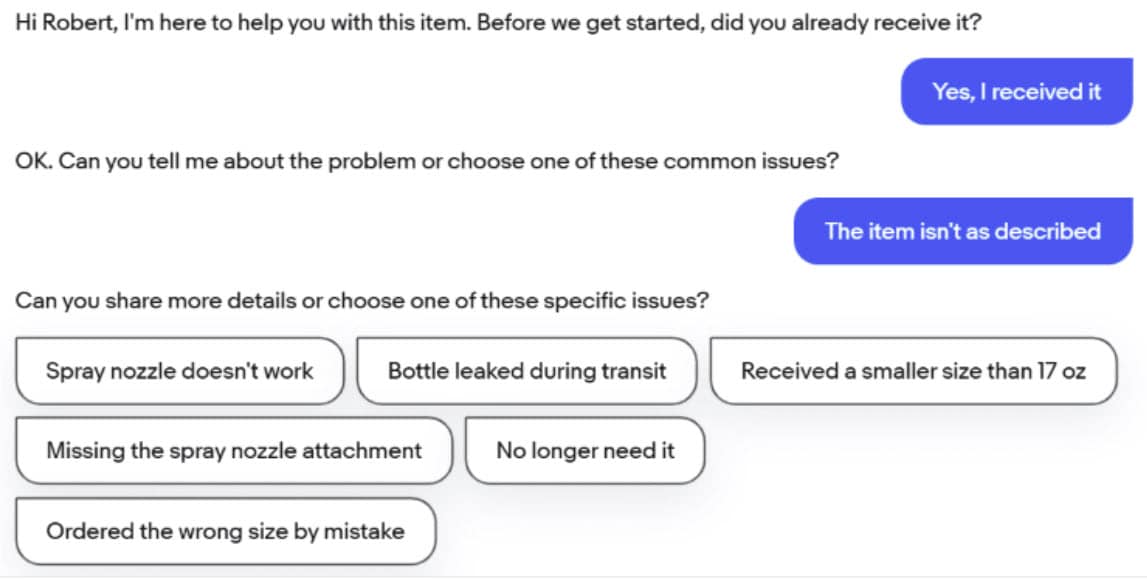
The buyer subsequently tested the process with another purchase and shared screenshots showing that after selecting "The item isn't as described" for a spray product, the assistant offered suggestions including a defective nozzle, leakage during shipping, a smaller size than advertised and a missing attachment. But the same list also included "No longer need it" and "Ordered the wrong size by mistake," neither of which would normally qualify as an INAD reason.
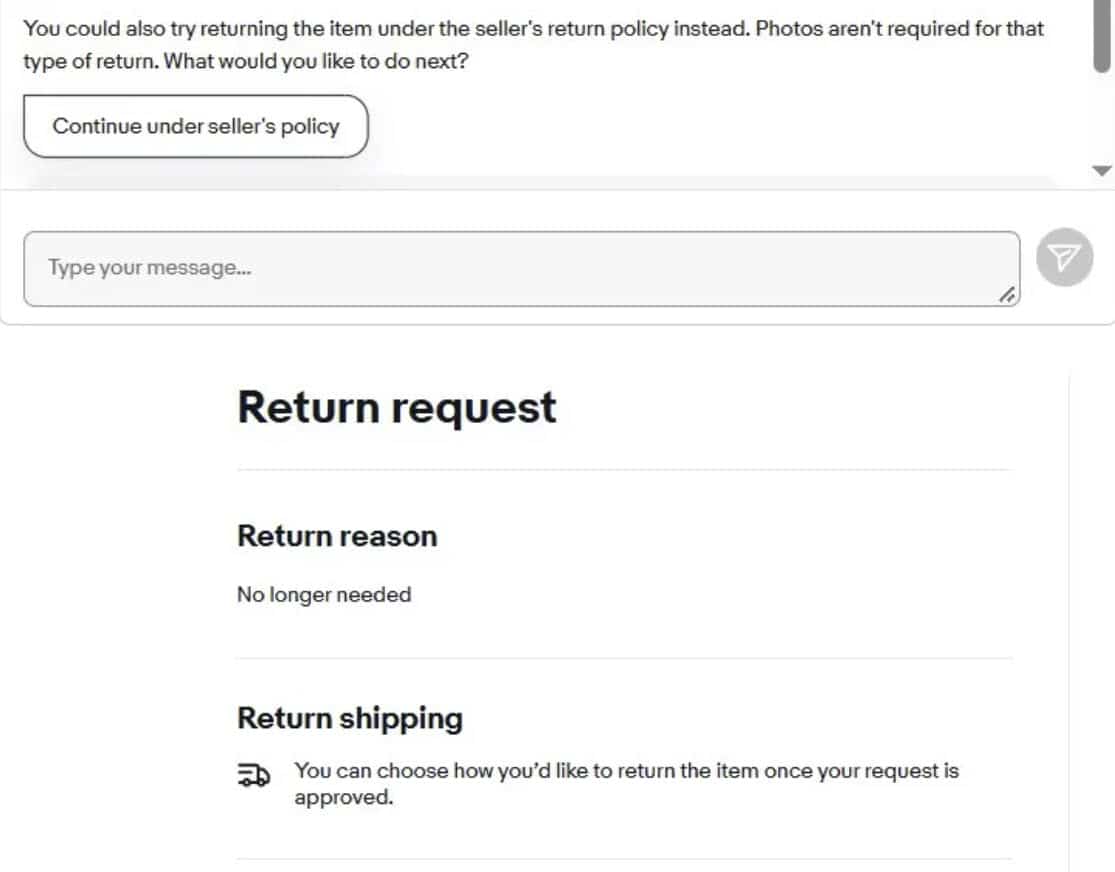
Other Community members testing the new process found that the assistant also offers buyers an alternative way to proceed if they don't want to or cannot upload the requested supporting photos, suggesting they try returning the item under the seller's return policy instead because photos aren't required for that type of return.
The option is presented with a "Continue under seller's policy" button, without clearly explaining that choosing it may mean abandoning the original INAD claim and giving up protections available under the Money Back Guarantee. Another participant demonstrated that following this path resulted in a return review showing "No longer needed" as the reason, which would allow a seller with a no-returns policy to refuse the request. The jacket buyer confirmed encountering the same alternative and said they felt they had no choice but to proceed or abandon the return entirely.
The issue was also documented in a separate eBay Community discussion where member gurlcat was working on a guide to help sellers understand the difference between INAD and buyer-remorse returns. She had planned to include screenshots of the familiar return-reason dropdown menu but discovered it had been replaced by a chat-style process with questions and suggested answers apparently generated from the original listing.
 gurlcat
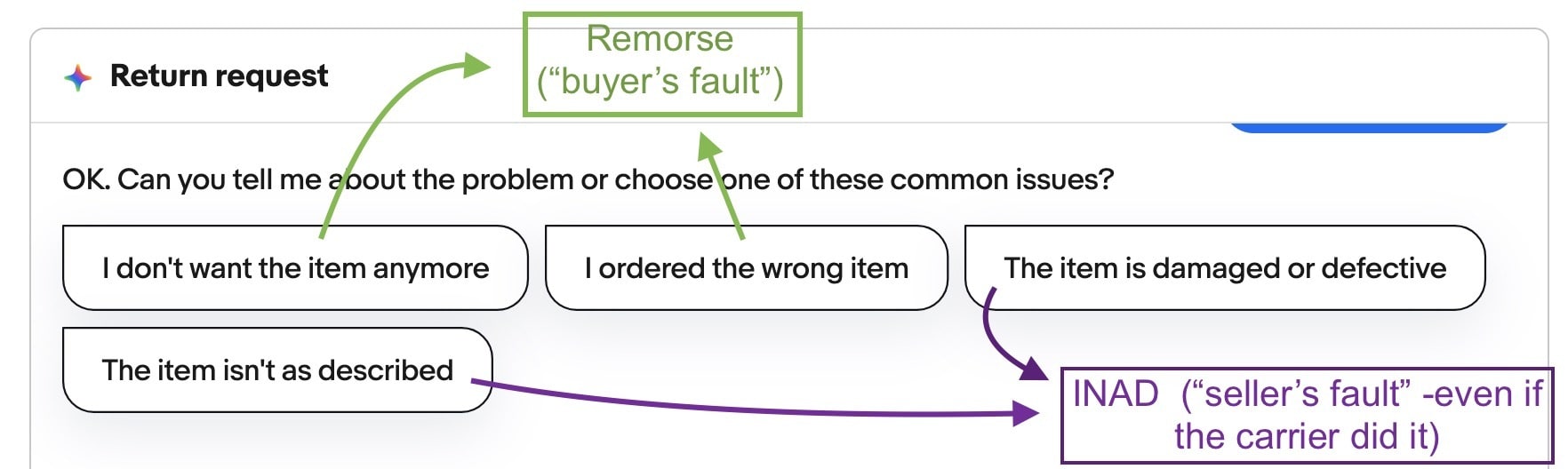
Using purchases from two accounts, gurlcat tested various paths through the new assistant without actually submitting return requests. One test involved a 16-pound lot of broken vintage jewelry, with the buyer selecting "The item isn't as described" and receiving suggestions that the package weighed substantially less than advertised, items were missing, or plastic toys had been received instead of jewelry parts. The suggestions also included buyer-remorse options like "No longer need for my projects" and "Ordered by mistake."
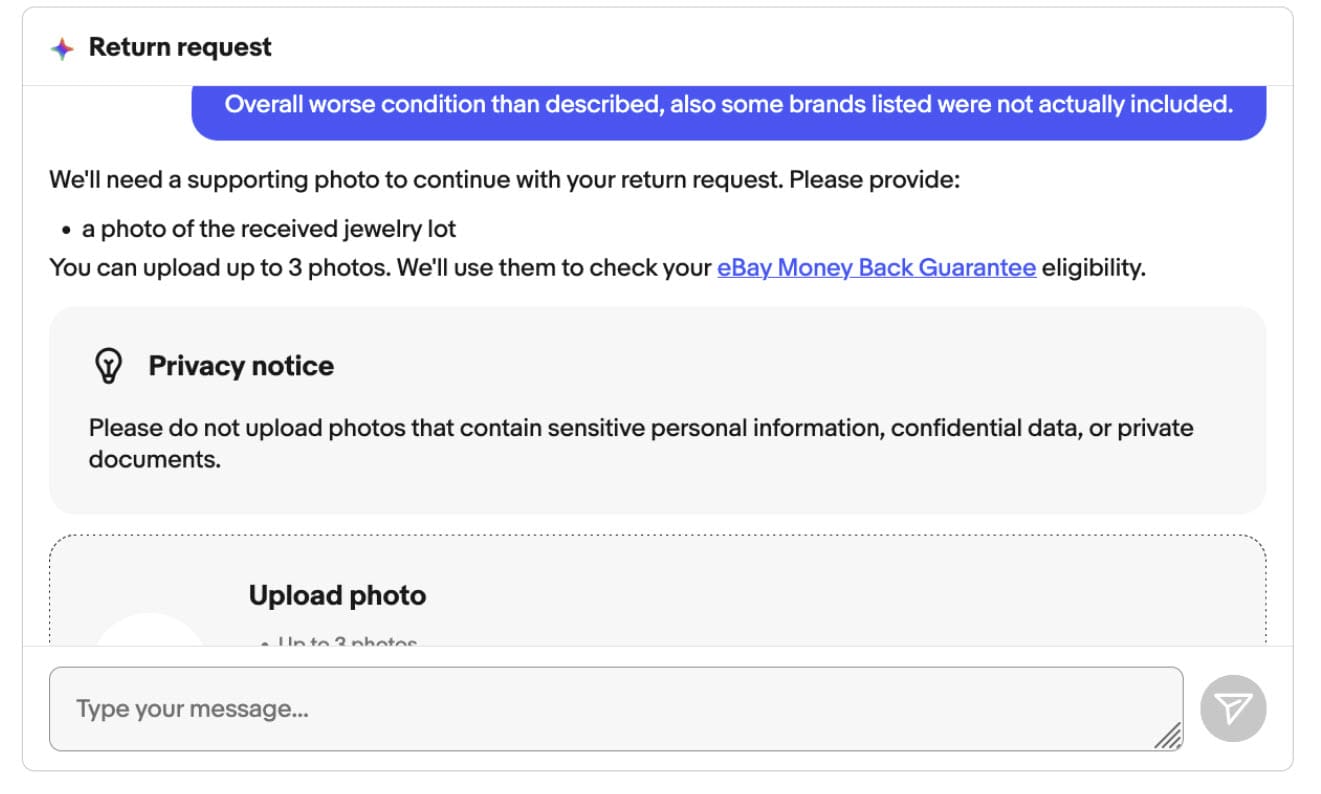
She discovered that it was possible to bypass the suggested choices by typing an explanation directly into the message field and submitting it with the arrow button. After entering that the jewelry was in worse condition than described and some advertised brands were missing, the assistant advanced to a request for supporting photographs. That workaround may help buyers who recognize the suggested reasons are inappropriate, but it isn't clearly explained in the interface.
Other buyers have reported similar problems with returns ending up with incorrect reasons. In an October 30 Reddit post, a buyer said they selected INAD but later discovered eBay had recorded "No longer needed" after the case was closed. When they contacted customer service, the buyer said they were told they had selected the wrong reason.
In another eBay Community complaint, a buyer reported receiving a package that had been crushed in transit, leaving the item inside unusable. They had taken photos of the damage but couldn't initially transfer them from their phone to their computer when the Return Assistant requested supporting evidence. Choosing the option to continue without photos changed the return reason to "No longer needed," and the buyer said they couldn't correct the classification or upload the pictures even after getting them onto their computer.
Under eBay's Money Back Guarantee policy, sellers must resolve eligible claims for damaged, faulty or incorrectly described items and pay return shipping, even if their listings don't accept returns. Buyer-remorse requests, however, are subject to the seller's return policy and may be refused entirely.
Correct classification is particularly important because eBay's published instructions warn that buyers who close a return request cannot reopen it or submit another for the same transaction, advising those who select the wrong reason to keep the request open and contact the seller instead. While certain case decisions can be appealed, buyers may not realize their return was incorrectly classified until after the seller has declined it.
The new assistant also raises questions about AI's role in determining Money Back Guarantee eligibility. In gurlcat's jewelry test, the system requested supporting photos and said they would be used to check eligibility, allowing up to three images, while eBay's published return instructions still refer to a limit of ten for damaged, broken or faulty items.
eBay has previously tightened photographic evidence requirements for some INAD claims and already reserves the right to review and decline unsupported claims before forwarding them to sellers, but has not explained whether the Return Assistant simply collects evidence for that process or independently determines eligibility.
A seller who encountered the new experience on November 9 reported that it reviewed and summarized previous messages between the buyer and seller, selected a return reason and offered the opportunity to upload three photographs. The seller said an eBay customer service representative described the change as encouraging the parties to work together before eBay evaluated the dispute using AI, though the company has not independently confirmed that description.
More accurate screening of INAD claims could be a welcome improvement for sellers who have long complained about buyers abusing the Money Back Guarantee to force returns or avoid paying return shipping. Some Community participants welcomed the possibility of more rigorous checks, but the experiences documented so far also show the potential for legitimate complaints to be incorrectly classified before they ever reach the seller.
The new Return Assistant is part of eBay's broader push to automate customer service, which executives have previously linked to reducing support costs and improving operational efficiency. In 2024, CEO Jamie Iannone described how eBay was already using AI to read lengthy customer service communications and generate initial responses, replacing tasks that previously required paid support agents. More recent customer experience job postings have explicitly tied additional AI integration to cost savings and Gross Merchandise Volume (GMV) growth.
eBay's official AI disclosure acknowledges using the technology for automated customer support, request routing, summaries and classifications, but does not specifically explain the new Return Assistant or how it handles Money Back Guarantee decisions.