Collectors Seeks Arbitration, Dismissal In Expanded PSA Antitrust Suit

PSA parent Collectors Holdings is again asking a California federal court to send most of a proposed antitrust class action to individual arbitration and dismiss what remains, arguing an expanded complaint still fails to show its acquisitions of SGC and Beckett caused higher grading prices, longer turnaround times or reduced competition.
Collectors filed the renewed motions September 21 after plaintiffs added two new collectors, state law claims and more detailed allegations about what happened at SGC and PSA following the acquisitions.
The original lawsuit was filed in April by collector Michael Rasmussen, accusing Collectors of using its 2024 acquisition of SGC and late 2025 acquisition of Beckett Grading Services to illegally maintain PSA's dominant position in the trading card grading market. Collectors moved to dismiss in June, arguing Rasmussen had not plausibly connected either acquisition to the higher prices and slower service he alleged and saying booming demand, not reduced competition, was the more obvious explanation for rising prices and turnaround times.
Plaintiffs expanded the case in August, adding Erick Azarian and Andrew Fedynyshyn along with new California Unfair Competition Law claims and more detail aimed directly at Collectors' earlier defense. The amended complaint alleged SGC had been gaining share before the acquisition by competing on price and turnaround time, but Collectors later shifted resources away from SGC while PSA restricted access to several lower-priced grading tiers.
 Liz Morton
Collectors says adding two plaintiffs did not solve the arbitration problem, arguing all three agreed to versions of the Collectors User Agreement containing binding arbitration and class action waivers before submitting cards to PSA, and none used a 30-day option to opt out.
The agreement also applies retroactively to claims arising before a user accepted the terms and leaves disputes over whether a claim is subject to arbitration for the arbitrator rather than the court, according to the renewed motion. The company points to a separate California case where a judge enforced what it describes as the same arbitration agreement in 2025.
If Judge John W. Holcomb grants the arbitration motion, the plaintiffs' damages claims could move out of federal court and into individual arbitration, preventing them from proceeding as a class action.
The request for public injunctive relief, including possible divestiture of SGC or Beckett, could remain before the court. Collectors is simultaneously asking Holcomb to dismiss that portion, arguing the plaintiffs lack standing to seek prospective relief, waited too long to challenge the acquisitions and allege economic injuries that can be addressed with monetary damages.
The renewed dismissal motion also disputes the plaintiffs' claim that the acquisitions reduced grading capacity rather than increased it. According to the amended complaint, SGC had been growing quickly around the time of the acquisition, with annual grading volume rising from about 930,000 cards to roughly 1.8 million over two years while competing with PSA on price and turnaround time.
It also alleges Collectors shifted staff and other resources from SGC to PSA in 2025, with SGC monthly grading volume dropping from about 150,000 cards in July to roughly 50,000 by October.
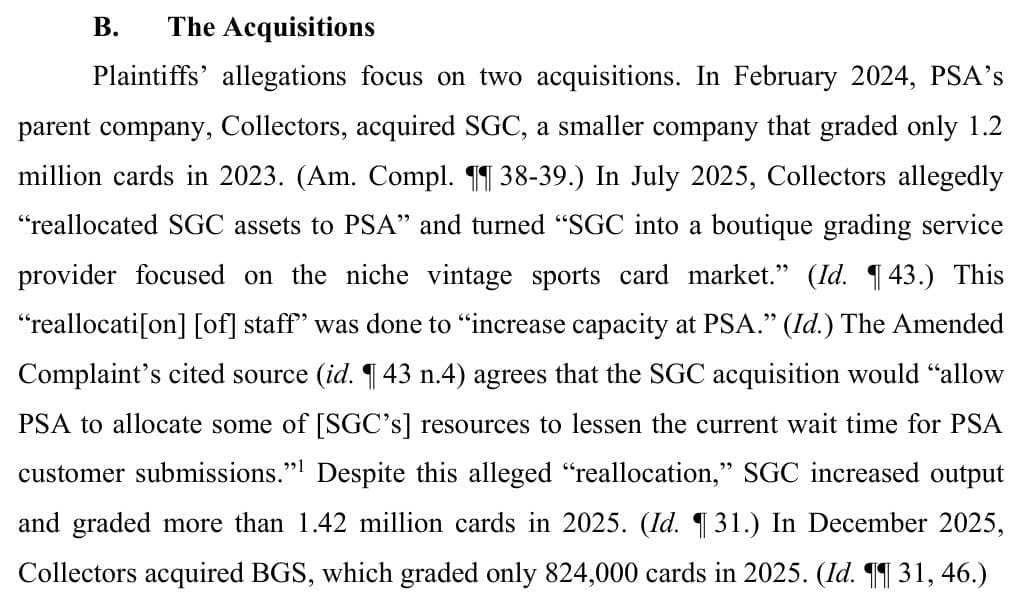
That comparison uses SGC's roughly 1.2 million cards graded in 2023 as the baseline. The amended complaint says SGC had already grown to about 1.8 million cards in 2024 before declining the following year, with plaintiffs alleging the drop accelerated as resources shifted during 2025.
A similar dispute surrounds PSA's decision to stop accepting several lower-priced service levels. The amended complaint points to the suspension of Value Bulk, Value, Value Plus and Value Max as evidence of reduced consumer choice and restricted access to cheaper grading, at one point leaving $74.99 as PSA's lowest available service level.
The renewed motion calls that characterization of reduced “output” wrong, arguing output should be measured by the number of cards actually graded rather than whether every service tier remained open for new submissions.
Collectors' broader defense remains that demand was growing faster than grading capacity, pointing to the amended complaint's own allegations that the market is rapidly growing and expanding operations requires trained and experienced graders, significant time and resources.
In a market experiencing explosive growth in demand while facing capacity constraints, price and turnaround time increases are what basic economics would naturally predict.
Plaintiffs counter that Collectors did not simply struggle to add capacity but actively moved resources away from SGC as PSA raised prices and later restricted cheaper services. Their amended complaint estimates PSA held about 72% of grading volume before the acquisitions, increasing Collectors' share to roughly 80% after adding SGC and Beckett. Those figures are based on cards graded by PSA, CGC, SGC and Beckett.
The renewed motion disputes whether those figures establish Collectors' share of the U.S. grading market, arguing they cover only four major grading companies and do not make clear whether the underlying volume is U.S.-only or global. It also points to CGC, which graded 4.92 million cards in 2025, substantially more than SGC and Beckett combined, and questions why CGC could not provide the competitive pressure plaintiffs attribute to those companies.
Rasmussen and Azarian each allege submitting a single card through PSA's Super Express service, while Fedynyshyn says he has graded hundreds of cards with PSA since 2022 and dozens between 2024 and 2026. None alleges submitting cards to SGC or Beckett.
Collectors says the amended complaint still does not plausibly connect the plaintiffs' alleged injuries to either acquisition and does not allege they plan to use PSA again in the future, which it argues prevents them from seeking prospective injunctive relief.
Both renewed motions are scheduled for a December 11 hearing in the U.S. District Court for the Central District of California.
Collectors' Renewed Motion to Compel Arbitration:
Collectors' Renewed Motion to Dismiss: