USPS Posts $2.5B Q3 Loss as Revenue Rises, Liquidity Crisis Persists

The U.S. Postal Service lost another $2.5 billion in the third quarter of fiscal year 2026, an improvement from last year but still a significant setback as the agency continues warning of a severe liquidity crisis.
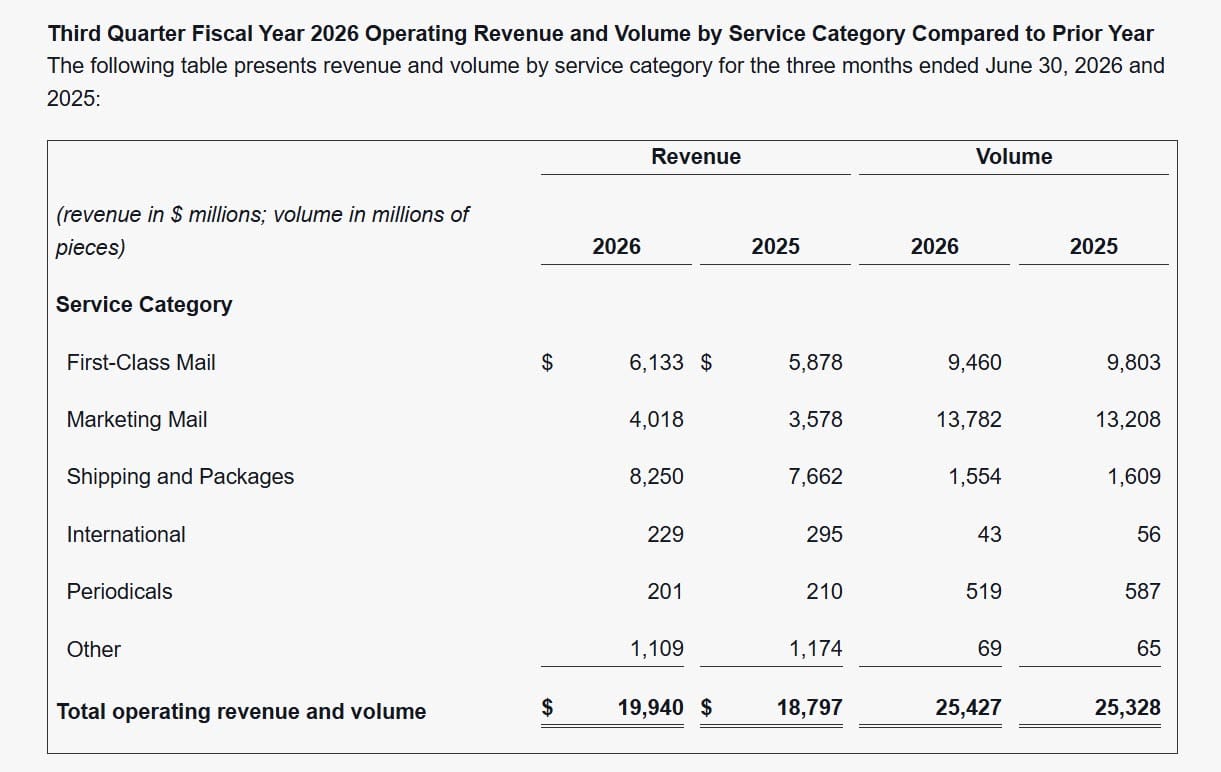
USPS reported $19.9 billion in operating revenue for the quarter covering April through June, up $1.1 billion or 6.1% from the same period last year. Net loss improved by $562 million from the $3.1 billion loss reported in Q3 2025, while controllable loss improved from $1.6 billion to just over $1 billion.
USPS has now lost about $5.7 billion through the first nine months of fiscal 2026 after posting a $1.3 billion Q1 loss previously covered by Value Added Resource and a $2 billion loss in Q2.
The latest results did show stronger revenue across several major product categories. Shipping and Packages revenue increased $588 million, or 7.7%, despite volume declining 3.4%. USPS said continued growth in Ground Advantage helped drive the increase.
Marketing Mail revenue increased $440 million, or 12.3%, on a 4.3% increase in volume, while First-Class Mail revenue rose $255 million, or 4.3%, even as volume declined 3.5%.
Higher prices also remain an important part of that revenue growth. USPS specifically pointed to First-Class Mail and Marketing Mail price increases along with the 8% transportation-related increase on competitive shipping products that took effect April 26.
As previously reported by Value Added Resource, that temporary increase applies to services including Ground Advantage, Priority Mail and Priority Mail Express and is scheduled to remain in effect through January 17, 2027.
 Liz Morton
USPS also raised Market Dominant rates again in July, including increasing the price of a Forever stamp from 78 cents to 82 cents, while Competitive rates were adjusted to target bulky, lightweight packages.
 Liz Morton
Postmaster General David Steiner made clear at the August 7 USPS Board of Governors meeting that pricing will continue to play an important role in the agency's financial strategy.
He said USPS has "more price to take in the marketplace" and argued it would be financially irresponsible to pull back from increases at this point.
That strategy carries some risk as higher prices can put additional pressure on already declining mail volumes.
The package business presents a more complicated picture. USPS says Ground Advantage helped drive higher Q3 shipping revenue even though total Shipping and Packages volume declined.
At the same time, online sellers have seen USPS make more targeted moves on Ground Advantage pricing, including significant temporary rate reductions for many 3 to 5 pound shipments and subsequent adjustments on platforms including eBay.
The moves suggest USPS is trying to use pricing more selectively to attract profitable package volume while continuing to raise rates elsewhere.
Costs are still moving in the wrong direction overall. Total operating expenses increased $438 million, or 2%, to $22.5 billion during the quarter, driven in part by higher retirement benefits, retiree health benefit expenses, compensation and benefits and fuel costs.
Chief Financial Officer Luke Grossmann said USPS reduced 4 million work hours during the quarter as part of ongoing cost-control efforts. Steiner said the agency is also continuing to improve transportation efficiency, expand visibility across the network and roll out Regional Processing and Distribution Centers and Sorting and Delivery Centers.
He argued recent network changes have gone more smoothly than earlier implementations and pointed to improving service performance alongside reduced work hours as evidence that some of the efficiency efforts are beginning to work.
But USPS itself says those efforts will not be enough to resolve the larger financial problems.
Grossmann said "management actions alone will not resolve ongoing financial problems," reiterating the agency's push for legislative, regulatory and administrative changes.
Earlier this year, USPS began suspending employer contributions toward the Federal Employees Retirement System and received a conditional waiver from the Postal Regulatory Commission giving it more flexibility over cash that had been required to go toward pension amortization payments.
USPS said suspending the FERS contributions has allowed it to preserve approximately $1.4 billion in cash through June 30, with the agency estimating that could grow to about $2.5 billion for the full fiscal year.
Those temporary measures have extended USPS’s cash runway. In its Q3 financial filing, the agency said the cash conservation plans have provided enough liquidity to continue operating through at least August 2027.
But USPS cautioned that it still does not have sufficient liquidity to meet all of its obligations, make necessary capital investments and prepare for unexpected contingencies, and the deferred pension obligations will eventually have to be satisfied.
Steiner described the goal more directly, saying, ‘We are taking responsible steps to conserve cash to extend our operating window.’
Beyond those temporary measures, USPS is seeking broader changes, including increasing its statutory $15 billion debt limit, revising how Civil Service Retirement System costs are allocated, allowing pension assets to be invested more broadly, reforming workers' compensation administration and giving the agency more pricing flexibility.
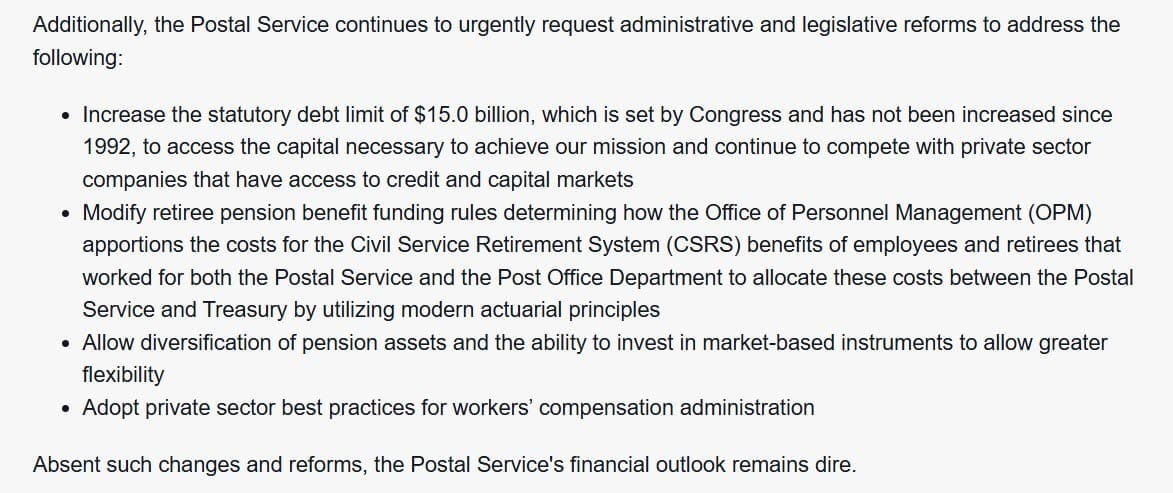
Steiner also said USPS is working on a legislative package that could include increased borrowing authority, benefit reforms and some form of federal appropriation to help support the agency while it works toward financial sustainability.
He described that government funding as an investment that could eventually be reduced as USPS improves revenue and lowers costs. Seeking a federal appropriation would mark a significant change for an agency that regularly emphasizes that it generally receives no tax dollars for operating expenses.
Steiner also warned that USPS will continue pursuing measures under its own control if Congress does not agree on a legislative package.
Those options could include additional price increases, changes to service levels and potentially closing thousands of post offices USPS considers unprofitable, though Steiner said the agency would not take such steps until after the New Year.
USPS did show improvement in the third quarter, with revenue growing faster than expenses and controllable loss narrowing. But it still lost $2.5 billion in three months, bringing its fiscal year-to-date loss to roughly $5.7 billion while it defers retirement-related payments to conserve cash.
For now, the recovery strategy depends on raising revenue through pricing, attracting more profitable package volume, cutting costs and gaining regulatory and legislative relief.