Etsy Sues CCMI, Claims Section 230 Protection For Alleged False Advertising Of Cashmere Items

UPDATE 3-6-26
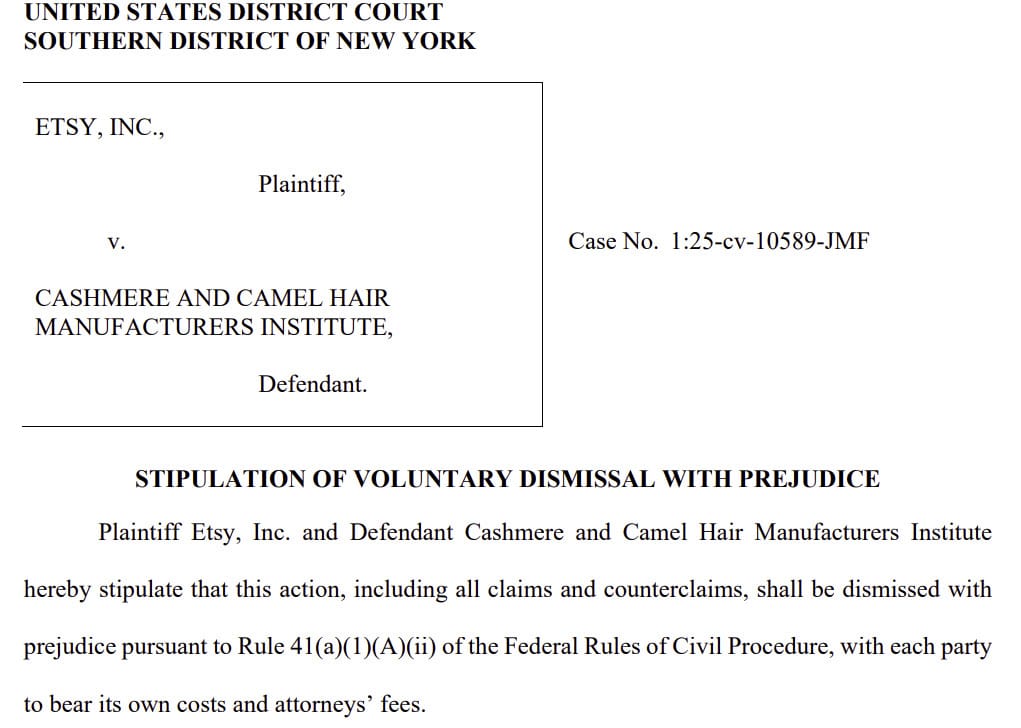
Etsy and the Cashmere and Camel Hair Manufacturers Institute (CCMI) have apparently resolved the claims at issue in this suit, filing a notice of voluntary dismissal with both parties paying their own legal costs on March 5,2026.
UPDATE 1-10-26
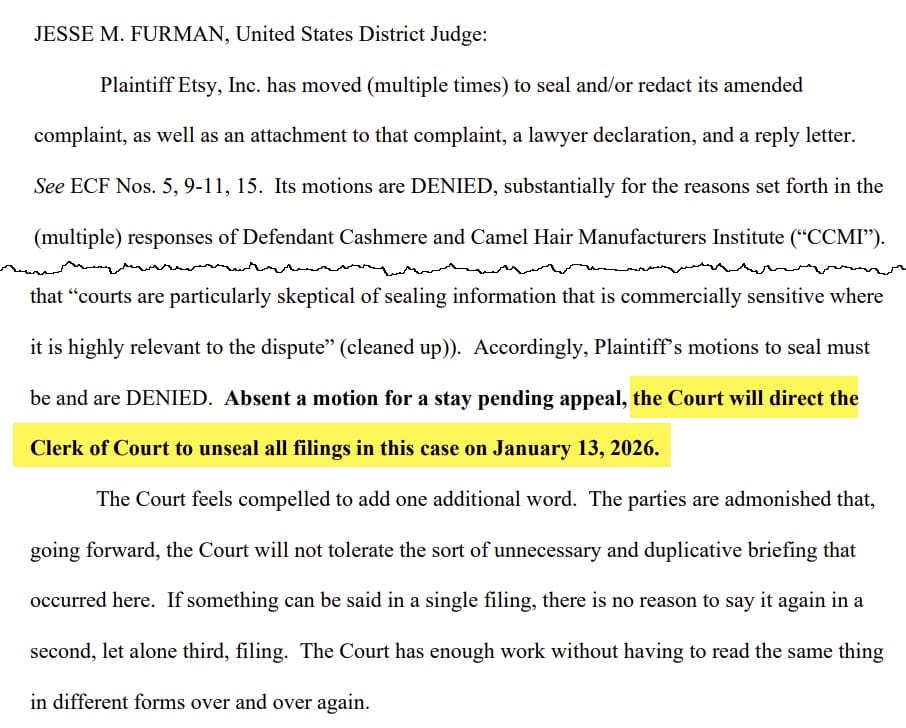
Etsy has lost their bid to keep certain documents they've filed in this suit under seal with Judge Jesse Furman ruling the company did not adequately argue why their desire not to "reveal commercially sensitive information" should outweigh the "strong presumption in favor of public access" in this litigation.
The ruling will mean that documents which had previously been filed under seal will be unsealed on January 13th.
Etsy is suing the Cashmere and Camel Hair Manufacturers Institute (CCMI) over ongoing actions trying to hold marketplace accountable for false advertising of some Cashmere items sold on the site, seeking to affirm platform is protected by Section 230 and not liable for activities or content of 3rd party sellers.
Background
CCMI, a trade association whose members include cashmere manufacturers, wholesalers, and retailers, has been raising concerns about products sold on Etsy for years.
As part of its industry activities, CCMI purchases products advertised as “cashmere” from various retail channels and sends them to laboratories for fiber‑content testing.
In 2020, CCMI began purchasing items from sellers on Etsy’s marketplace abd in n 2022, their testing found some goods to be inaccurately labeled as “cashmere” based on fiber-content results it claimed did not meet applicable labeling standards under the federal Wool Products Labeling Act.
CCMI flagged some of the items and Etsy removed them, until discussions about further action and proactive measures CCMI wanted Etsy to take broke down in September 2022 when, Etsy alleges, CCMI insisted that the marketplace change its business model and test every item described as “cashmere” offered on the site.
CCMI sued Etsy shortly thereafter, claiming violations of the Lanham Act; Massachusetts’ false advertising law; common law prohibitions on unfair competition; and Massachusetts’ Anti-Dilution Statute.
 Liz Morton
The parties ultimately resolved that dispute, and CCMI dismissed the action against Etsy with prejudice on February 3, 2023 - meaning it was a final decision and CCMI would not be able to bring the same claims/causes of action against Etsy again in the future.
But, according to Etsy, that hasn't stopped CCMI from continuing to buy and test products from the platform and make allegations that the company is in violation of “multiple federal and state laws that prohibit false and deceptive advertising” while demanding that Etsy “take steps to eliminate references to Cashmere from all advertisements on its website of garments whose specific content labeling clearly states that they are not Cashmere.”
Etsy's Section 230 Declaratory Judgement Action
That takes us to Etsy's newly filed complaint on December 22, 2025, seeking a declaratory judgment against CCMI and asking a Federal Court to confirm that the marketplace is protected from liability for actions or content of its third party sellers by Section 230 of the Communications Decency Act of 1996.
Section 230 of the Communications Decency Act of 1996, the so called "26 words that created the internet," provides broad immunity to online platforms for content posted by their users, stating:
No provider or user of an interactive computer service shall be treated as the publisher or speaker of any information provided by another information content provider.
Etsy's complaint against CCMI states:
Etsy, Inc. brings this declaratory judgment action to resolve an expansive and unfounded effort by the Cashmere and Camel Hair Manufacturers Institute (“CCMI”) to reshape the rules governing online marketplaces.
Specifically, CCMI has made sweeping accusations,including false advertising under federal and state law and related claims—all aimed at forcing Etsy to manually scrutinize over 100 million existing and new product listings from independent sellers for possible misrepresentations about cashmere.
Etsy already requires sellers to honestly and accurately describe their items and it offers Purchase Protection, which ensures that buyers are made whole in the unlikely event they receive an item that is not as described.
But CCMI’s demands disregard controlling law, including Section 230 of the Communications Decency Act—which shields online platform providers like Etsy from liability for the representations of its users—and go far beyond anything required by federal or state advertising law.
Ultimately, CCMI seeks no less than the wholesale redesign of Etsy’s business model. Accordingly, Etsy brings this action for a declaration of its rights under federal and state law and to put an end to CCMI’s attempted coercion.
After explaining the background of the dispute, Etsy goes on to say that CCMI has renewed its claims that the marketplace must vet and monitor every product described as “cashmere” across its entire platform.
On October 9, 2025, CCMI reiterated its allegations, again claiming that Etsy was violating “multiple federal and state laws that prohibit false and deceptive advertising” and demanding that Etsy “take steps to eliminate references to Cashmere from all advertisements on its website of garments whose specific content labeling clearly states that they are not Cashmere.”
On December 9, 2025, CCMI provided test results for three products it described as a “family” of garments, concluding they contained no cashmere. Etsy promptly removed those listings—and removed all other listings from the same sellers that referenced cashmere—and notified CCMI of the removals.
Despite those removals, CCMI continued to allege that Etsy was engaged in widespread false advertising involving cashmere-related listings and that it reserved the right to pursue all available legal remedies.
CCMI now contends that Etsy must remove all listings from its marketplace that use the term “cashmere” to describe any product containing non-cashmere materials, regardless of context and accuracy, because such listings would allegedly “cause significant harm during the upcoming holiday selling season.”
This demand is not only legally baseless, but absurd in its breadth. For example, complying would require Etsy to remove a listing for a “Cashmere Sweater Candle: Hand Poured Soy Wax, Clean Musk Scent” because, even though the product is clearly a candle made of wax, the description indicates that the item contains non-cashmere material (i.e., wax).
This type of overreach exemplifies CCMI’s tactic of stretching “false advertising” claims to target any listing containing the word “cashmere.”
CCMI seeks to impose obligations and liability on Etsy that have no foundation in the law. Even accepting CCMI’s allegation that independent sellers on Etsy have used the term “cashmere” inaccurately in certain circumstances, under CDA 230, Etsy is expressly immune from liability for the sellers’ conduct under CDA 230.
Etsy then explains the basic functioning of their site, focusing on the fact that they "provide the digital infrastructure to enable sellers to reach a global audience" with tools for shop setup, marketing, payment processing, and analytics, but that within that framework, sellers are responsible for the products they offer, descriptions, images, prices, packaging, shipping, returns etc. with Etsy never being in physical possession of items at any point in the process.
That "just a venue" stance has largely been used by Etsy, eBay and other marketplaces to skirt liability for items sold on their platforms and while it's no longer really true for eBay, it didn't stop them from successfully defending themselves against a lawsuit brought by the US Department of Justice on behalf of the Environmental Protection Agency, seeking to hold the company liable for illegal chemicals, pesticides and emissions control cheat devices sold on the platform.
U.S. District Judge Orelia Merchant dismissed the case against eBay on Section 230 grounds and the DOJ dropped their plan to appeal earlier this year.
 Liz Morton
NOTE: it's not just the spectre of direct fines or lawsuits that has marketplaces like Etsy and eBay clamoring to hold onto Section 230 protection at all costs.
If that "get out of liability free" card goes away, it could also expose just how much of their publicly reported Gross Merchandise Volume or Sales come from fraud, counterfeits, stolen goods and other illegal activity, potentially impacting stock prices and leading to shareholder action and/or SEC investigations.
 Liz Morton
In the action against CCMI, Etsy is asking the Court to:
- Declare that Etsy is immune under CDA 230 from CCMI’s efforts to impose liability on Etsy based on content and information generated by independent third‑party sellers regarding “Cashmere” and “Cashmere-blend” products;
- Declare that Etsy has not violated Section 43(a) of the Lanham Act, 15 U.S.C.§ 1125(a);
- Declare that Etsy is not liable for common-law unfair competition, whether on a palming-off or misappropriation theory;
- Declare that Etsy has no contributory or vicarious liability for any alleged trademark infringement or false advertising by independent third-party sellers regarding claims relating to “Cashmere” and “Cashmere-blend” products;
- Declare that Etsy has no joint liability with independent third-party sellers regarding claims relating to “Cashmere” and “Cashmere-blend” products under a civil conspiracy theory;
- Declare that Etsy is not liable for aiding and abetting any alleged trademark infringement or false advertising regarding claims by independent third-party sellers relating to “Cashmere” and “Cashmere-blend” products;
- Award Etsy its costs and attorneys’ fees; and
- Grant such other relief as the Court deems proper.
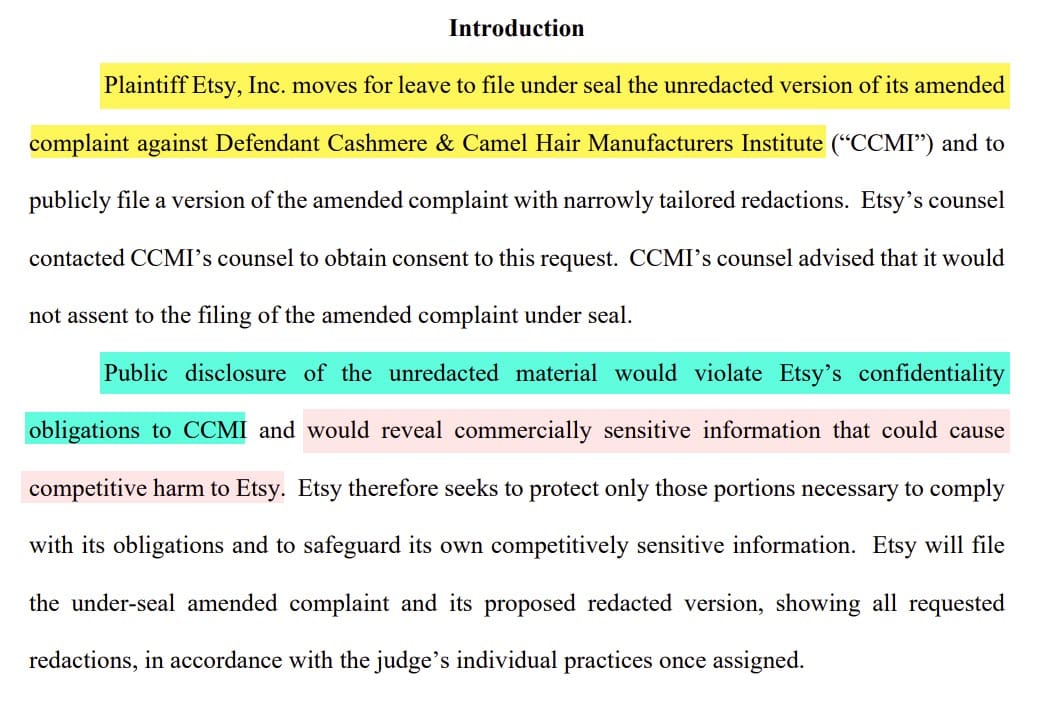
Etsy is also seeking the Court's permission to file an amended complaint with additional details to be redacted and filed under seal, claiming that public disclosure of the unredacted material would violate Etsy’s confidentiality obligations and reveal commercially sensitive information.
The timing of this action is particularly interesting as just last week, US Senate Democratic Whip Dick Durbin (D-IL) and US Senator Lindsey Graham (R-SC) introduced the Sunset Section 230 Act, which would repeal Section 230 two years after the date of enactment.
 Liz Morton
In addition to consumer harm and product liability concerns, lawmakers have also raised red flags about how tech companies may practice discrimination, retaliation or censorship on political grounds under the guise of 230 - like when Paypal made updates to their Acceptable Use Policy in 2022 that would have allowed them to fine users $2,500 for sending, posting or publication of content deemed "harmful" or Etsy policy updates in 2024 aimed at political activism and giving the platform wider latitude to remove items that it deems "violent, degrading, or hateful."
 Liz Morton
Just days before that update, Etsy was explicitly name-checked in Supreme Court arguments about content moderation laws passed in Florida and Texas in response to concerns that social media companies were censoring their users, particularly those with conservative viewpoints.
The laws contained provisions that limited decisions social media companies can make about how and which user-generated content is presented to the public, and others that required social media platforms to provide individualized explanations to users about their editorial choices.
 Brian Fung, John Fritze
While much of the conversation centered around more traditional social media like Facebook, YouTube and Twitter/X, several Justices opened their thoughts up to how the laws could have a broader impact on companies like Uber and Etsy.
Conservative Justice Amy Coney Barrett said, “Florida’s law, so far as I can understand it, is very broad. We’re talking about the classic social media platforms, but it looks to me like it could cover Uber. It looks to me like it could cover Google’s search engine. Amazon Web Services. And all of those things would look very different.”
Liberal Justice Sonia Sotomayor observed that the Florida law “is so, so broad, it’s covering almost everything” on the internet, including Etsy listings and the website’s own recommendation engine.
Florida Solicitor General, Henry Whitaker stumbled a bit before being forced to acknowledge that the law likely would cover Etsy's services - "I’m not sure to what extent it actually would apply to Etsy. I guess it would apply somewhat, [because] people are uploading user-generated content in connection with the sale of goods.”
With Section 230 as it is currently applied and interpreted by the courts, corporations have very little incentive to do anything beyond Minimum Viable Compliance box checking exercises when they know they are legally insulated from liability and can afford to keep litigation tied up for years should anyone try to challenge the status quo.
But increasing use of LLMs and other AI technology to create description summaries and product highlights, alter seller-provided images and other content without their knowledge, and control search and discovery experiences for consumers could pose interesting legal questions about how far Section 230 protections stretch.
 Liz Morton
In those contexts, the AI generated content is not a verbatim usage of third party seller-provided information but rather new/distinct content created by LLMs or other technology the company has put in place between sellers and buyers on their platforms, which could potentially make the marketplace the publisher of that content and possibly liable for any resulting consumer harm.
The timing of Etsy's action against CCMI is also very interesting when you consider that soon to be ex-CEO (but still Executive Chair) Josh Silverman joined TechNet's Executive Council last week for a two year term.


Technet, which bills itself as a "national, bipartisan network of tech CEOs and senior executives" has come out swinging against the proposed bill to sunset Section 230, with President and CEO Linda Moore saying:
“Repealing Section 230 would create uncertainty, disproportionately harm entrepreneurs, and make it harder for startups and emerging companies to compete. A repeal would also have serious unintended consequences — fundamentally changing how people communicate online, reducing access to information, and making it more difficult to protect users, including children and vulnerable communities."
"We urge Congress to reject efforts to repeal Section 230 without a clear, workable alternative that protects consumers, preserves free speech, and ensures the United States remains the global leader in innovation.”
While Etsy may gain some breathing room if the Court grants their request for declaratory judgment against CCMI, it may be short lived if the Sunset Section 230 Act passes and finally forces marketplaces to take accountability for cleaning up the massive amounts of fraud, counterfeit, falsely advertised, stolen and illegal goods flooding their sites - or pay the price in potential fines and lawsuits.
The case is Etsy, Inc. v. Cashmere and Camel Hair Manufacturers Institute New York Southern District Court # 1:25-cv-10589
Full initial complaint: