Sellers Question eBay’s New INR, Same Zip Code Return Tracking Fraud Protection Trade-Offs

eBay is working on new ways to protect sellers from item not received claims and same zip code return tracking scams, but will sellers be willing to give up shipping control in return?
The new Item Not Received protections were first announced for the US at eBay Open 2025 in August, providing repayment if an item that was refunded is later delivered with a catch - sellers must purchase their shipping labels from eBay to qualify.
 Liz Morton
New Seller Protections:
Seller Item Not Received (INR) Protections
- Starting in October, eBay is implementing a new measure to ensure sellers aren’t penalized for shipping delays outside of their control.
- When a seller ships on time with eBay labels and tracked shipping: eBay has your back.
- If an item was delivered after a refund was issued, eBay will reimburse the seller for item costs and remove any negative or neutral feedback resulting from delayed delivery.
Those same INR Protections were then also announced this past week at the eBay UK Open 2025 event, coming in November
 Liz Morton
Sellers in both the US and UK have questioned why eBay is limiting the protection only to those who purchase labels through the platform, saying that eBay can see delivery information when sellers purchase labels elsewhere and upload the tracking on the order just as easily as they can see delivery information for labels purchased from eBay.
The answer most sellers have landed on is that eBay is likely simply trying to incentivize use of their labels because they financial benefit from negotiated rates with the carriers based on volume - and they certainly aren't wrong about that.
eBay has made it no secret that their Simple Delivery managed shipping offering in the UK is a revenue generator when speaking to investors on quarterly earnings calls and recent surveys point to a high probability they are looking to expand it to the US in the near future as well.
 Liz Morton
Of course it's not just Simple Delivery that eBay makes a profit on, they also have a deal with FedEx for mandatory pre-paid shipping for sneakers in the Authenticity Guarantee Program and have benefited for years from having Negotiated Service Contracts with USPS and other carriers which provide deeper discounts on labels than eBay passes on to their sellers.
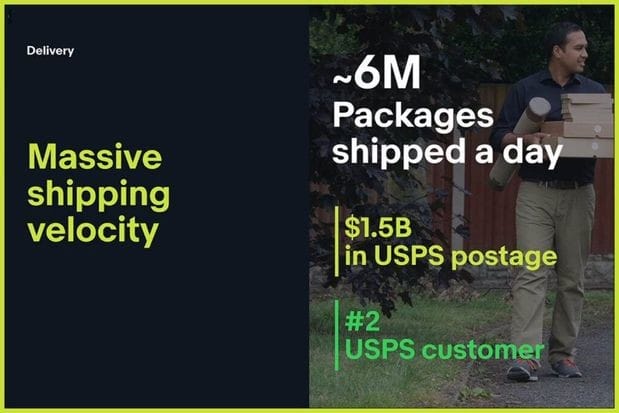
In fact, back in 2019, it was revealed that eBay was at that time the second-largest customer of the US Postal Service, and while it's not clear where eBay ranks today, it's a good bet they are still one of the largest customers for USPS labels.
But comments made by Senior Director Trust David Newman at eBay Open UK 2025 may reveal there's more than profit motive in play and that there really is a significant difference in tracking visibility for labels purchased from the platform that allows eBay to offer these protections.
First, addressing the INR protections, Newman said they only apply to shipments using eBay labels because they can see "all of the information" whereas with non-eBay labels, they supposedly "can't see it."
So, I hope you all heard the announcement—there was a lot going on with multiple sessions—but in our trust session, we talked about the new protection that's launching for item not received claims.
So, if you have an item not received claim and you pay out to the buyer and then the item arrives afterwards, we're now going to refund you that money. So that's an investment eBay's making directly with you.
And we do tie that to the use of eBay labels, because when you use eBay labels, we can see all of the information. Unfortunately, when you don't use an eBay label, we can't see it... So we're trying to put these pieces together, put investment in place so that we have your back.
On its face, most sellers would dismiss that assertion - after all, if you manually upload a non-eBay label tracking number to an order, it shows both the buyer and seller the same tracking and delivery data as an eBay purchased label would.
However, Newman then alluded to eBay also being able to provide preemptive protection on fake tracking scam returns as their partnerships with the carriers enables eBay to access an unprecedented level of data to confirm delivery - down to latitude and longitude coordinates.
Another one as I just was alluding to is carrier data. Just right before this on the other side of the stage, we had representatives from all the major carriers.
And we're working really closely with them to get an unprecedented level of data from them—so even latitude and longitude coordinates—so that anytime that there might be any label fraud on a return coming back to you, where something arrives in your zip code, shows as delivered, we're now able to see was it delivered to your precise address and protect you preemptively.
Same zip code tracking scams have plagued both sides of the marketplaces almost as long as eBay has existed.
 Liz Morton
Whether it's the original shipment from the seller to the buyer or a return shipment from the buyer to the seller, when it comes to claims and disputes involving delivery of a package less than $750, eBay's policies and dispute resolution processes have traditionally only looked for one thing - is there a tracking scan that shows delivery to the correct zip code?
That creates an easy loophole for bad actors on both sides to exploit since all that is required is to send a piece of paper or cheap plastic trinket to any address within the correct zip code or to gain access to a large amount of active tracking numbers through hacking or the dark web in order to provide "proof" of delivery to eBay and get a claim closed in their favor.
When this tactic is used by abusive buyers to commit return fraud, not only does it leave the seller out both the item and their money, it can also lead to additional penalty fees being charged on future orders if it causes the seller's Service Metrics to fall to "Below Standard."
 Liz Morton
While eBay has not officially posted any more details about protections for this kind of return fraud, Mr. Newman's comments suggest eBay is already or will soon be doing more preemptively to identify and take action in this situations, which would be a welcome change indeed.
However, his statement also suggestions that, like the INR protections, any action eBay may be taking on fake tracking return scams will also be limited to returns which use eBay generated labels - which could leave those sellers who still wish to provide their own shipping labels out in the cold once again.
In this case, the limitation would make sense though as shipping carriers can more easily share that deeper level of data with eBay when they are a legitimate party to the label transaction as the platform from which the label was purchased.
In situations where a label is purchased elsewhere from another third party label provider or from the carrier directly, eBay has no part in that transaction and those no right to access data - in fact the carriers could potentially face legal and/or regulatory consequences if they breached privacy by sharing exact latitude and longitude delivery coordinates with eBay when they are not a party to the shipping transaction.
And the cherry on top for eBay is that they do also stand to gain financially as well when labels are purchased through the platform, even if it's true that isn't the only reason they have for limiting protections in this way.
Of course that leaves many sellers in a difficult position, especially those who sell on multiple platforms, use 3rd party logistics or fulfillment services, and/or are large enough to have negotiated their own discounted rates with a preferred carrier that meets their business needs better than the rates eBay offers.
Will sellers be willing to give up control over when/where/how they purchase shipping and return labels in return for protections from Item Not Received claims and fake tracking return scams? Let us know what you think in the comments below!