USPS Seeks New Pricing Power, Enabling Larger Market‑Dominant Rate Increases Starting in 2027

The US Postal Service has filed two new petitions with the Postal Regulatory Commission, seeking to adjust the system for regulating market dominant rates by lifting price caps and eliminating payment requirements for future retirees’ pension and health benefits in effort to tackle multibillion dollar yearly losses.
USPS posted a $3.1 Billion net loss for the third quarter of fiscal 2025 with year end financials, showing a ~$9 Billion total loss for 2025.
 Liz Morton
To help address ongoing systemic problems, the Postal Service is requesting additional flexibility to price Mail and Services and to improve their precarious cash position - a move that the Association For Postal Commerce calls a shameless effort to make customers pay for USPS failures.
Shameless effort by USPS to make customers pay for its failures: https://t.co/w20Iy5QqGp
— PostCom (@PostCom2) December 22, 2025
The first proposal calls for removal of the price cap system for Market Dominant products in favor of a regulatory monitoring approach which could see Market Dominant prices rise in January 2027 by roughly 7.4% on average, not exceeding the following by class: 8% for First-Class Mail; 6% for Marketing Mail; 12% for Periodicals; 10% for Package Services; and 8% for Special Services.
That represents a high single‑digit step‑up versus typical annual changes, with some mailers fearing potential for double‑digit spike in subsequent years.


Rate Authority
The first petition requests that the PRC replace the price cap system with a regulatory monitoring approach, under which the Postal Service’s Governors would be given the authority and flexibility to establish the parameters that will govern the path of rates over a 5-year regulatory review period.As part of this proposal, the Postal Service is committing to providing forward guidance to specify: the estimated filing and implementation dates for future rate adjustments, the price “ceiling” for the entire course of the five-year regulatory review period based on the established parameters, and mail and service class-level guidance for the first rate adjustment.
The regulatory monitoring approach is the best way to properly balance and achieve the statutory objectives, including assuring the Postal Service’s financial stability, by giving the Postal Service the pricing tools we need to adapt to changing conditions while retaining a robust oversight role for the PRC.
Alternatively, if the PRC decides the statutory objectives cannot be balanced without a price cap system, we propose a rate reset, consistent with established principles of price cap regulation, in the form of additional pricing authority to give the Postal Service a meaningful opportunity to close the gap between our costs and our revenues.
Using a very conservative methodology, we estimate this would require at least 22% of additional pricing authority to be provided as a bank to be used, as the Governors deem appropriate, over the course of the regulatory review period.
Under either approach, we proposed a first-year rate adjustment at the mail and service class-level, assuming the first rate adjustment under the system would be implemented on January 17, 2027.
Market Dominant prices would rise by roughly 7.4% on average, and price increases would not exceed the following by class: 8% for First-Class Mail; 6% for Marketing Mail; 12% for Periodicals; 10% for Package Services; and 8% for Special Services.
This approach is intended to provide more time for the Postal Service to pursue other means of narrowing our losses. We believe it is prudent to be cautious in the first year, while we pursue other strategies to achieve financial stability before determining whether it is necessary to implement higher magnitude price increases.
The petition does not specify exact rate increases after 2027. Instead, it would give USPS flexibility over a five‑year ‘regulatory review’ period to decide whether to implement ‘higher magnitude’ increases later, depending on its financial condition.
If approved, this structure would allow USPS to implement substantially larger cumulative rate increases over the five‑year period than under today’s price‑cap regime, though the size and timing of any such increases remain uncertain.
As an alternative if the PRC insists on keeping a cap, USPS proposes a one‑time ‘rate reset’ that would grant at least 22% of additional pricing authority as a bank the Governors could draw on at any point during the five‑year period.
That bank does not automatically translate to a 22% increase in any single year, but it would permit USPS to layer on sizeable additional increases over time.
The second proposal seeks to improve liquidity by eliminating payment requirements for future retirees’ pension and health benefits.
Liquidity
The second petition seeks near-term relief for our precarious cash position, to allow us to continue serving the American people while the PRC considers our larger reform petition.As background, Congress has required the Postal Service to make certain payments for future retirees’ pension and health benefits. For years, the Postal Service has had to make the difficult choice to forgo these future benefits payments in order to conserve scarce cash and continue serving the American public.
In 2020, the PRC provided additional pricing authority aimed at covering a portion of these future benefits payments. As a condition of that authority, however, the PRC mandated that we commit a certain amount of revenue to those future benefits payments and away from our ability to serve the American people.
The Postal Service has complied with the PRC’s requirement to date. Given our current liquidity position, and the need for more unrestricted cash, we are requesting that the PRC eliminate the payment conditions that it imposed.
This liquidity relief request does not itself raise prices, but it interacts with the broader effort to redesign the ratemaking system that could support higher rates over the coming years.
The full petition to the PRC lays out the dire situation the Post Office is currently facing, saying:
"No organization, not even the Postal Service, can lose billions of dollars every year without consequence. Without material changes to the statutory and regulatory constraints under which we operate, the Postal Service will not only continue to incur net losses each year, but also projects that we could become illiquid by 2027."
"The Commission has a clear role in preventing such an outcome and, in fact, is obligated to do so through its market-dominant ratemaking system design."
But are these really the only or even best options the Postal Service has available to tackle mounting losses?
Ross Marchand, author of the Go[ing] Postal substack, thinks not - suggesting ending Saturday delivery, hiring more seasonal and part time vs career workers, and cracking down on counterfeit postage could save USPS ~$5 Billion per year.
 Ross Marchand
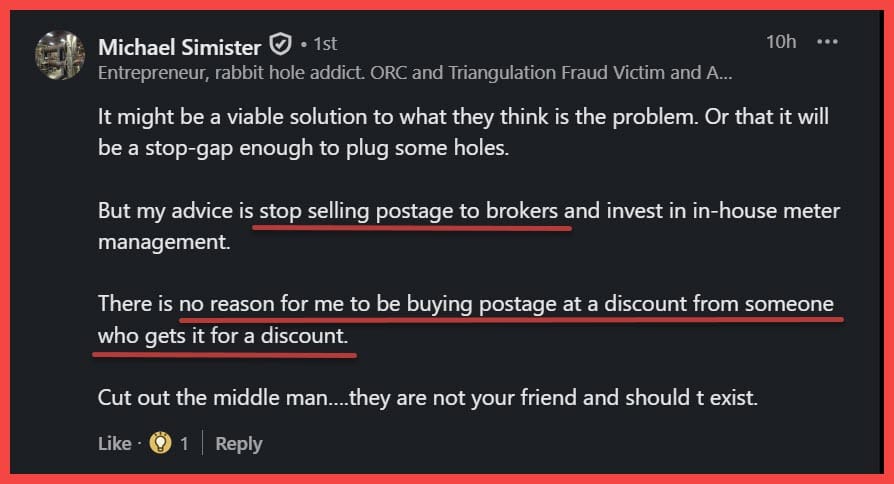
And as Value Added Resource reader Michael Simister wisely points out on LinkedIn, USPS is also missing a huge opportunity to disintermediate postage purchasing.
Shippers were ecstatic when it was announced there would be no Market Dominant rate increase for January 2026, but were already expecting the shoe to drop with an expected increase later in the year - now it appears 2027 could be even worse if the PRC grants these petitions.
 Liz Morton
Meanwhile, non-profit advocacy group Keep Us Posted has been urging support for the “USPS Services Enhancement and Regulatory Viability Expansion and Sustainability for the U.S. Act” (or USPS SERVES US Act).
The bill, introduced by Congressman Sam Graves (R-Mo.), would give the Postal Regulatory Commission the power to stop onerous stamp hikes and mail delays, limit price increases to once per-year, and institute other reforms aimed at accountability, efficiency and success like creating an autonomous Office of Customer Advocate to hear Americans’ concerns and protect the public.
While that bill is still far from being enacted into law, the Postal Regulatory Commission is also considering a proposed rule, filed in June, which would limit USPS to only raising prices once per year.
Under this proposal, USPS would be limited to no more than one price adjustment of general applicability for market dominant products “per fiscal year from October 1, 2025, through October 1, 2030, unless such rate adjustment filings only include rate decreases or are de minimis [minimal] increases.”
However, it's important to note again that would only affect Market Dominant products but it would not apply to competitive products like Ground Advantage, Priority, or Priority Express services.
If USPS is granted their petition to remove price caps for Market Dominant products, online sellers who use those services will also face additional increases in their cost of doing business since some marketplaces, like eBay and Etsy, charge their selling fees on the total sale price including shipping and tax - which means any time there's a postage increase, it's a de facto revenue and GMV windfall for the marketplaces too.
How would these proposed changes impact your ecommerce business? Let us know in the comments below!