The “End & Relist” Myth? eBay Says This Popular Seller Shortcut May Hurt More Than It Helps

The eBay Open 2025 seller conference is a wrap after 3 days of keynote presentations, workshops, Q&A and feedback sessions, but some sellers may be leaving with more questions than they started due to a very interesting claim by Senior Director of Search, Pete Dainty about one very common tactic sellers swear by to boost sales.
In the workshop Search Best Practices from eBay & Google, Dainty acknowledged part of his presentation was sure to controversial before flashing a slide which read: "Myth | Ending and relisting items is the only way to get visibility on eBay"
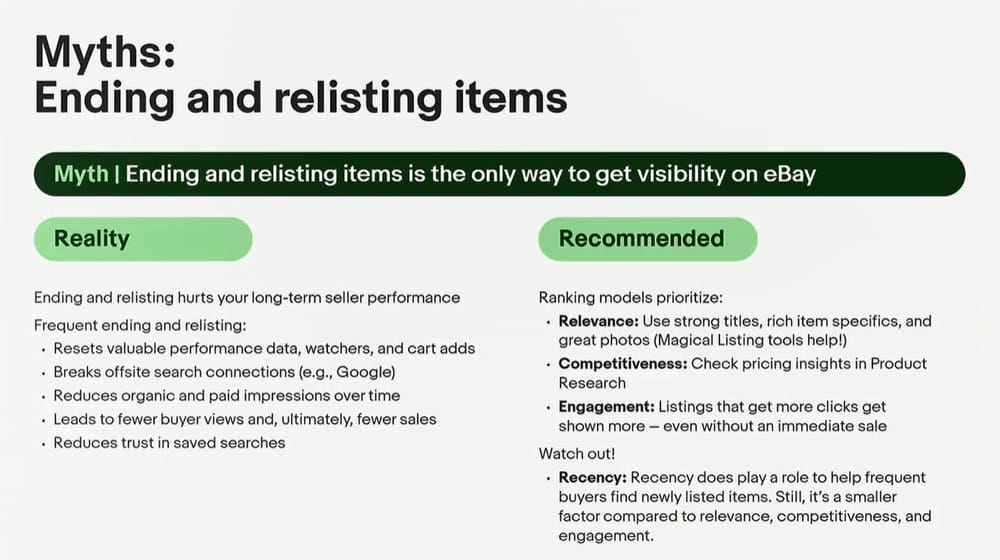
Myth | Ending and relisting items is the only way to get visibility on eBay
Reality: Ending and relisting hurts your long-term seller performance
Frequent ending and relisting:
- Resets valuable performance data, watchers, and cart adds
- Breaks offsite search connections (e.g., Google)
- Reduces organic and paid impressions over time
- Leads to fewer buyer views and, ultimately, fewer sales
- Reduces trust in saved searches
Recommended
Ranking models prioritize:
- Relevance: Use strong titles, rich item specifics, and great photos (Magical Listing tools help!)
- Competitiveness: Check pricing insights in Product Research
- Engagement: Listings that get more clicks get shown more – even without an immediate sale
Watch out!
- Recency: Recency does play a role to help frequent buyers find newly listed items. Still, it’s a smaller factor compared to relevance, competitiveness, and engagement.
And here's what Pete said about this slide:
This is a contentious one. So about ending and relisting items, right? We all think that ending and relisting is the way to get more visibility. But over time, it actually does end up hurting your long-term performance.
So for example...every time you make a listing, we have to store that listing and everything that goes with that listing. Then you end it and relist it, so we have to make a new copy of that listing and keep the old one.
Now, you make another listing and do the same thing. I have to keep the old listing, that older listing, and your new one. And you do it again and again...we have to store all of this, and we have to go back and backdate across all of it. So it is a big problem for us right now.
But that said, that’s not the reason why we don’t want to look at doing this. There’s other things that happen...we put this item into our feed for Google, and Google’s going to come and crawl and understand that and try and index it.
So it gets the item, and then, it’s going to come back in 3, 5, whatever days and fetch the item but you ended the item, it’s gone. So you’re not going to get that traffic, right?
From my experience, it takes Google about 3 days to get about 90% of our inventory. So you’re outside of that window...
...Another thing you gotta factor in is we have saved searches. So you’ll save your search, and you’re going to come back, and you’re going to look for the things that are new. Well, if you’re always ending and relisting a thing, you’re always going to be “new.” But that person who’s looking at your saved search is going to go, “I know that’s not new. I’m not going to click on it,” right?
If I do a search for newly listed, I’m going to see the same “new” listings. I know they’re not new, so I’m not going to click on them. Guess what we do with the click data? We’re showing it, nobody’s clicking it, so you know, [rankings] start going down because we’re looking at engagement. We’re trying to optimize for people buying things, right?
But it is a big problem, and we’re working on it. I understand exactly why you want to do this kind of thing as well. So we are working on that.
But if you talk to experienced eBay sellers, many of them will tell you they swear by this practice, saying they've seen first-hand that ending and relisting items that haven't sold after a certain period of time usually results in a noticeable increase in views and engagement, which also usually correlates to more sales.
So why is eBay calling it a myth and should sellers stop doing it? Importantly, I think the slide shows room for more nuance than the actual presentation provided.
For example, the slide references "frequent" ending and relisting, without providing any definition for that word - the guidance may be different for a listing that is over 30, 60, or 90 days old vs 1 week.
And under the Recommended heading, it does acknowledge that recency is a factor (which is why sellers typically use end and relist) it's just a smaller factor than other ones listed and may not always provide benefits worth taking the risk of the possible downsides listed under the Reality heading.
Since this presentation was made in partnership with Google and Google Strategic Business Lead Abby McGuckin was sharing the stage with Pete, it could also be that eBay may be feeling some pressure to cater to what Google would like to see for external search and SEO best practices (URLs that stay the same/don't break, less bounces back to search if the URL leads to an ended listing etc.) rather than providing advice tailored to how onsite eBay search works.
Sellers discussing the presentation in the eBay community forum also had this to say:
I do wonder if Pete's example is based on multi quantity listings, rather than one offs....
Ebay employees [and members and most people] are horrible with terminology and semantics. They just presume you know what they mean.
"frequent" ending" - does that mean a few days after it renews or just before it renews or every 90 days or every six months?
"...and relisting" Again, immediately, later that day, next day, next week.
We end every BIN just before it relists, and it sit on the unsold list till it makes it to the 'top' and gets scheduled for relisting. Is doing it that way an advantage or disadvantage? Don't know, don't care
The question clearly peaked the interest of some attending the conference as one seller asked about it in a later feedback and Q&A session with Product Marketing Manager and Seller Advocate Chuck Van Pelt and Product Marketing Manager Jonathan Chard.
While they stopped short of directly contradicting Pete's presentation, Chuck took it as an opportunity to say that the feedback he was going to take back about the issue was that eBay needs to do a better job of making sure they are all on the same page internally so that information is properly communicated to sellers.
Jonathan (reading seller question from Q&A): We heard from Pete Dainty, Senior director of search, earlier in his session that we should not be ending and relisting items as it's creating bad data. Yet I have resoundingly heard from other eBay employees that after 90 days listings are stagnant and you should end and relist.
So which one is correct? Also Pete did not state the length of time when discussing listings, perhaps he meant listings newer than 90 days old.
Chuck: Well, I mean my first takeaway from that question is that we have some work to do around consistent messaging on this topic.
Jonathan: Yeah. I think it sort of starts spinning theories, conspiracy theories and you're like, I see — I've seen it happen all the time where someone's like, "They said do this" and "They said do that," and it's like…
Chuck: And Pete is a data guy and I will definitely believe his opinion on, you know, whether it makes bad data. I'm not sure exactly what impact that would have on you, but I also talk to a lot of sellers who do this practice — they end and sell similar — and they say they have good results with it.
Right now what I’m advising sellers when I talk to them is that every business is different and everyone has different results, and I would encourage you to experiment if you feel comfortable and see what results it has for you, and make your decisions around facts and data in that regard.
What I'm going to do is take back to my team that we should talk about this internally and come up with some kind of consistent messaging, and maybe there’s a way to productize this, or turn it into something… a tool for you guys to have a little more awareness around, like, long-tail items in your store and how long they've been sitting, and what you can do to boost their visibility.
Jonathan: Yeah. And if you are going to do that, I would also recommend change the title up a little bit, because there might have been a reason for it to go 90 days. So do some tweaks to the listing...even though I’m sure your listings were perfect, there’s still probably some room to tweak. So make a little bit of a change when you’re doing that, just to try to see what happens.
This topic will no doubt be making the rounds across seller forums, Facebook Groups, and YouTube in the coming weeks and hopefully eBay will follow up on Chuck's suggestion to provide more consistent formal guidance around this as well as some tools to help sellers specifically manage stale inventory.
In the meantime, do you use End and Relist and will you continue doing so even after this eBay Open presentation? Let us know in the comments below!