Etsy Tells Sellers To Violate Messaging Policy, Retracts Advice Three Days Later

Etsy is apologizing after encouraging sellers to send unsolicited promotional messages to previous customers in violation of its own longstanding policies, retracting the advice three days later without addressing whether sellers who followed the instructions could face spam enforcement or other account consequences.
In a November 6 message promoting its upcoming Cyber Specials holiday sale, Etsy encouraged sellers who participated in last year's event to sign up again and contact previous buyers directly through Etsy Conversations to let them know about upcoming discounts. The message suggested that customers who had already purchased from a seller would be more likely to return if they received a reminder before the sale.
...send out a warm note through Convos letting your past buyers know that your shop is part of Cyber Specials again this year. Buyers who've already purchased from you once know your work and trust your shop. Reaching out before the sale starts gives them a heads-up and a reason to check back in when they're ready to buy.
Etsy reinforced the recommendation with specific instructions to "Head to your Convos in Shop Manager to send a message to past buyers and let them know of the discounts coming their way."
But Etsy's Seller Policy explicitly prohibits using Messages for "sending unsolicited advertising or promotions, requests for donations, or spam," a restriction that has been part of the marketplace's House Rules for years. The policy does not provide an exception simply because a customer previously purchased from a shop.
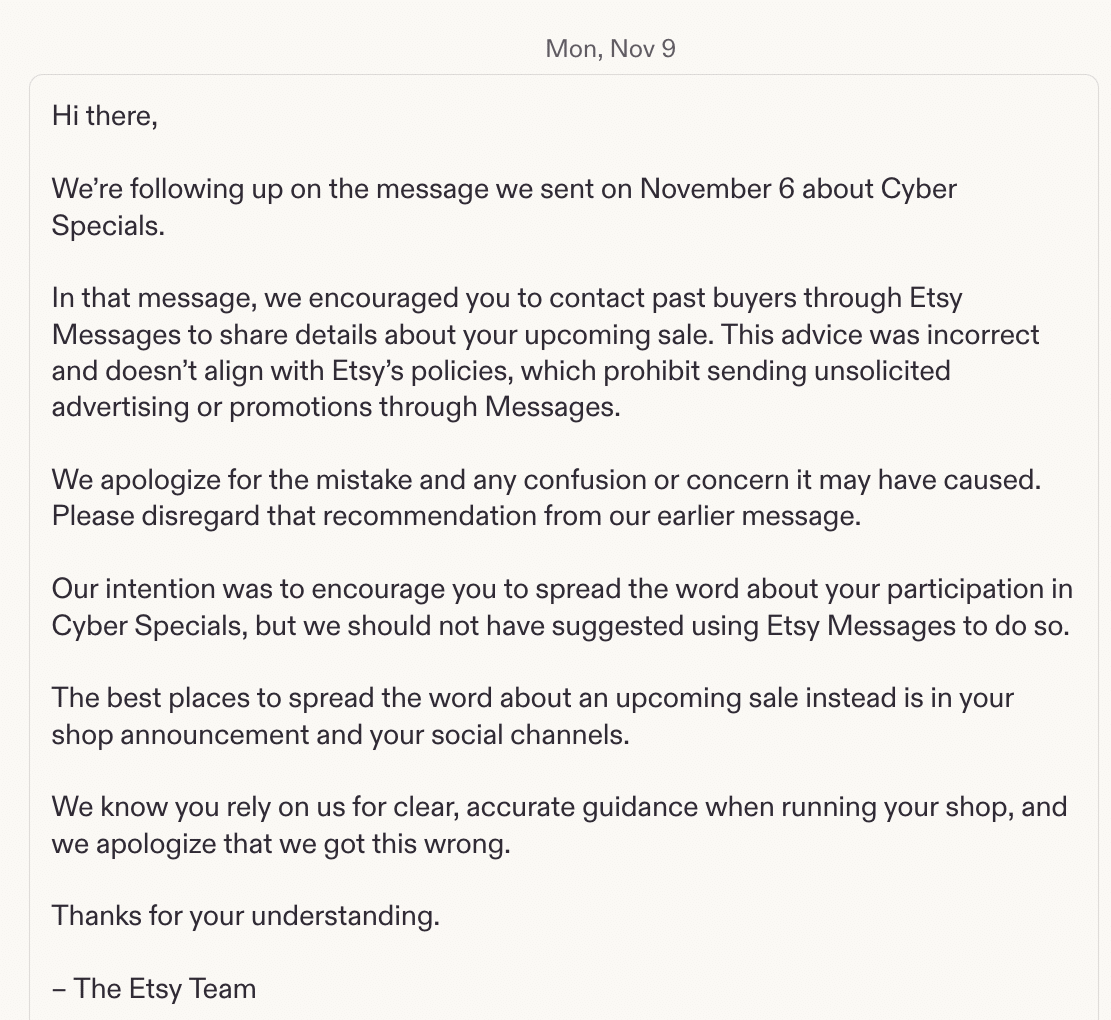
On November 9, Etsy sent a follow-up message acknowledging that its original recommendation violated those policies and instructing sellers to disregard the advice.
"In that message, we encouraged you to contact past buyers through Etsy Messages to share details about your upcoming sale. This advice was incorrect and doesn't align with Etsy's policies, which prohibit sending unsolicited advertising or promotions through Messages."
The company apologized for the mistake and suggested sellers use shop announcements and social media to promote their sales instead, adding "We know you rely on us for clear, accurate guidance when running your shop, and we apologize that we got this wrong."
However, the correction did not say whether sellers who had already followed the November 6 instructions would be protected from spam enforcement or account restrictions, despite Etsy operating automated systems that can temporarily prevent sellers from communicating with customers when their messages are flagged as spam.
According to Etsy's Help Center, the company monitors for suspicious messaging activity and can automatically mute an account for 48 hours if it determines that a certain amount of messages sent by the user are spam. During that period, sellers cannot send any messages to other Etsy users, including customers with questions or problems related to existing orders, and Etsy says support agents cannot reverse the restriction.
Etsy also allows buyers to mark unwanted messages as spam, blocking further communication from the sender, including replies to existing conversations. The company quietly changed its messaging system in February 2024 to expand the consequences of using the spam button, with buyers and sellers reporting that they were unexpectedly unable to communicate about existing transactions after messages were marked as spam.
 Liz Morton
Etsy's November 6 recommendation may also put sellers at odds with anti-spam laws in some countries, a risk the company specifically warns about in its own Seller Handbook, which states that unsolicited advertising through Etsy Messages is prohibited and may constitute a criminal offense in some jurisdictions. The guidance also advises sellers to obtain express consent before sending marketing communications and to respect requests to opt out.
In the UK, the Information Commissioner's Office says electronic marketing rules under the Privacy and Electronic Communications Regulations apply to direct messages sent through social media and similar messaging services. Those rules generally require consent for unsolicited marketing to individuals, subject to a limited exception for existing customers when specific conditions are met, including providing opportunities to opt out. In the US, the CAN-SPAM Act regulates commercial marketing emails, though whether those requirements extend to Etsy's internal messaging system is less clear.
The mistake has drawn criticism from sellers in a Reddit discussion, questioning how Etsy could send official guidance encouraging conduct expressly prohibited under its own policies and speculating that AI may have been involved in the creation of the original message.
Either they used AI or they didn't bother running it through someone who knows policies (which is very worrying to say the least)...
...Admittedly, I didn't even bother opening that first message, I didn't appreciate their spam (yes, i considered that a spam). And today, when I saw the second message, it annoyed me because it seemed really pushy but eventually clicked on it and was gobsmacked to see it. Well done etsy for this big mess up that you wouldn't expect from an ecommerce platform with 15+ years in business.
Etsy has not explained how the conflicting instructions made it into an official seller communication or said whether it will make exceptions to its spam enforcement policies for sellers who followed those instructions before the November 9 correction.