eBay Sellers Report PPC Promoted Stores & Priority Ads Overspending Daily Budgets By 2X

eBay sellers who use Promoted Listings Priority or Promoted Stores cost per click ads say campaigns are overspending daily budgets, highlighting transparency concerns as important policies remain buried in fine print.
When the first cost per click ad product was introduced by eBay in 2021, the budget settings were a straightforward maximum daily amount - once that maximum was reached on any given day, ads would turn off for the rest of the day and start up again the next day to run until/unless the budget was met.
But in 2024, eBay made several major changes to Promoted Listings, including introducing "dynamic target daily budgets" for cost per click options like Priority and Promoted Stores.
 Liz Morton
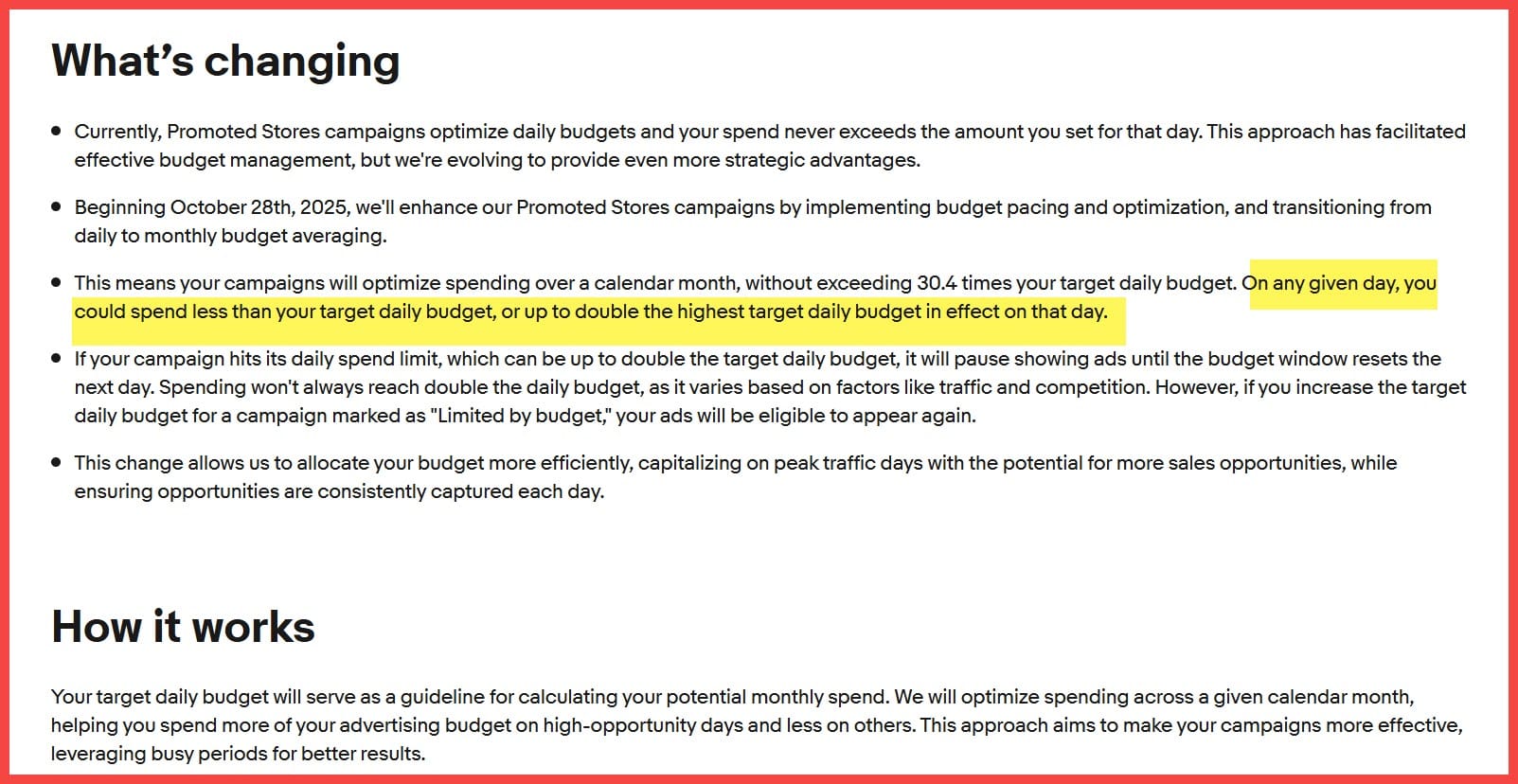
The "target daily budget" is just that - a target, not a hard limit - and the terms say eBay can go up to double your daily budget on some days, less on others, with the idea it will average out over time.
But many sellers are being caught unaware of how their ad budgets may be spent, taking to social media with concerns about apparently being overcharged for cost per click ad fees.
Also had a promoted listing priority campaign which went way over budget and cost more money than sales generated. I highly suggest sellers avoid these rip offs. FEEbay needs to get this figured out. You should not be encouraging sellers to utilize this nonsense. pic.twitter.com/g5WW85eCcl
— Chris Doetsch (@LLSportsCards) December 16, 2025
A recent post by a different seller in the eBay community forum raised similar concerns, saying they have their daily budget set at $100, but eBay has been charging them $200 per day.
I JUST CANCELLED MY PROMOTED STORE CAMPAIGN. I ONLY ALLOWED $100 PER DAY AND EBAY HAS BEEN TAKING $200 PER DAY. THIS MORNING TOO!!!!!!! SO FRUSTRATING. WAY TO GO EBAY. YOU'VE BEEN TAKING $200 A DAY FOR WEEKS. I JUST REALIZED THIS THE OTHER DAY. WILL I GET MY $$ BACK????????? ASKING FOR SOMEONE TO CALL ME TO CLEAR UP THIS MESS IF YOU EVER WANT ME TO USE A PROMOTED CAMPAIGN AGAIN!
Unfortunately for these sellers, this is exactly how eBay Promoting Listings Priority and Promoted Stores cost per click ads work - by opting in to these ads, you are agreeing to allow eBay to dynamically adjust the daily rate up to 2x the "target" spend.
Initially, eBay used weekly budget pacing for these campaigns, but changed Priority ads to monthly pacing in May 2025, with Promoted Stores campaigns following in October 2025.
 Liz Morton
Here's how it works:
Your target daily budget will serve as a guideline for calculating your potential monthly spend.
eBay says it will optimize spending across a given calendar month to target budget spend on high-opportunity days and less on others, without exceeding 30.4 times your target daily budget.
So if you set your daily target at $10, the maximum total spend for the month will be no more than $304 ($10 x 30.4) but how that gets used across each day can change - for example, some days it might be $12, others it might be $8 etc. with the maximum on any single day being $20 (double the $10 target).
The impact of the change may depend on when and how you make changes to your campaigns at different times of the month, so eBay also provides the following examples for a few different scenarios:
Mid-month campaign start: Your total monthly spend will not exceed your target daily budget multiplied by the remaining days in the calendar month, including the start day.
- Example: If you start a new campaign with a $10 target daily budget on January 15th, there are 17 days left in the month (including the 15th & 31st). Therefore, the maximum spend for the remainder of the month would be $170 ($10×17 remaining days).
Mid-month budget adjustment: Your total monthly spend will not exceed the amount already spent plus your new target daily budget multiplied by the remaining days in the calendar month.
- Example: If you raise your campaign's target daily budget from $10 to $15 on January 15th, assuming you've spent $150 by then, your total monthly budget will increase from $304 to $405 [i.e. $150 + (17*$15)]. Therefore you will have $255 left to spend for the rest of the month.
Mid-month campaign end: Your total monthly spend will not exceed your target daily budget multiplied by the number of days from the start of the calendar month up to and including the campaign's end date.
- Example: If your campaign starts on the 1st with a $10 daily budget and is set to end on the 15th of the month, the maximum spend for the month would be $150 ($10×15 days, including the 15th)
eBay's justification is it allows them to maximize your budget on "high opportunity" days while spending less on other days and keeping the same total monthly budget.
But in practice, sellers say that since eBay can use up to double the daily target budget on any given day, this model often maxes out their total monthly budget very quickly and once that happens, sellers are "nudged" to increase the budget to keep their ads running.
That makes monthly budget pacing a sneaky way for eBay to ratchet up ad budgets beyond what sellers may have spent under the previous model.
eBay of course is not the only company which runs cost per click advertising by this model - this change actually brings them more in line with others like, Google Ads which similarly average out daily budget over a 30 day timeframe.
But eBay's ad offerings are often targeted at small business or consumer sellers without the background, experience, or knowledge that many advertising professionals or agencies may have.
That makes it easier for these sellers to be overwhelmed, confused, or taken for a ride by policies which are intentionally complex, filled with corporate or legal jargon, and/or outside of industry standard practices - and that's assuming they even actually see the terms that explain how "target daily budgets" work in the first place.
When setting up a Promoted Stores or Priority cost per click ad campaign, the main screens don't explicitly state anything about the "up to double" terms, they simply say "Your target daily budget determines how much you could be charged for clicks on your ads" with a "Learn more" link.
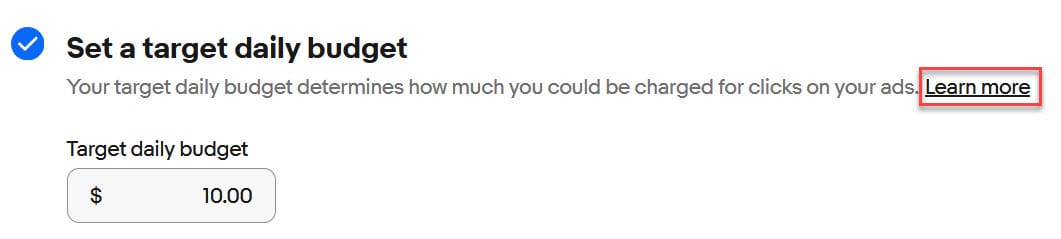
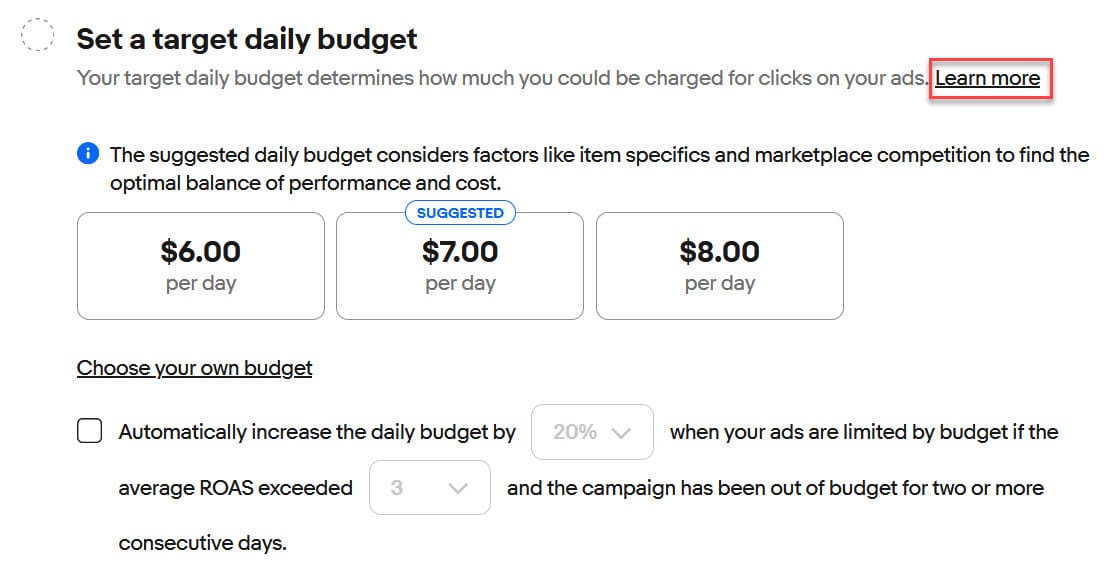
But since that statement seems fairly straightforward, it's understandable that many sellers may not feel the need to click "Learn more" and will instead simply proceed under the again understandable assumption that whatever they set for the daily budget is a hard limit maximum, not a guideline that can be doubled at eBay's discretion.
Technically, eBay has legal cover because if you do click "Learn more", the terms are spelled out more explicitly, but if they actually cared about transparency and earning goodwill with sellers, they wouldn't hide it a non-obvious click away.
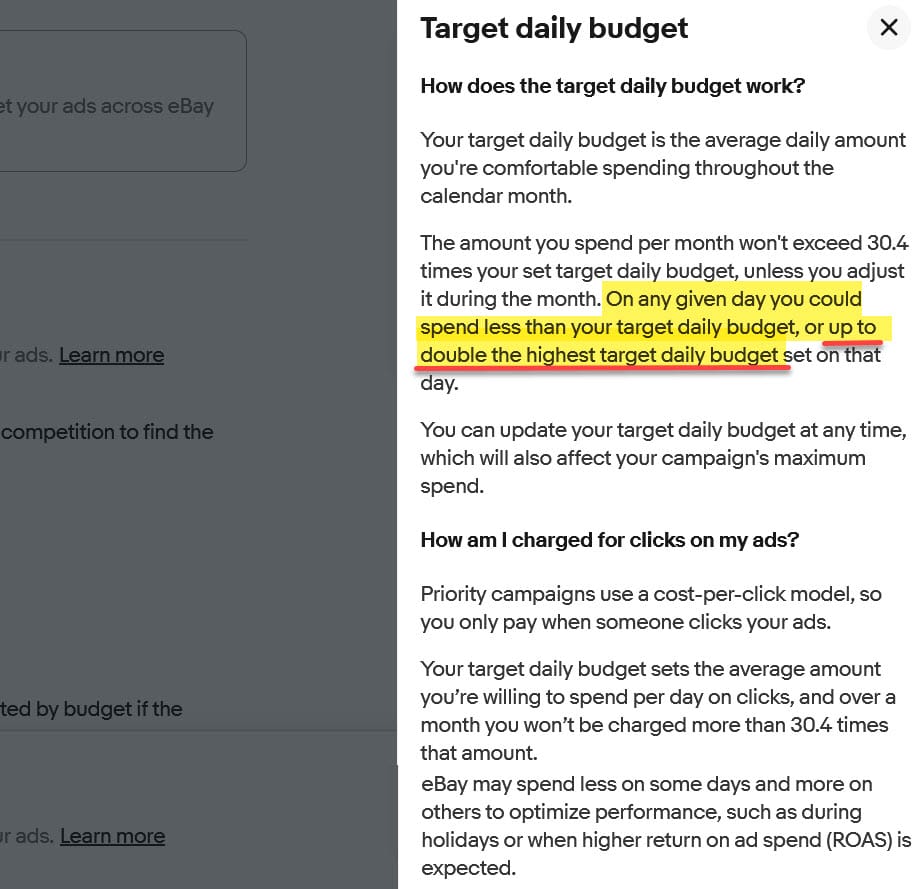
Sellers have also grown weary of shady at rate shenanigans with eBay making stealth updates in Q4 2024, first raising the Promoted Listings General Dynamic rate minimum from 2% to 5% and then instituting a massive 10X minimum bid increase on Promoted Listings Priority cost per click ads, going from $0.02 to $0.20 per click - with no notice to sellers.
Beyond playing around with rates, eBay has moved to increase ad attributable sales through user experience changes like manipulating social share links and introducing a new attribution model which has exponentially increased ad attribution while not providing any significant increase in sales or ROI.
 Liz Morton
And these are likely not the only major changes we'll see to Promoted Listings ads in 2026, as eBay is taking inspiration and strategy cues from Amazon in quest for continued ad revenue growth and tinkering with Promoted Stores cost per click ads as well.
Unfortunately for eBay, these shady tactics may backfire as sellers wise up and either stop promoting all together or reduce their budgets - as the seller in that community forum post so aptly put it:
So if I really wanted to just spend $100 per day I should only put $50 for my campaign. Ahhh, the small print no one reads....
Sellers are encouraged to share their concerns about attribution updates, "daily target budgets" and other eBay ad policies with the FTC and/or their state attorney general's office with calm, factual and data-based reports about how these changes are impacting their businesses.
 Liz Morton