eBay's Mixed Messaging On Payout Holds & Delays: A Call For Transparency

eBay signs small business payments pledge, promising transparency and fairness when applying holds on seller funds - but sellers continue to be left in the dark on policy delaying payouts until after delivery.
The Office of the Small Business Commissioner (OSBC) in the UK urged marketplaces and payment providers to commit to fair treatment of small business sellers, with PayPal, Temu, OnBuy, Stripe and more joining eBay in signing the pledge.
 dantekellmanthompson
Signatories agreed to 10 key points:
- If accounts are reserved or funds withheld, inform the small business promptly with transparent communication including as far as practical (subject to legal restrictions) information on the reasons for holding funds and timelines for the hold.
- Provide as clear details as possible as to what steps need to be taken to release funds that are withheld, if permissible under applicable laws.
- Aim to implement effective and efficient processes to undertake relevant checks, aimed to limit any disruption to cashflow as far as possible.
- Provide clear terms and conditions around withholding funds and clearly communicate any material changes to sellers.
- Where investigation shows no legitimate reason for holding funds remain, or where sellers have met all obligations asked of them, ensure funds are released as quickly as practical.
- Ensure that any decision to impose penalties or require refunds from small businesses is evidence based.
- Where funds are withheld from a small business, have a process in place to undertake a timely individual case review in response to customer complaints.
- Enable small businesses to appeal decisions, allowing them to provide further evidence to support their case.
- Not deliberately target sellers with working capital solutions, outside of general advertising, when funds are being withheld in an attempt to profit.
- Work constructively with Government and the Small Business Commissioner in promoting this good practice to small businesses.
Eve Williams, VP and general manager at eBay UK, said:
“We want to make sure that our sellers get paid as quickly as possible, especially the hundreds of thousands of small businesses who use our platform every day. We know how vital cash flow is to allowing small businesses to invest and grow."
“Sometimes we have to hold payments either because of regulations or as part of our efforts to ensure a safe marketplace for our buyers. However, this should be the exception rather than the rule. We therefore welcome this initiative by the Small Business Commissioner to help businesses get the support they need to grow.”
But far too often business sellers in the UK, US and other markets are finding holds and delays on funds are in fact the rule not the exception with eBay - with confusing and conflicting information provided by support and no clear path to getting payouts back on a standard schedule in sight.
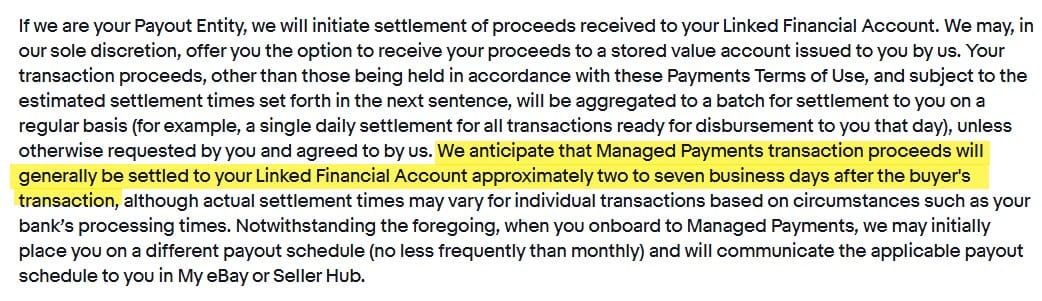
Some US sellers started having their funds delayed until 2-3 days after delivery confirmation earlier this year after eBay made a change to their Payments Terms of Use in December 2024.
 Liz Morton
Tucked away in the Additional Terms For Services Provided By eCI (eBay Commerce Inc.), the entity that handles payment processing for the US/.com marketplace, was this change that allows eBay to delay payouts for "some" sellers.
Old Version:
New Version:
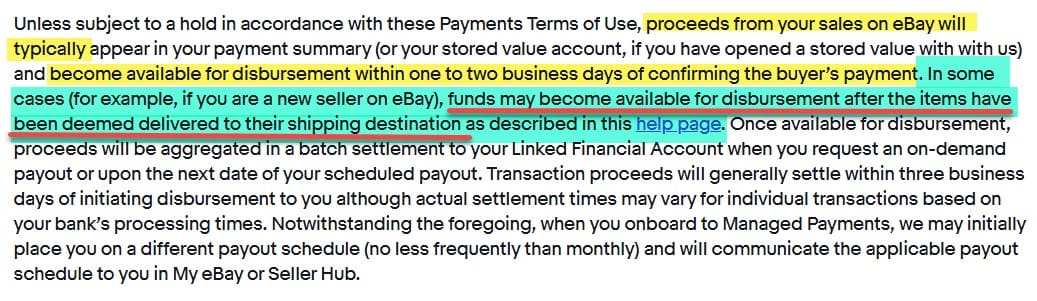
"In some cases (for example, if you are a new seller on eBay), funds may become available for disbursement after the items have been deemed delivered to their shipping destination as described in this help page."
That new section means that in some situations, US sellers will have their funds held until after delivery - but crucially, it does not provide any more detail about to which sellers or in which situations this new policy will apply, instead it just uses a generic term of "some sellers."


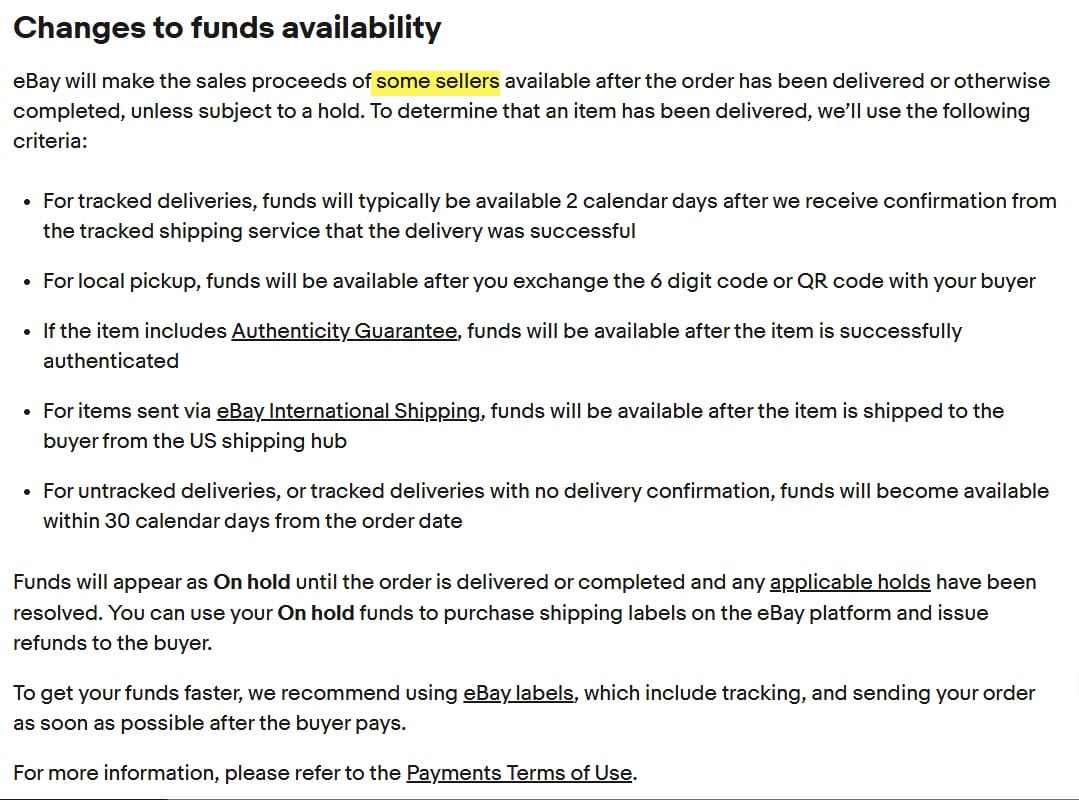
Anecdotally, most sellers I've seen affected by this policy all appear to have tripped at least one risk factor, including but not limited to: being a new or infrequent seller, having unresolved claims from buyers or account defects, or having unusual selling patterns like a sudden increase in the number of sales or average value of items being sold.
But to add insult to injury, when sellers contact eBay support, they are being told this new policy will eventually be applied to all sellers on the platform - and alarmingly, that information has been directly contradicted by eBay community personnel in the US, UK, and Germany, leaving sellers wondering who they should trust and what's really going on with these holds on funds.
Here's the email notification sellers receive once this policy is applied to their account.
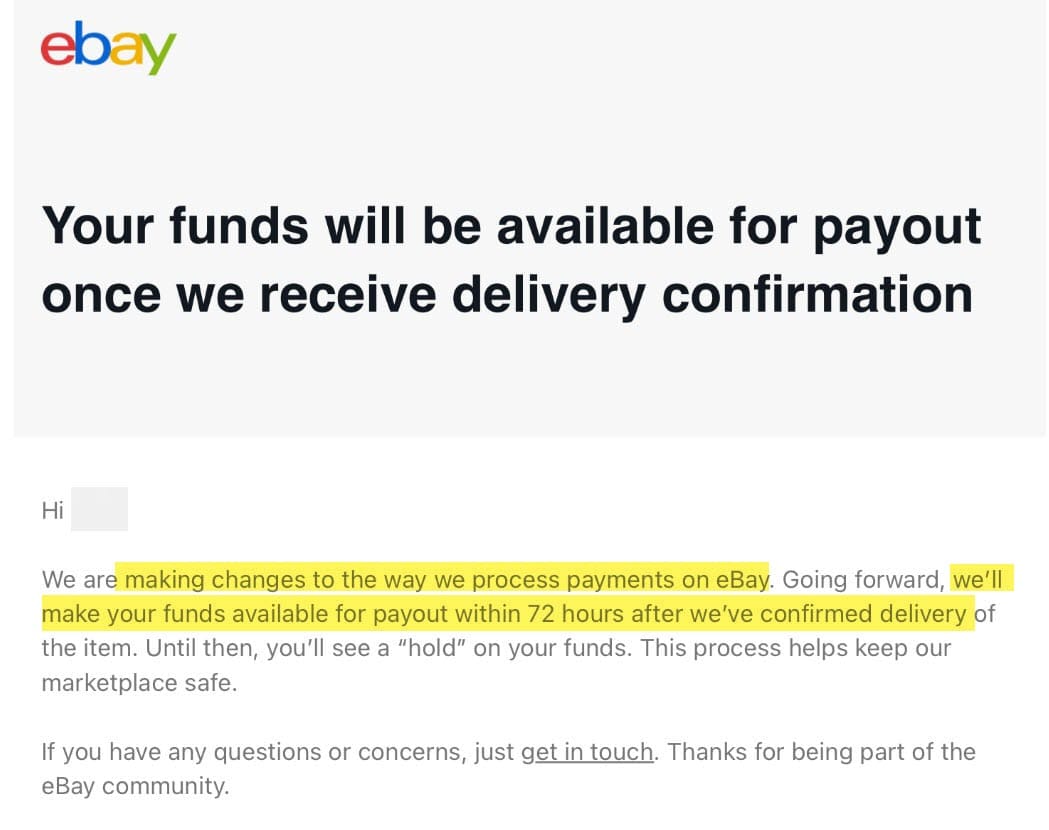
The first sentence makes it sound like it is a sitewide change that will apply to all sellers, but the second sentence is clearly just specific to the individual seller's account - and it importantly it fails on just about every point of that 10 point pledge.
When sellers contact customer service to have their questions or concerns addressed, the poorly trained overseas support reps often tell them that the action is not being taken due to any performance issues and that all sellers will eventually have payouts held until after delivery, giving varying dates for when that full rollout is supposed to happen.
And the same confusion is happening for sellers across the UK, Germany and eBay's other markets, with staff in eBay's community forums directly contradicting what support is telling sellers.
In a November 2024 thread about this topic in the US community forum Kyle@eBay confirmed that the payout delay would not apply to all sellers:
....this is absolutely correct! As you pointed out, there are instances where a seller may be subject to holds like this, but it is not something that will be occurring on all transactions on the site.
Kat@eBay in the UK community told sellers in June 2025:
Just to confirm that no there isn't any change to the payout rules for business accounts. What they may have been referring to was the change for private sellers that was introduced earlier in the year. This does not apply to business sellers.
Business accounts that are having funds held for longer periods would be for performance reasons for that account only. We are not able to check individual accounts here but these holds are usually temporary.
And Miriam@eBay told German sellers in July 2025 (translated by Google):
To ensure a secure marketplace, in some cases we may need to take precautions with certain accounts. If we detect certain changes or unusual sales patterns on an account, this may result in a delay in the availability of funds for withdrawal. For example, funds may not be available until three days after item delivery is confirmed. We carefully review each situation to promote a positive shopping experience.
This measure will not be applied to all sellers in Germany, but only to those where changes or unusual sales patterns have been observed.
But the communication breakdown continues as more sellers in the last few months have had this delayed payout policy applied and regular support continues to tell them that this will be the standard payout policy applied to all accounts in the near future.
I personally don't believe eBay will be delaying payouts in this way for all sellers for several reasons, chief among them is that eBay already tried applying a similar policy just to private sellers in the UK and has already backtracked under pressure.
Starting in February 2025, all private (non-business) sellers in the UK had payouts delayed until 2 days after delivery confirmation for tracked shipments or 14 days after order date for shipments without tracking as long as the buyer didn't report any problems.
 Liz Morton
It went over like a lead balloon - before it even started, eBay made the concession that untracked shipments would have funds released and not have to wait the full 14 days if they got positive feedback.
Then in March it was more concessions, saying "selling a single item for £25 or less, funds will be available instantly if positive feedback is received from the buyer*. This will apply on both tracked and untracked orders" or if the order was shipped with Simple Delivery, "we’ve reduced the payout time so funds will now be available 8 calendar days from the order date or 2 calendar days after we receive delivery confirmation, whichever comes first. "
Then in April that £25 concession we went up to £750: "we expanded the eligibility criteria by raising the item cap on tracked orders from £25 to £750. This means you can benefit from your funds being released faster for more of your transactions."
And then finally in August they went back to this for most private sellers (because the criteria is ridiculously easy to meet) and it's basically what the old policy was.
 Liz Morton
We’re also making it easier and faster for our more experienced sellers to receive their funds. This means you can get your funds within 24 hours of the buyer paying. To qualify for faster payment, all you’ll need to do is:
- Complete at least 10 sales with a total of £150 or more within the last 5 years
- Maintain 2 or fewer cases in the last 12 months
If receiving pushback just from private sellers alone in one of their smaller markets was enough to make eBay almost do a complete 180 on this idea in ~6 months time, the backlash from attempting to apply it to all sellers in the US would be so enormous that I honestly don't believe eBay would dare to try it.
But understandably that is little comfort for the sellers who have had payout delays applied and who have been unable to get any answers from eBay about what caused it and when/if the delay will ever be lifted.
Sellers had hoped that an announcement from the August 2025 seller update would provide some relief on this subject as eBay promised to take a "more flexible approach to managing fulfillment risks."


What you need to know
To help keep eBay a trusted marketplace for everyone, we monitor for risk factors that a seller may not be able to fulfill an order as expected.To help minimize potential disruptions for sellers as we complete these reviews, we've improved how we spot and address potential fulfillment issues—helping to keep your business running smoothly and reducing the need for action on your part.
Based on your feedback, we’ve made our review process for potential fulfillment issues more flexible. This way, we can better address your individual situation if any concerns come up.
Before this, if a potential risk was identified, restrictions could be placed on your account or listings while we manually reviewed orders to confirm delivery.
With the revised process, we’ll take a more flexible approach. In most cases, you'll get the chance to resolve the concern before any action is taken.
We’ll also use tracking information to automatically release funds once orders are shown as delivered. This change helps prevent account disruptions while maintaining a trusted marketplace for everyone.
What it means for you
If we contact you about a concern, we’ll provide clear, specific steps to help prevent restrictions—such as resolving unpaid balances, closing open claims, or uploading tracking information.With these improvements, any next steps will be easier to handle, so you can keep growing your business. You won’t need to take any action unless we reach out to you directly.
We’re working to cut down on disruptions and keep communication clear, so you can focus on what matters: selling on eBay.
But 2 months later, eBay has still completely failed to live up to those promises as more and more sellers report experiencing delayed payouts and zero support from eBay to help resolve the issues.
It's far past time for eBay to make a definitive, transparent public statement about what criteria may trigger these payout delays; direct action affected sellers can take to resolve the issues and whether the delay is permanent or can be lifted; and if they really do plan to apply it to all sellers, the exact date that policy will go into effect.
If eBay continues to refuse to provide that basic level of communication about these policies, sellers should report them to the appropriate regulatory authorities like The Office of the Small Business Commissioner in the UK or the FTC or the Consumer Financial Protection Bureau in the US.