eBay Faces Tough Seller Questions Over Controversial Promoted Listings Ad Attribution Policy Shift

UPDATE 11-20-25
eBay seller and YouTuber Casa Chic has now also posted an interview with Kye and Rishi from eBay about the new Promoted Listings General attribution policy coming in January 2026.
eBay’s latest advertising policy update is prompting pushback from sellers who say new attribution rules could massively increase the amount they pay in Promoted Listings ad fees without any real benefits or return on investment.
Seller Liz O'Kane from Colorado Reworn hosted a Seller Circle meetup about recently announced Promoted Listings ad attribution changes yesterday, with eBay Ads Senior Product Marketing Manager, Kye Mou, on hand to answer seller questions about the controversial update coming to the US in January.
Mou joined the eBay ads team last year after 10 years shaping and leading ad strategies at Google and was accompanied in the meeting by Product Marketing, Retail Marketing, Merchandising, and eCommerce Leader, Scott Hankal; Product Manager Rishi V.; and Community Program Manager, Kayomi Kayoshi.
Sellers have been taking to the eBay community forum and social media to express their outrage over the new Promoted Listings ad attribution policy which will expand the number of sales on which eBay will collect ad fees - but this is the first opportunity they've had to engage directly with eBay on the subject in a live virtual event.
 Liz Morton
Attendees raised questions and concerns about paying more ad fees while not getting more sales, lack of transparency and reporting, potential click fraud or clicks with no intent to buy (like other sellers doing research), and the multi-billion dollar question - how does eBay justify taking ad fees on sales where the buyer may have never even seen or clicked on an ad?
Click Fraud/No Intent To Buy Clicks
Both the host and sellers in the chat asked how eBay will be protecting them from nefarious or malicious click fraud (where a competitor might repeatedly click their ads in order to try to trigger attribution for any eventual sales) as well as non-malicious but still no intent to buy clicks (like other sellers doing item research or looking for an item to "sell one like this" from).
Mou and the other eBay employees were quick to talk about the "robust systems" they have in place to detect and mitigate nefarious or fraudulent clicks - but failed to explain how they would differentiate non-malicious no intent to buy clicks from other sellers.
So in the instances where somebody else, another seller says hey I have an item like this. Let me go search for it. Oh look at the first listing that looks good. Let me click into it and it happens to be a sponsored listing right or promoted listing.
And then they go into the lower left and they say I want to sell one like this or save the draft of whatever the description attributes etc are. That would trigger an ad click in that scenario.
Now the statement that I would make on top of that is eBay does deploy very robust anti-click fraud and anything that we deem to sort of be a nefarious click.
eBay tracks and monitors and essentially will take action against those. So there are going to be cases in which what I think you're getting at is the
intent doesn't match up with the actual ad click, right?And yes, those instances will happen here. What I've requested from our product team and our analytics team, our engineering team is actually to look into that data to better understand just how frequent those instances are and what type of actions, if any, need to be taken as a result of it.
Paying More Ad Fees But Not Seeing Significant Increase In Sales
Liz asked Kye to address the results which have been shared by sellers in the UK, EU and Australia where the new model is already in effect - saying some have seen ad attribution rates rise from about 50% to 80% of their sales without getting a significant increase in the number of total sales overall and asking if eBay has data that differs from what those sellers report.
Unfortunately, he declined to share any data about sales lift, but did confirm that sellers can expect to see their attribution ratio increase, which will likely result in paying more Promoted Listings fees.
So from a sales lift perspective I don't have any data at least substantial data to share here but what I can say is that yes, what we call the attribution ratio will increase...
...Right now how much that increases is going to be dependent on the seller and ultimately their promotion strategy...So across those different factors, yes, in aggregate and on average, we will see a higher percentage of sales and fees attributed to ads.
Transparency and Reporting
Many questions in this session revolved around lack of transparency in reporting, with sellers saying once the new model goes into effect, Return On Ad Spend (ROAS) will be a meaningless number since the click on the ad may now be completely divorced from the eventual sale of their item.
Kye, Rishi and Scott all pushed back on this idea, saying they don't agree ROAS will be meaningless because the click on the ad gives the listing an algorithmic boost, so the seller is getting the benefit of that ad interaction, even if it's indirect and the eventual sale happens from an Organic view.
Rishi said:
In general, whoever clicks on any of the listings, that is an interaction. Interaction can help improve our algorithm to learn there is interest in this item. So there's always going to be help overall in the long run for helping improving the rankings. Right?
So with ads you get some clicks. Now without ads that may not have shown up on those slots and would not have received those clicks.
Because of the ad, these clicks can eventually end up showing up higher organically as well as via promoted. But...that organic listing directly or indirectly was helped with the clicks on the ad.
This is the first time I can recall an eBay employee so explicitly admitting that clicks and activity on Promoted Listings ads directly impact the algorithm for onsite Organic placement too.
That certainly explains why many sellers report if they lower their ad rates or stop promoting completely, they don't just lose the traffic attributed in reports directly to ads, they also see their onsite Organic traffic go down too.
But that puts sellers in an untenable and unfair situation - using Promoted Listings may still technically be "voluntary" but in many categories you have to use ads to have any chance of maintaining consistent sales volume and once you start, you can't easily stop or else you risk losing Organic ranking too.
Liz and sellers in the chat also took the opportunity to push for more transparency and better reporting over all, including that it would be helpful for those using Promoted Listings General and/or paying for a Store subscription to have access to the same kind of keyword research that is available for Promoted Listings Priority cost per click ads.
While the eBay team did not make any specific promises, Rishi hinted at improvements to reporting and analytics coming next year.
How Does eBay Justify The New Ad Attribution Model?
Kudos to Liz for directly asking the question that is on everybody's minds (and stated so perfectly by one seller in the chat):
"What is the logical rationale for the new attribution model, which appears to be nonsensical to anyone outside of eBay? Is there any reason for it other than to extract more fees? If so, why not just increase the final value fee?"
Kye responded by trying to sell the idea the new model is simpler and allows sellers to have more control, which are improvements he believes justify paying more in fees:
..there's sort of three things here...we're approaching this from a simplicity perspective, a control perspective, and there's a pricing component to this.
So when we talk about simplicity...today we have Halo and direct attribution. We are moving from a two sort of attribution logic model to a singular attribution model whereby now your ad fees are more predictable because any click and if it's purchased you pay the ad fee.
And then we talk about control. As a result of that update to the attribution logic, now you get to essentially say when I don't want to pay an ad fee, I can turn off promoted listings and not pay any ad fees...
...Then we get to price which is, because of the changes, the attribution ratio increases and therefore more sales are attributable to ads and ad fees in general sellers will see increase.
Now the degree to that increase is on a seller by seller, category by category basis. But those are the three components of the way that I think about this change.
Rishi was once again more direct about the reason eBay believes the attribution model makes sense, referring back to the fact that interactions with ads give sellers a boost in Organic ranking as well and saying that the previous models (and ad fees being paid) didn't accurately account for the value sellers supposedly get from ads.
...the moment you get any interaction with your ad. It improves your internal algorithm, helps improve your ranking in the long run.
That was not accurately measured or priced as of now...we are going towards making PL general as accurately priced as it should have been, which was way lower priced so far, which on the reverse side looks like a cash grab but it's not, it's basically trying to accurately price what it should be.
Translation: eBay thinks sellers should have been paying more for the "benefits" of Promoted Listings ads all along and sellers should just be happy they got it at a lower price for years, but now it's time to pay up.
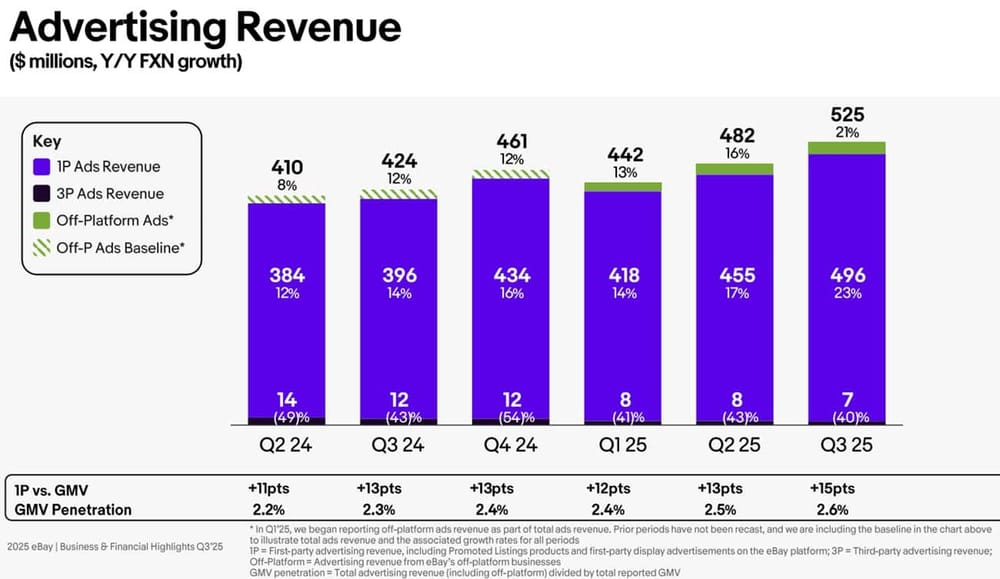
So eBay took in ~$1.6B in first party ad revenue (all Promoted Listings) in 2024 and is at ~$1.4B just for the first 3 quarters of 2025 - but apparently we're supposed to feel sorry for them supposedly getting ripped off by sellers who (according to eBay) haven't been paying for the full value Promoted Listings theoretically provides?
Kye added to Rishi's answer by saying they are "recalibrating" the price of Promoted Listings ads to more accurately reflect the connection that Promoted Listings performance can have on Organic, non-promoted performance.
What Rishi is talking about is actually the connection between promoted listings and non-promoted or organic listings, right?
Which is to say the clicks and the sales that a seller gets from a promoted listing inherently benefits the overall performance of the listing even from an organic perspective.
So the algorithms that we use for ranking take multiple factors into consideration. One of them being historical performance. So, as you use ads and as those ads help your listings boost higher up in search and show up in other highly visible places, they are accruing performance history.
So when you say there's no longer any connection, I don't fundamentally believe that is accurate, because there is a connection between historical performance of your paid listing and your organic listing.
However, when sellers took the next logical step to ask about strategies like possibly promoting an item for a short amount of time to get some ranking benefits, but then turning off promotion before they get a sale to avoid paying the ad fees - Kye started to walk back the earlier comments, saying it's only one component in a complex system and sellers shouldn't change their strategies because of it.
I'll be a little bit more transparent here which is that's exactly the reason why we didn't want to share that component because we don't want sellers to change the way they approach their selling strategy based on a singular component of what is a very complex system.
So when I talk about historical performance, historical performance is one of many factors that are taken into consideration by the algorithm. So what we don't want sellers to do is to hang their hat on something like that and say, well now my strategy is going to be this.
When in fact that is going to look very different based on the listing quality, right?
Your ad rate, your selling category, the competition around you... All of these things need to be taken into consideration when we think about what is going to be my listing and promotion strategy versus well because you told me when you release this product that there's this component here and that's the thing that I'm going to then sort of ride off to the sunset on.
Some savvy sellers in the chat noted that if that is true and it's only one component of many, it's not as valuable as eBay says and thus does not actually justify the massive ad fee increase most will see under the new model - but the eBay team did not address those observations any further.
The rest of the 2 hour discussion was wide-ranging, touching on other topics in addition to ads - and while they said it was being recorded to be shared internally with eBay, unfortunately they do not plan to publish it anywhere publicly for sellers who couldn't make it live to watch a replay.
While attendees may not have left the event feeling any better about the changes coming next year, they were appreciative of Kye and the eBay team being willing to engage with their often pointed and passionate questions and feedback.
My Thoughts
Sellers should absolutely take opportunities like this to engage directly with the company about the new policies, but eBay has often historically been swayed more by public efforts to advocate for change - so don't stop making your voices heard across social media and other avenues outside of corporate controlled "walled-garden" forums and events as well.
If you still have concerns about how eBay's new ad policies will impact your business or believe they are unethical, unfair or may constitute deceptive business practices, you can file a report with the Federal Trade Commission.
 Liz Morton
Don't be thrown off by the FTC form and website mentioning fraud - you can select "unfair/deceptive business practices" as the reason for your report and then give details about why you believe eBay's ad practices should be investigated.
Sellers can also contact their State Attorney General's offices and/or consumer protection divisions - if you don't know who to contact for your specific state, you can find that information:
Pro Tips For Reporting eBay's Ad Practices
You are protected: The FTC does not share identities of those who file reports and you can request confidentiality in reports to AG's offices as well - tell them "I have an active eBay seller account” and request anonymity if you have concerns about retaliation.
Stay calm and factual: regulators notice transparency issues before they notice outrage. Provide as much detailed data as possible about the estimated impact these changes will have on your specific business.
Support and encourage fellow sellers: encourage other sellers who will be affected to also file their own reports.
Share examples of your reports either privately or publicly to help others navigate the process and feel more comfortable with advocating for themselves and others.
Remember, the more sellers who file, the more reasons the FTC and other authorities will have to possibly investigate and act.
Beyond that, I'm currently working on other potential actions sellers can take to pushback against eBay's ad attribution overreach.
If you are an active eBay seller who is willing to go on the record about how these changes will impact your business, I'd love to speak with you! Contact VAR