Smarter Selling Or Silent Summaries? eBay AI Raises Transparency Concerns

UPDATE 9-8-25
CEO Jamie Iannone's comments at Goldman Sachs Communacopia + Technology Conference 2025 appear to confirm that eBay is using AI to alter seller provided images for offsite advertising purposes (emphasis mine).
We have the original format we launched ten years ago—promoted listings general, our CPA continues to be our largest contributor to growth. We’re leaning into new formats like promoted stores and promoted offsite, helping drive new growth.
It's another area where we're able to leverage AI to drive the experience. For example, we're using AI in recommendations and search technologies to drive more relevant listings.
We're able to use it to actually change images for promoted offsite, putting more compelling and compliant images out there to help our sellers promote offsite - buying ads on third parties like Google through eBay - because they're able to leverage all our AI expertise.
 Liz Morton
Sellers who attended eBay Open 2025 say if there's one message they took away from the annual conference it was this - eBay is all in on AI and sellers better get on board.
That's likely not a surprise for anyone who's been paying attention over the last year, but the focus was almost exclusively on how the company is creating AI tools to make selling easier and more efficient while practically ignoring ways in which eBay uses AI to transform the way seller-provided information and content is presented to buyers.
Presentations from eBay personnel extolled the virtues of image-based "magical" listing in the app experience (a feature most sellers at this conference still don't actually have access to) or highlighted the new AI answers for messages functionality that just rolled out.
 Liz Morton
While some sellers have been skeptical about the usefulness of these features (as well as the AI description generator and AI image enhancement), the one thing all of these tools have in common is that sellers have to actively choose to use them and can easily turn them off or simply opt not to use the AI generated content if they don't like it or find that the results are not accurate.
But eBay is increasingly placing AI between buyers and sellers in various other ways as well, including product search and discovery features like Shop The Look and Explore, "find similar" in search, and a promised but not yet seen in the wild "agentic AI experience" for buyers.
Beyond that, some of the most troubling uses of eBay AI have been features which use the technology to fundamentally alter seller-provided content, serving up sometimes dubious AI generated information to buyers instead.
For example, last year, sellers spotted a test which inserted AI generated FAQs directly into search results, pushing some listings further down in visibility on the page.
 Liz Morton
Sellers were also concerned when they started seeing eBay AI generated description summaries appearing for their items shown on Facebook Marketplace as part of Meta partnership announced earlier this year.
 Liz Morton
This example shows the potential perils of Item Not As Described claims that may result from eBay's user of AI as nothing in the seller's actual title, description or item specifics mentioned anything about "25 racing decal grab bag vintage" - the AI just completely made that part up.
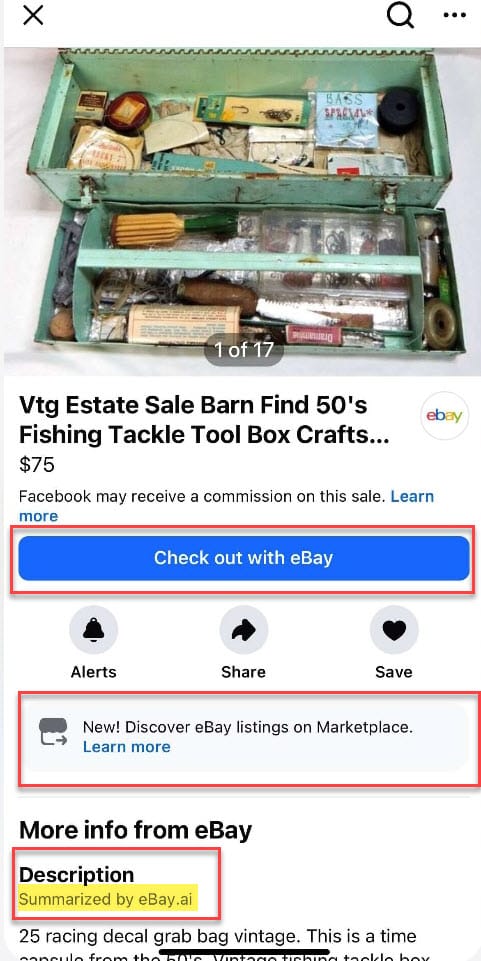
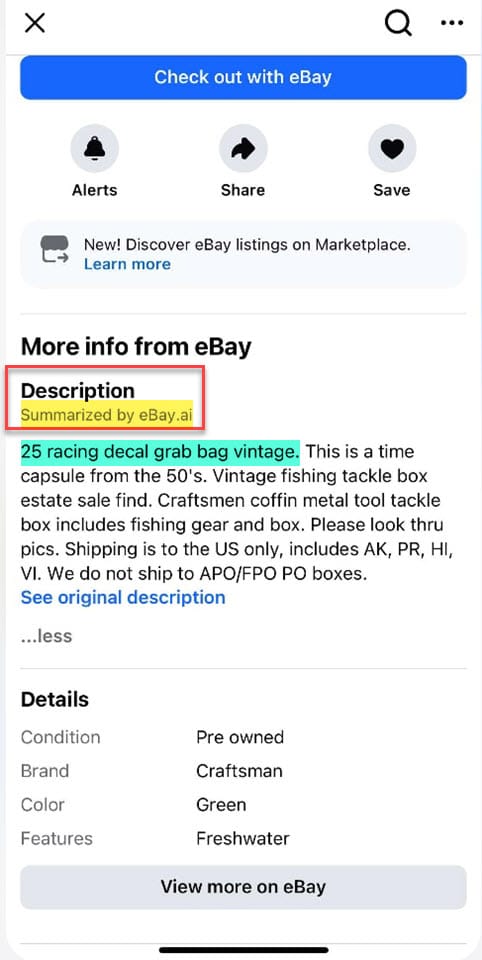
Those AI generated description summaries have now also started appearing onsite in both the eBay web and app experiences for some users as well.

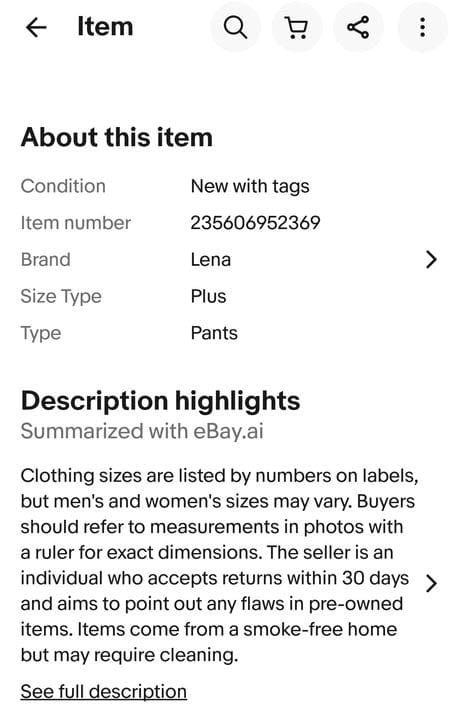
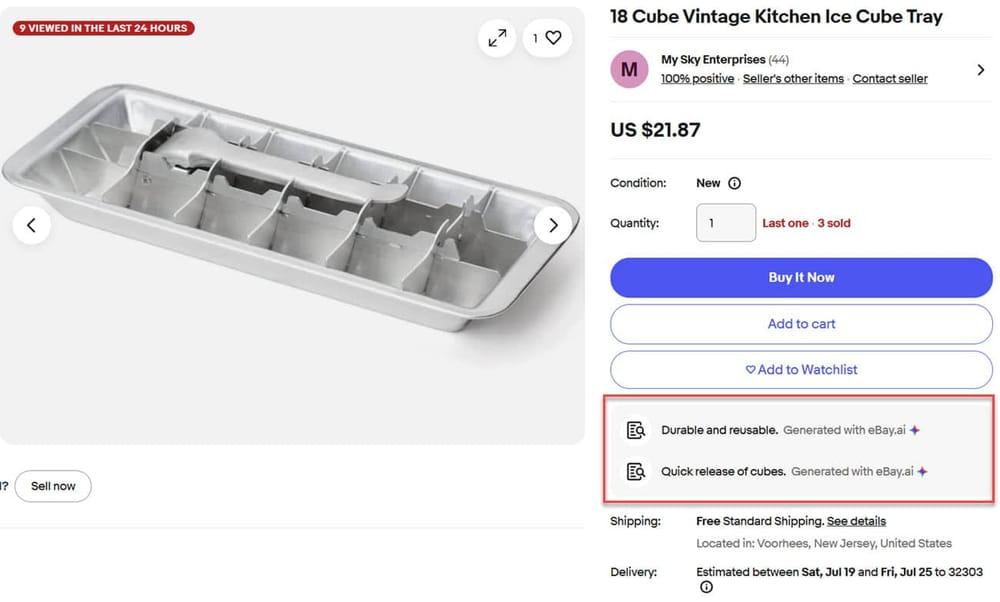
And eBay has been testing using AI to generate item detail highlights to feature in prominent and highly visible places on the listing page, which has only increased seller fears about potentially receiving claims or negative feedback from buyers who are disappointed if/when the AI doesn't get it right.
 Liz Morton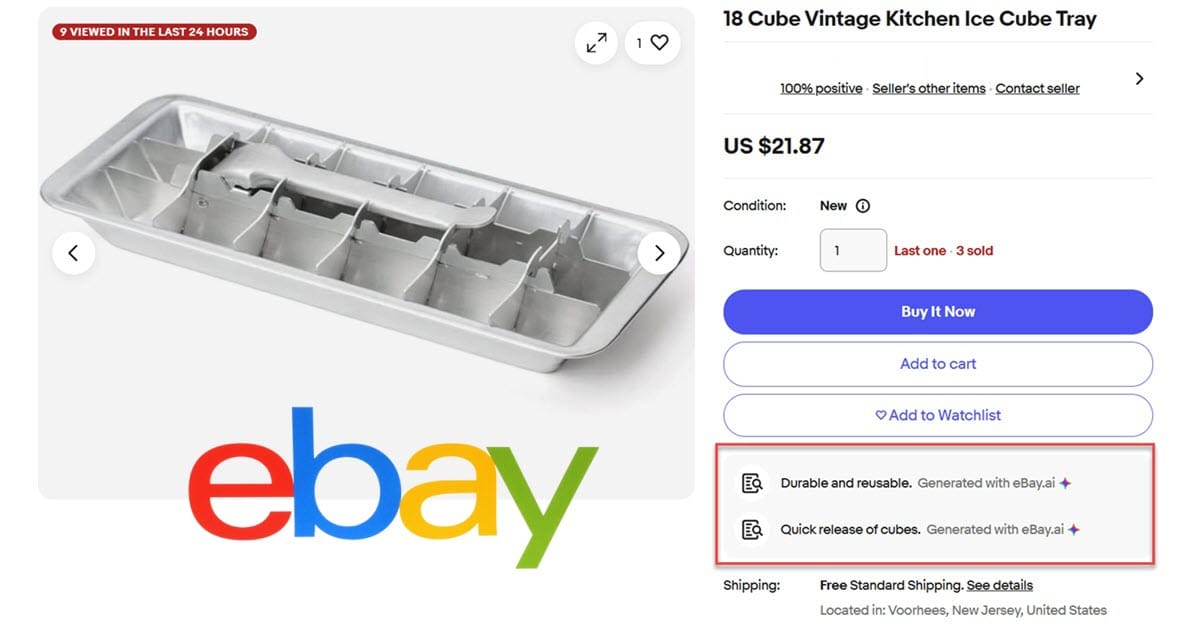
Importantly, sellers have no way to opt out of having these AI tests and features applied to their listings and in fact may not even be aware that eBay is showing their potential buyers AI generated or altered information about the items they have for sale.
And this doesn't happen only to listings that use eBay's AI description generator or Magical Listing experience - every listing on the platform can potentially have these AI features applied.
It's also noteworthy that eBay does not publicly disclose any details of these tests when they are running or proactively advise sellers that these features may change how their listings are shown to buyers- the only reason we even know about them is that sellers discovered them in the wild and shared screenshots in community forums or across social media.
Even more concerning, it now appears that eBay may be considering using AI to remove watermarks from sellers' picture without any notice or explicit permission, according to remarks made by Senior Manager eBay Advertising, Alan Feder, in a presentation at eBay Open 2025.
The session, titled "Search Best Practices from eBay & Google", included Feder, eBay Senior Director of Search Pete Dainty and Google Strategic Business Lead Abby McGuckin discussing how to make sure your eBay listings get seen on Google - with several mentions of the fact that Google will reject listings from search if the images don't comply with their policies which require the picture to be free of text or watermarks.
That prompted a seller in the Q&A segment to question how they could still protect their intellectual property rights and prevent theft or misuse of their images while avoiding being blocked by Google.
Shockingly, Feder said that eBay is working on how to use AI to remove seller watermarks to provide a clean image to Google while maintaining the image with watermarks for on eBay search.
We're actually trying to leverage some AI technology between both Google and eBay to say like well if you guys submitted a bunch of pictures with watermarks, we don't want to go back and ask you to correct them, can we correct them ourselves? We keep the watermark version on eBay and then we have a non-watermarked version that we send to Google, so that doesn't get rejected.
So we're trying to mitigate that, but it's absolutely a huge issue with watermarks, logos, text, brand names...anything that's not a picture of the item just don't put on there.
Not only does that answer not address the IP protection part of the question the seller asked, it also raises serious concerns that eBay may be altering seller provided images using AI without notice or disclosure - which presents potential IP violations and could also cause Item Not As Described issues if the AI altered image doesn't exactly and precisely represent the actual item being sold.
On the third day of eBay Open, Product Marketing Manager and Seller Advocate Chuck Van Pelt and Product Marketing Manager Jonathan Chard conducted a seller feedback session about AI Tools, so I took the opportunity to ask: will eBay protect sellers from Not As Described Claims in situations where eBay.AI has generated and displayed incorrect information to buyers through no fault of the seller?
Chuck didn't have a specific response but acknowledged eBay will likely need to have an official policy for this in the future if it becomes an issue and for now, sellers who believe they are experiencing negative impacts from eBay AI should reach out with details of the specific situation.
I don't know what our official policy is on these AI descriptions and whether they're accurate or not...what I would suggest is if you have a dispute, follow the channels that we have in Seller Help to engage with us and explain the problem.
It's not been my experience, I've not heard from a lot of sellers that it's been a problem. If it becomes a bigger issue and we see it more, I think we'll probably have to come out with some official statement and the reason I'm hesitant to answer is because I just don't have an official answer for you and I don't want to speak out of turn.
Unfortunately, putting the onus on sellers to report problems is not likely to address the issue, since again, many sellers may not even be aware that eBay is showing AI generated summaries or feature highlights in place of or in higher visibility areas than the verbatim, word for word seller-provided details.
And even if they are generally aware that eBay could be showing buyers AI generated content, that content may display differently for different users at different times since part of the goal of using AI is to try to optimize and personalize the experience for the specific user.
That means sellers likely won't be able to make a direct connection between any particular claim or negative feedback, or provide proof to eBay that the eBay AI generated content was incorrect - unless they happen to get lucky and catch it themselves on their own listings or the buyer is able and willing to provide confirmation the information they viewed said it was generated by eBay AI.
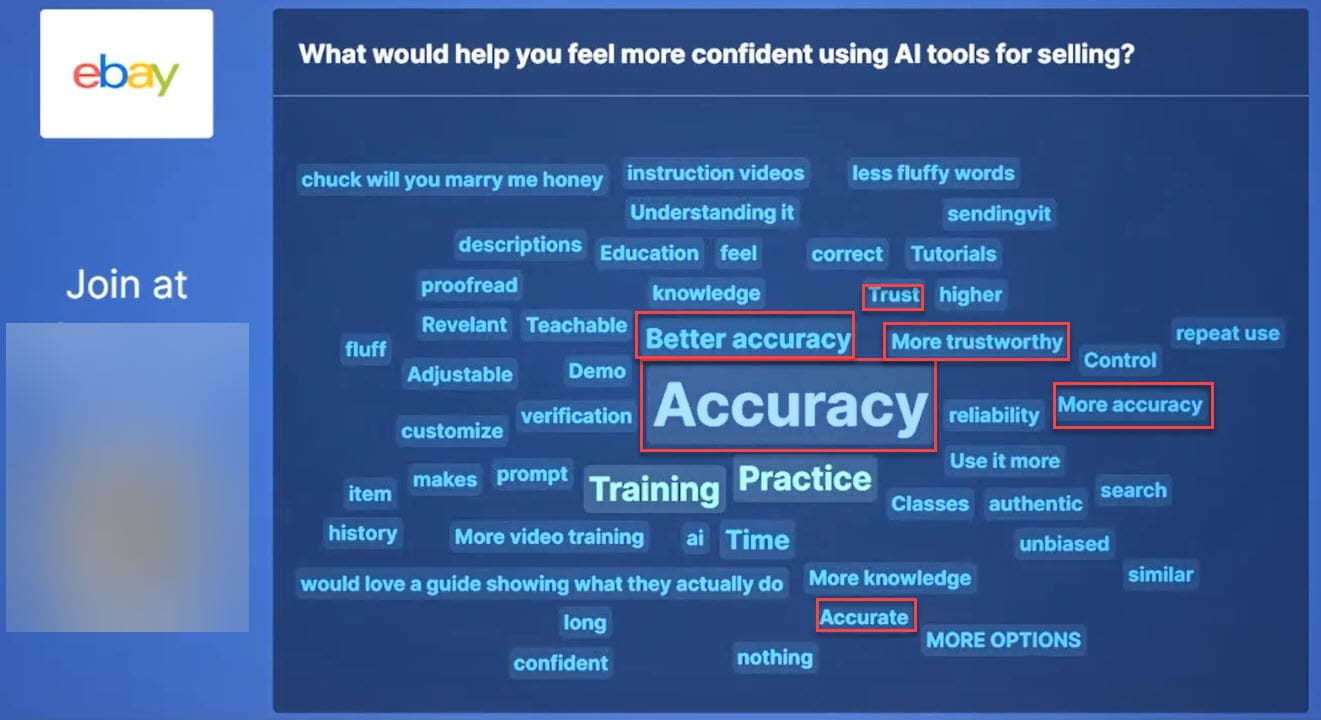
Interestingly, during Chuck and Jonathan's AI feedback session, they had a live poll feature that allowed attendees to type in their answers with the results shown in real time as a word cloud where the most often repeated responses were presented in the largest font size.
Based on these results, it's clear that accuracy and trust are top of mind for sellers when it comes to using AI tools - and you can bet that is also their number one concern about eBay using AI to summarize descriptions or alter information that is shown to buyers in any way.
Back in 2024, eBay published their "Responsible AI Principles" laying out ethics and accountability policies the company was committed to adhering to as they develop and deploy this new technology.
 Liz Morton
One of the five key pillars of this AI responsibility pledge is Transparency:
Provide users with transparency into our use of AI
Recent classes of AI technologies, such as Generative AI, make it difficult to understand the reasoning behind an AI system’s output. eBay strives to be transparent to end users about its use of AI.In some cases, we accomplish this by disclosing information about the type of AI being used within the experience itself, and in other cases, through broader disclosure of our use of AI generally, based on the stage of its lifecycle.
Our transparency approaches will also strive to communicate most effectively given the role of the individuals interacting with or using the AI system.
Given the fact that eBay does not publicly announce any of the testing they have been doing around these features or disclose to sellers that AI may be being used to fundamentally substantially alter pictures, descriptions and other listing details, it would be difficult to give them anything but a failing grade on that point.
If eBay wants sellers to believe they take AI Responsibility seriously they need to provide clear guidelines for how to report errors in eBay AI generated content, proactive protections for when eBay's AI gets it wrong when there is no direct seller involvement, and an easy way for sellers to opt out of having these features applied to their listings - or better yet, make them opted out by default and require sellers to give explicit, affirmative consent before they are enabled.