eBay Seeks Arbitration In Employee Whistleblower Retaliation Suit

UPDATE 9-9-26
A Utah federal court has dismissed Paige Williams’ lawsuit against eBay without prejudice after Williams stopped participating in the case and failed to respond to multiple court deadlines.
eBay filed its motion to compel arbitration on July 2, but Williams did not file a response. On July 23, Magistrate Judge Paul Kohler ordered her to explain the status of the case and whether she intended to proceed by August 17, warning that failure to respond would result in a recommendation for dismissal. Williams did not respond, and Kohler recommended dismissing the case for failure to prosecute on August 18.
District Judge Ann Marie McIff Allen adopted that recommendation on September 9, finding Williams had failed to take any action in the case for months.
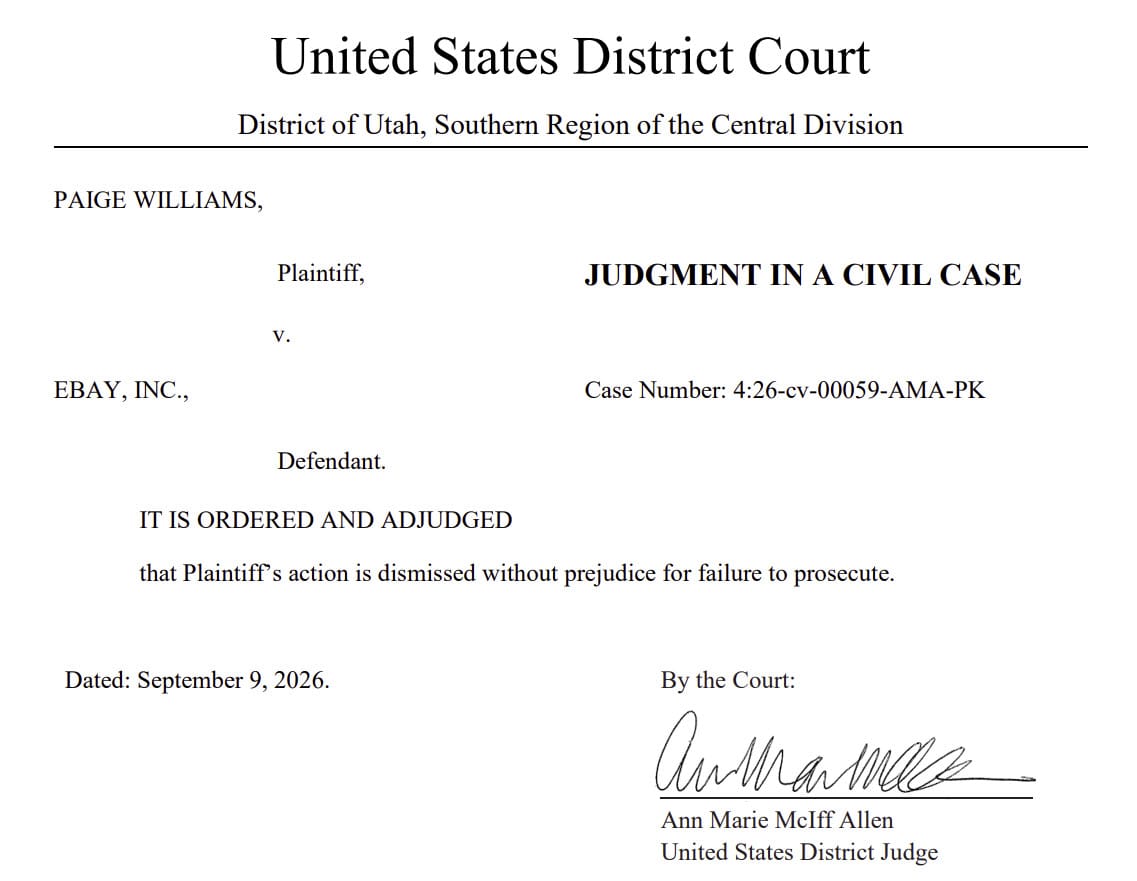
The dismissal does not resolve eBay’s arbitration arguments or the substance of Williams’ allegations, which were never tested in court. The court record also does not indicate whether Williams has separately pursued any of her claims through arbitration.
eBay has responded to a former employee’s whistleblower and retaliation lawsuit by asking a Utah federal court to send most of the case to arbitration and pause the court proceedings.
The motion, filed July 2, does not address the factual substance of Paige Williams’ allegations. Instead, eBay argues Williams signed a binding arbitration agreement when she joined the company in 2014, requiring employment-related disputes to be resolved through final and binding arbitration rather than a public court case.
Williams sued eBay in May, alleging she was unlawfully terminated after years of documented complaints involving disability accommodation, Family and Medical Leave Act access, medical confidentiality, discrimination, retaliation and pay equity.
The original complaint focuses heavily on leave administration, with Williams alleging eBay and Sedgwick failed for months to provide required FMLA paperwork and that her disability status, accommodation details and medical information were disclosed to unauthorized employees and managers.
As Value Added Resource previously reported, the complaint also raises securities-related whistleblower claims, with Williams alleging she became aware of what she described as a systemic internal practice involving manipulation of metrics, data or reporting associated with eBay’s Promoted Listings advertising program.
 Liz Morton
Williams claims she raised concerns about the Promoted Listings issue to leadership and later provided information to the SEC, alleging the matter could affect investors, sellers, advertisers or public reporting connected to one of eBay’s largest revenue streams.
The allegations have not been tested in court, and eBay has not yet filed an answer admitting or denying them.
eBay says Williams was hired in 2014 as a Customer Solutions Teammate in Utah and electronically signed both her offer letter and a Mutual Arbitration Agreement on September 22, 2014. The company says that agreement covers “any and all disputes” arising from the employment relationship, including termination.
The filing also says Williams later moved from phone-based customer support to email-based support in 2019 and then became a Social Media Teammate in 2020, responding to eBay customers on social media platforms.
According to eBay, Williams was separated in January 2024 “as part of a reduction in force.”
That framing is important because Williams’ complaint alleges she returned from short-term disability leave on December 26, 2023 and was terminated 29 days later under the stated rationale of a reduction in force, despite claiming she had no disciplinary record and had been documented at 177% of target shortly before her termination.
eBay argues Williams’ claims all stem from her employment and are covered by the arbitration agreement. It also says the Federal Arbitration Act applies because eBay’s marketplace depends on interstate and international transactions, payments, communications and data.
The key complication for eBay’s arbitration argument is the Sarbanes-Oxley whistleblower claim.
eBay acknowledges the SOX whistleblower claim is different because federal law bars companies from forcing those claims into arbitration under predispute agreements.
Even so, eBay wants the court to pause the SOX claim while the rest of the case moves through arbitration, arguing the arbitrable claims make up most of the dispute.
eBay takes a different position on the Dodd-Frank whistleblower claim, saying that law does not include the same arbitration carveout as SOX.
Williams’ original complaint alleges she feared using eBay’s ethics or compliance channels to escalate Promoted Listings concerns, citing what she described as the company’s documented pattern of retaliating against employees who used internal reporting systems.
If the court grants eBay’s motion, much of the employment dispute could move into arbitration while the SOX claim remains paused, limiting how much of the Promoted Listings dispute remains visible on the public docket.
eBay also says the arbitrator, not the judge, should decide any remaining fights over which claims belong in arbitration.
The company separately argues the federal law limiting forced arbitration of sexual assault and sexual harassment claims does not apply here. Williams’ complaint, eBay says, only makes conclusory references to sexual harassment and does not allege facts showing any such claim arose after the law took effect in March 2022.
Williams will have an opportunity to oppose eBay’s motion, and the court has not yet ruled.
For sellers and investors, the arbitration fight is more than a routine employment-law detour. The complaint puts Promoted Listings back under a spotlight at a time when eBay is leaning heavily on advertising revenue for growth.
eBay reported almost $2 billion in ad revenue for 2025, and sellers have continued raising concerns about Promoted Listings policies, attribution changes and whether the company is extracting more fees than it creates value for advertisers.
 Liz Morton
The Williams complaint does not provide detailed proof of the alleged Promoted Listings “scheme,” and eBay has not yet answered those allegations.
The complaint also asks the court to issue a referral to the SEC and FTC regarding the alleged Promoted Listings scheme if the court deems it appropriate.
But if those claims are ever tested in court, arbitration or by regulators, the outcome could be highly relevant to anyone watching eBay’s increasingly advertising-dependent marketplace strategy.
The allegations come as eBay remains under broader governance scrutiny tied to the 2019 cyberstalking scandal, questions about internal compliance culture, and Ryan Cohen’s unsolicited GameStop-backed bid to acquire the company.
The case is Williams v. eBay Inc., Case No. 4:26-cv-00059, in the U.S. District Court for the District of Utah.
Download the full initial complaint:
And eBay's response: