eBay Listings Go Missing In Recurring Annual Tech Snafu

eBay sellers are once again reporting listings which are supposed to end or renew today are instead disappearing, showing annual tech snafu still hasn't been solved.
Affected sellers say the listings in question are longer shown under Active status in Seller Hub, but also are not shown under Unsold/Ended (or Inactive if you have the latest update). The items are simply nowhere to be found, raising concerns that eBay may have deleted or lost them.
Ended listings not showing up in Inactive/ended
Anyone else having this issue? Ended 37 listings this morning from my "renewing today" and they are not showing up in inactive/ended and the number is not deducted from the "renewing today" count either.
Ended items have disappeared and I can't find them
This just happened to me just now. I ended about 15 listings and usually they show up in the Unsold listing section. Today...GONE. This is the first time it's happened to me. Yesterday I ended about 10 and they showed back up in the unsold like normal so I could relist them. What is going on? Anyone figure out what happened and if they can get back those listings?
Unfortunately, this issue isn't a "glitch" in the strictest sense of the term - it's simply eBay failing for years to solve a predictable, annual technical challenge created by the way that Good 'Til Canceled (GTC) listing renewals work on the platform.
 Liz Morton
When eBay first introduced the Good 'Til Canceled, listings would renew on a 30 day interval unless/until they sold out or the seller ended the listing. Sellers complained that could cause them to be charged insertion and other listing fees twice in some months.
In response to those complaints, eBay changed Good 'Til Canceled to a monthly renewal in 2019 - and it continues to operate on that schedule today.
Here's how it works: Good 'Til Canceled listings renew every month on the same day of the month as the item was originally listed - but that creates an issue for items listed at the end of a month since some month have more days than others.
In those instances, the listing duration will be adjusted to end on whatever the last day of the shorter month is, then revert back to the original day for longer months.

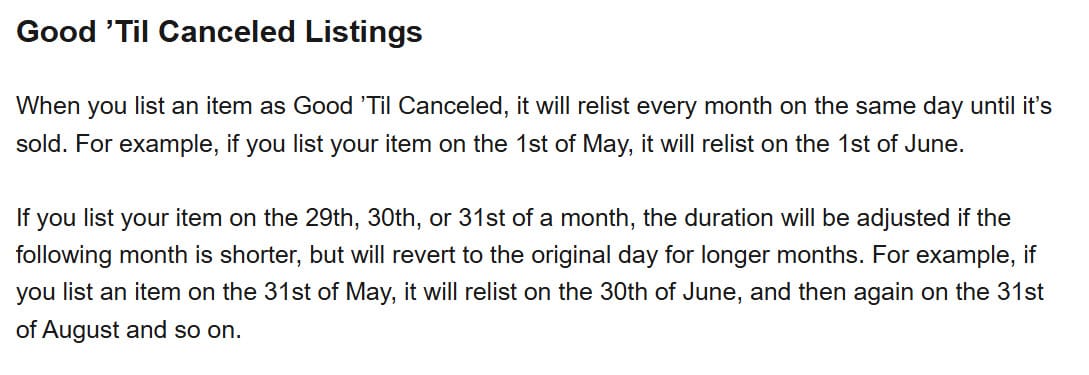
That means every year on the last day of February, eBay has handle relisting 3-4 days worth of automatic GTC turnover, plus any new listings or listings sellers have manually ended and relisted during that time - resulting in longer than usual delays, during which time the listings are in "limbo" not appearing in either Active or Unsold/Ended/Inactive areas of Seller Hub.
eBay has received many complaints about this issue every year since they made the change in 2019 and finally got smart enough to post an advisory in the community forum last year to explain why sellers may not see their listings renew right away.
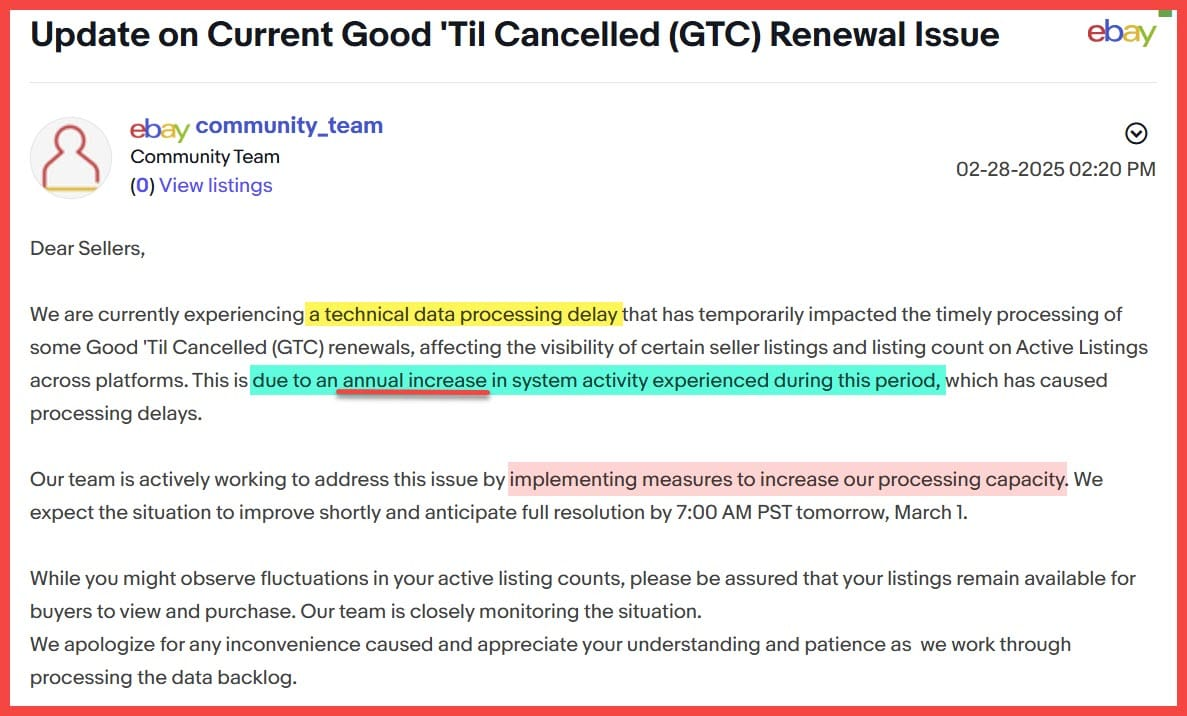
In 2025, eBay called this a "technical data processing delay" and said they were implementing measures to increase processing capacity to compensate, and yet here we are, seeing the exact same issue again this year.
That raises the question - if eBay knows this is an annual occurrence because of the way GTC works, why would they not proactively implement measures to increase the processing capacity ahead of this entirely predictable event?
Sadly, the answer may be that in some instances, eBay may be simply "load-balancing" - intentionally choosing to preference fast load time and responsiveness on the buying side of the site, even if it causes a negative experience on the selling side, especially during heavy traffic or peak load events.
The importance of optimizing for the consumer-buyer experience was laid out in a corporate blog post when they launched a company-wide Speed initiative in 2019, focused on improving performance across experiences on desktop, mobile, and apps and specifically targeting home page, search and item page performance - all importantly geared toward the buyer-facing side of the user experience.
The post explicitly calls out making cuts in certain areas to balance their "need for speed" as well as creating a committee to monitor and oversee application of the "speed budget."
Death by a thousand cuts is a popular figure of speech that refers to a failure that occurs as a result of many small problems. It has a negative connotation to it and is referenced on many occasions when things go wrong, and there is no one primary reason to blame.
We have a similar story at eBay, but this time on a positive note. In 2019, we started working on an initiative called “Speed” to improve the performance of end-user experiences across major consumer channels — iOS, Android, and Web.
Fast forward today, we have made significant improvements to our speed numbers, both globally and across all platforms, but there was no one major contributing factor. It was a culmination of many small enhancements (or “cuts” as we call it) that moved the needle.
It's perhaps understandable why eBay would favor the performance of the buyer experience in the constantly changing calculations for how to prioritize resources, but if that is the case, they should be more upfront and transparent with sellers about it rather than hiding behind vague 24-48 hour window when performance bogs down.
Back in 2019, eBay and then CEO Devin Wenig faced activist investor pressure from Elliott Management calling for changes at the company, with constant site glitches and technical misexecution called out explicitly as one of the major problems at the company.
7 years later, it's shocking just how much of Elliott's "Enhancing eBay" plan still rings true today - particularly critiques around glitches constantly plaguing the platform and lack of leadership prioritizing operational and technical excellence.
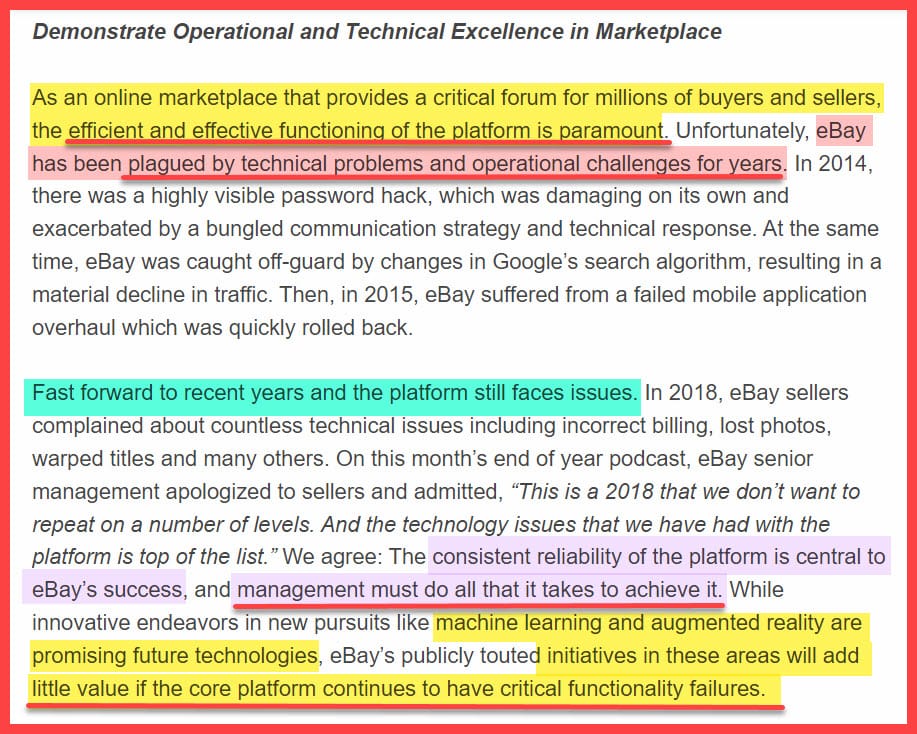
Mazen Rawashdeh, who was Chief Infrastructure and Architecture Officer at that time, was promoted to Chief Technology Officer in 2019 - a title he still retains today despite the fact the site continues to experience near daily business impacting "glitches" and recurring "data processing delays."
Given the pace of technological advancement since 2019 and the fact that eBay wants the world to believe it's in a new era of innovation driven by AI, there is no excuse for not solving this annual problem of "disappearing listings."
eBay either needs to finally admit to sellers that they have made the intentional choice not to fix this issue because they simply don't see it as a priority or find new technical leadership who can get the job done.